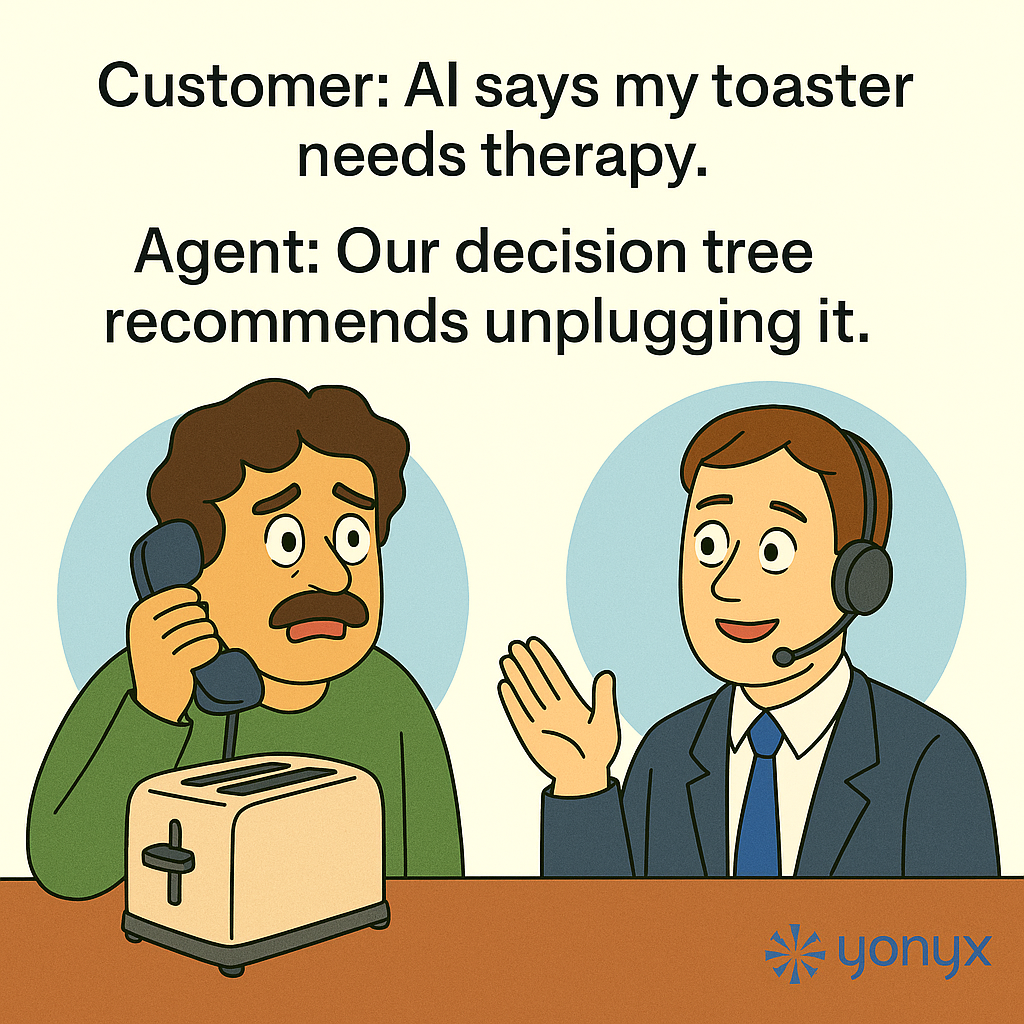
Every support team has seen AI take creative liberties, but nothing beats the moment a customer says, “AI says my toaster needs therapy.” And the human agent — grounded in experience and sanity — replies, “Our decision tree recommends unplugging it.”
It’s a humorous contrast, but it highlights one of the most important realities of modern support: AI may be brilliant, but it still needs structure to avoid wandering into imaginative territory.
Why AI Sometimes Goes… a Little Too Far
Generative AI is designed to interpret language, make connections, and produce conversational responses. But without constraints, it sometimes does what it does best — gets creative. It fills gaps, infers emotions, and occasionally anthropomorphizes appliances.
Toasters don’t need therapy. They need electricity, heating elements, and working sensors. But AI, without guardrails, can respond to ambiguous or humorous inputs in unexpected ways.
Decision Trees Bring AI Back to Earth
This is where structured logic becomes essential. An interactive decision tree doesn’t “imagine” possibilities; it evaluates known conditions. It follows SME-authored paths that reflect real troubleshooting steps — not creative interpretations.
So when AI goes off-script, the decision tree pulls it back with questions like:
- Is the appliance plugged in?
- Is the outlet working?
- Did the safety breaker trip?
- Does it heat at all?
Logical. Predictable. Actual troubleshooting.
Why Structure Matters More as AI Becomes More Conversational
As AI becomes more natural and human-like in conversation, customers begin to treat its responses as definitive. The risk is not that AI fails — but that it offers answers that sound confident while being completely incorrect.
Decision trees ensure:
- Consistency across all agents and AI interactions
- Accurate diagnostic steps
- Fewer “creative interpretations” of technical issues
- Support that is grounded in SME knowledge
AI provides warmth, clarity, and ease of use. Decision trees provide correctness.
Humor Aside, Customers Appreciate Reliability
Even when the AI’s response makes everyone laugh, the customer still needs a real solution. Decision trees offer a structured path that keeps troubleshooting on track, ensuring customer trust stays intact.
In the end, the goal is to blend conversational intelligence with reliable logic — not let creativity overshadow accuracy.
Conclusion
When AI diagnoses your toaster with emotional problems, it’s a reminder of why structured decision trees matter. They bring order to AI’s creativity, turning humorous moments into real troubleshooting.
And sometimes, the simplest answer really is the right one: unplug it, replug it, and let the logic do its job.