Do you sometimes feel the customer service rep doesn’t really care what you’re asking about? They’re pleasant. They’re polite. They say all the “right” things. And yet… everything sounds rehearsed, rigid, and oddly disconnected from your actual problem.
If you’ve ever hung up a support call thinking, “They were nice, but they didn’t hear me,” you’ve experienced what many companies call a customer relationship — but what often feels like a scripted interaction.
Which raises an important question for leaders:
Are your reps building relationships… or performing politeness?
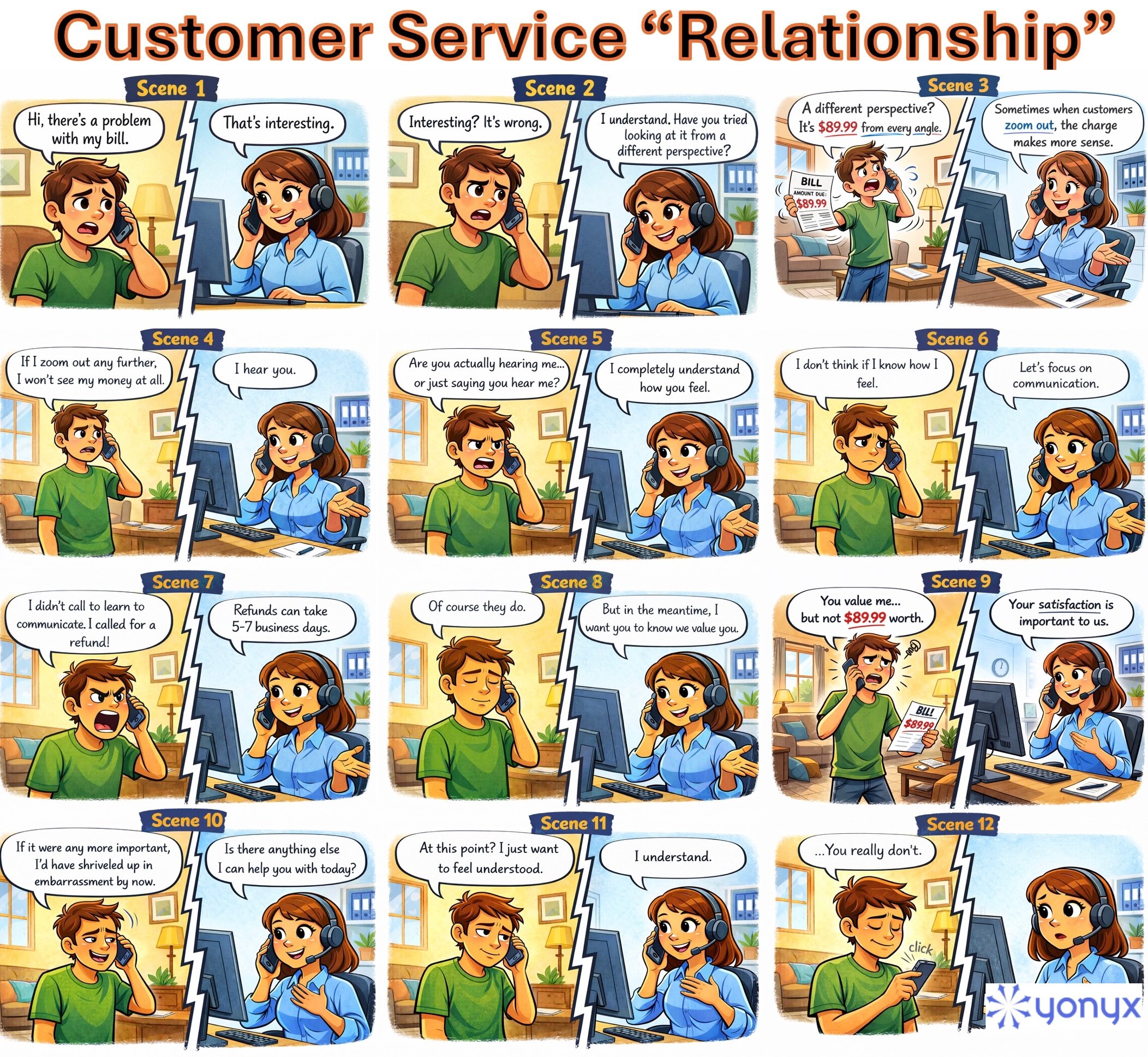
Scene 1: The Opening
The customer calls with a clear issue: there’s a problem with the bill. The rep responds: “That’s interesting.”
Not rude. Not hostile. But not connected either.
A relationship doesn’t start with detachment.
Scene 2: When Alignment Slips
The customer clarifies: “It’s wrong.” The rep pivots into abstraction: “Have you tried looking at it from a different perspective?”
When someone brings you a concrete issue, philosophical reframing feels like avoidance — not partnership.
Scene 3: The Reality Gap
The customer names the number: $89.99. From every angle.
In a real relationship, shared reality matters. If one person is holding the bill and the other is talking about “perspective,” trust erodes.
Scene 4: The First Empathy Line
The rep says: “I hear you.”
But hearing is not demonstrated by saying it. It’s demonstrated by responding specifically to what was said.
Scene 5: The Customer Tests the Relationship
“Are you actually hearing me… or just saying you hear me?”
This is the turning point. The customer is no longer asking about money. They’re asking about sincerity.
Scene 6: Emotional Fatigue
The customer admits confusion and frustration. The rep says: “Let’s focus on communication.”
But customers don’t call to work on communication skills. They call for resolution.
Scene 7: The Breaking Point
The customer shouts: “I didn’t call to learn to communicate. I called for a refund.”
The rep replies with policy: “Refunds can take 5–7 business days.”
This is where many “customer relationships” collapse — when policy overrides ownership.
Scene 8: The Quiet Withdrawal
The customer goes calm: “Of course they do.”
Calm resignation is not satisfaction. It’s emotional disengagement.
Scene 9: The Core Question
“You value me… but not $89.99 worth.”
The rep responds: “Your satisfaction is important to us.”
In relationships, words without aligned action feel hollow.
Scene 10: Humor as Armor
The customer laughs: “If it were any more important, I’d have shriveled up in embarrassment by now.”
The rep moves to the closing line: “Is there anything else I can help you with today?”
The script advances. The issue doesn’t.
Scene 11: The Honest Admission
“At this point? I just want to feel understood.”
The rep says: “I understand.”
But understanding isn’t declared. It’s demonstrated.
Scene 12: The End of the “Relationship”
“…You really don’t.”
Click.
No resolution, ownership or trust.
What This Reveals About Customer Service “Relationships”
Many organizations talk about building customer relationships.
But a relationship requires:
- Mutual acknowledgment
- Shared reality
- Responsiveness
- Follow-through
Politeness alone does not create connection.
Empathy phrases alone do not build trust.
Consistency without adaptability creates distance.
Are Your Reps Listening… or Just Staying On Script?
If your team frequently says:
- “I understand how you feel.”
- “I hear you.”
- “Your satisfaction is important to us.”
…but customers still leave frustrated, the issue may not be attitude.
It may be rigidity.
What a Real Customer Service Relationship Looks Like
In a real relationship, the response would sound like:
- Specific: “I see the $89.99 charge you’re referring to.”
- Accountable: “Let me verify what caused this.”
- Decisive: “If this is incorrect, we’ll correct it.”
- Clear: “Here’s exactly what will happen next.”
That’s not theatrics. That’s alignment.
The Structural Fix
The solution isn’t to eliminate scripts. It’s to make them adaptive.
Interactive decision-tree workflows allow agents to:
- Stay compliant
- Capture required information
- Branch based on real responses
- Resolve faster with clarity
When process adapts to the conversation, relationships strengthen.
If you’d like to see how structured yet flexible workflows improve customer interactions, visit AskYourFAQ.com.
Final Thought
Companies don’t lose customers because agents were impolite.
They lose customers when the “relationship” feels one-sided.
A customer service relationship isn’t built on phrases.
It’s built on demonstrated listening.