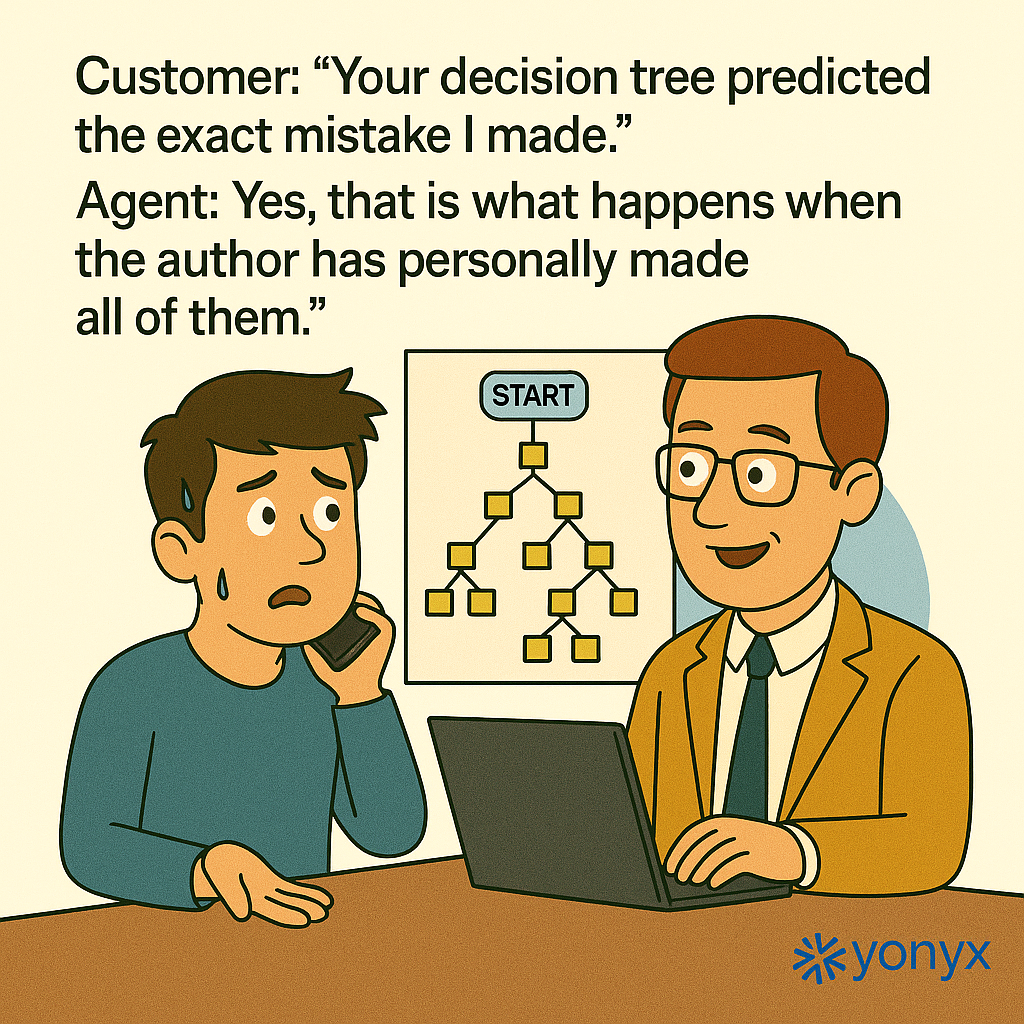
Some troubleshooting experiences feel uncanny — almost too accurate. Like when a customer realizes the decision tree knew exactly what they were going to do wrong.
Customer: “Your decision tree predicted the exact mistake I made.”
Agent: “Yes, that is what happens when the author has personally made all of them.”
And just like that, the customer discovers the true secret ingredient behind a brilliant troubleshooting flow: lived experience… sometimes painfully lived.
Why Great Decision Trees Feel Uncomfortably Accurate
A useful interactive decision tree doesn’t come from theory — it comes from the author remembering every wrong turn they took while learning the system. And the more seasoned the subject matter expert, the more eerily specific the decision tree becomes.
That accuracy comes from:
- Years of trial and error
- Every mistake someone has confessed on a support call
- Every “Wait… what happened when you clicked that?” moment
- Every scenario no one thought humanly possible — until it happened
A good decision tree isn’t just documentation. It’s biography.
The Hidden Strength of Imperfect Authors
The best subject matter experts aren’t the ones who did everything right the first time. They’re the ones who broke things, fixed them, broke them again, and finally figured out the rules the hard way.
That’s why their decision trees feel psychic — they’re simply cataloging every error they personally survived.
And because of that:
- Agents get faster answers
- Customers feel understood
- Rare edge cases become routine steps
- Support teams avoid repeating the past
The path looks structured. But behind the scenes? It’s built on chaos distilled into clarity.
The Comforting Truth: You Are Not Alone
When a customer realizes the decision tree predicted their mistake, it’s not judgment — it’s reassurance. It means someone else has already made that same mistake, probably multiple times, and lived to document it.
The tree isn’t mocking the user. It’s guiding them through a museum of past learning moments — curated by someone who understands the struggle intimately.
Conclusion
Decision trees feel smart not because they’re algorithmically clever, but because they’re written by people who have been through the same frustrations.
So when the customer says, “How did your system know I’d do that?”, the agent can confidently smile and reply:
“Because the author made that mistake first.”
After all, behind every flawless troubleshooting experience is someone who learned every lesson the hard way.