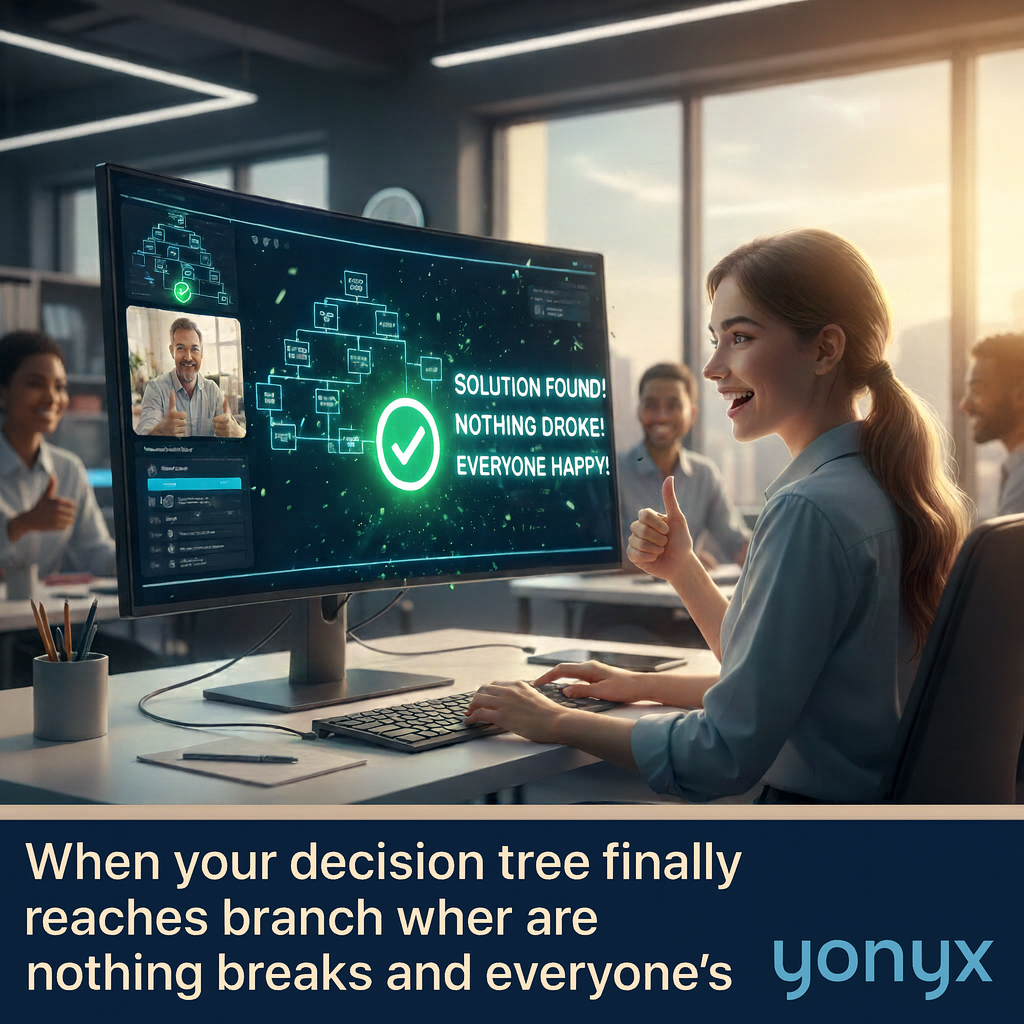
The decision tree happy path is that magical moment when logic works exactly as intended, the issue gets resolved cleanly, and no one has to say “we’ll circle back” or “engineering is looking into it.”
You can see it on the screen: the final branch lights up, the green checkmark appears, and the system confidently declares victory. No retries. No escalations. No follow-up emails titled “Quick question.”
Why This Moment Feels So Satisfying
Most workflows don’t fail because people aren’t trying. They fail because the path forward isn’t clear. When a decision tree finally reaches the exact branch it was designed for, it removes uncertainty for everyone involved.
That clarity is what platforms like Yonyx Interactive Decision Trees are built to deliver—step-by-step guidance that leads users, agents, or customers to a clean resolution instead of a workaround.
The Difference Between a Happy Path and a Lucky Guess
A lucky fix feels good once. A documented happy path works every time.
- The right questions were asked in the right order
- Inputs were validated before moving forward
- Unnecessary branches were skipped automatically
- The final outcome was predictable and repeatable
When teams rely on memory or improvisation, outcomes vary wildly. When they rely on structured decision trees, success becomes the default instead of the exception.
Why “Nothing Broke” Is the Ultimate Success Metric
In support, sales, onboarding, or internal operations, the best outcome is often boring. Nothing broke. Nobody escalated. Everyone moved on with their day. That is not an accident—it is the result of thoughtful workflow design.
For customer-facing self-service, this same principle applies. Guided experiences built with AskYourFAQ help users reach the right answer without guessing, searching endlessly, or starting over.
Call to Action
If your decision trees rarely reach the “everyone happy” branch, it may be time to rethink how those paths are designed. Turn fragile workflows into reliable outcomes with Yonyx Interactive Decision Trees.