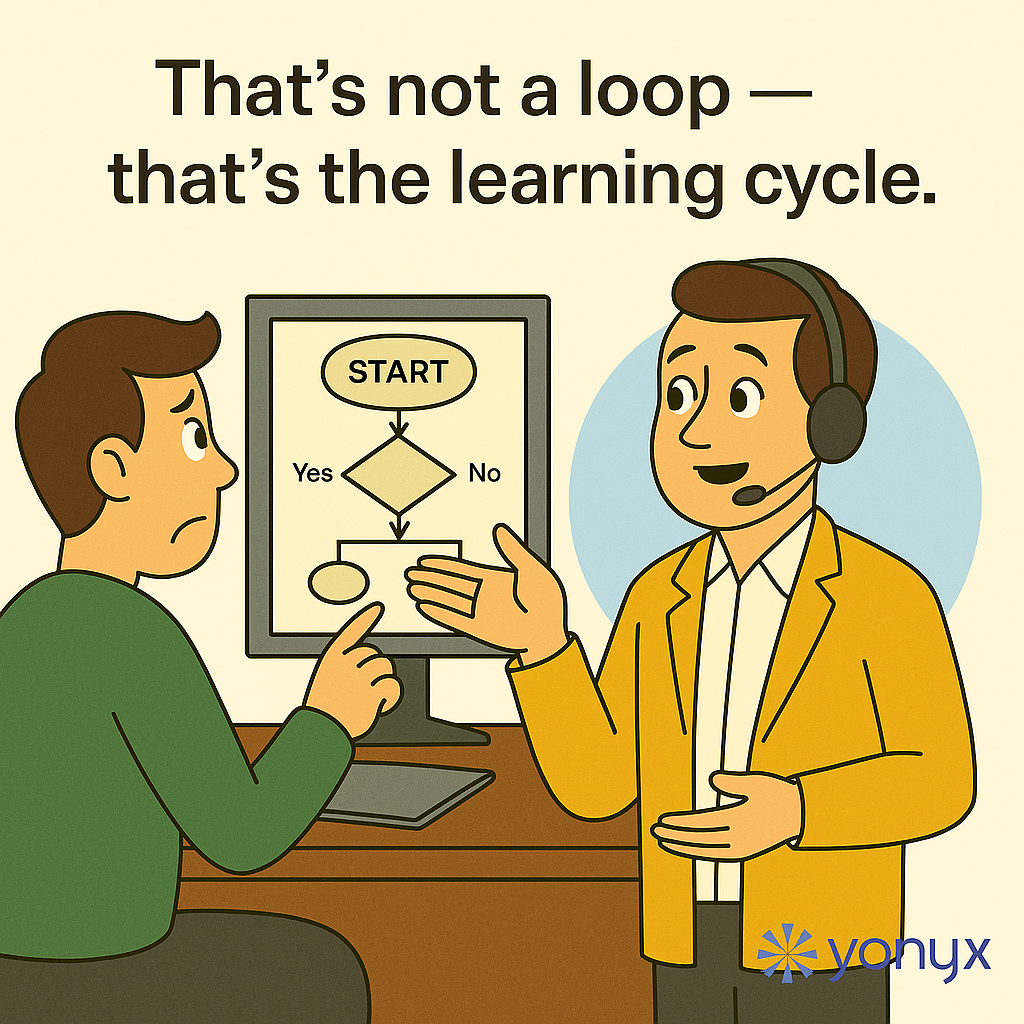
Every support agent has heard it: “Your decision tree just sent me back to the first question.” And the agent’s reply says everything: “That’s not a loop — that’s the learning cycle.”
It’s a humorous moment, but it captures a real truth: when troubleshooting gets messy, starting over isn’t always a mistake — sometimes it’s the only way to make sense of the situation.
Why Decision Trees Sometimes Bring You Back to the Beginning
In troubleshooting, the information provided at the start of the call often turns out to be incomplete, incorrect, or interpreted differently once more symptoms appear. A good interactive decision tree adapts to these discoveries.
Going back to the first question helps agents:
- Confirm the original symptoms
- Correct misunderstandings
- Re-evaluate forgotten details
- Reset the flow after inconsistent steps
- Navigate tricky issues that branch differently depending on new context
It’s not a loop — it’s recalibration.
Customers Think in Symptoms, Agents Think in Logic
Customers describe issues the way they experience them: frustrating, nonlinear, and often out of order. Agents, on the other hand, diagnose problems through structured reasoning — making a decision tree the perfect bridge between emotion and logic.
When a key detail emerges late in the conversation, the tree needs to reset. It’s the same reason doctors sometimes ask the first question again: context changes the answer.
Without a Decision Tree, Repetition Gets Even Worse
Ironically, without a decision tree, repetitions multiply. Agents ask the same question in different ways, try steps that don’t apply, or restart troubleshooting several times unknowingly.
A structured flow reduces repetition by:
- Resetting only when necessary
- Maintaining a consistent logic path
- Ensuring all diagnostic branches are covered
- Preventing circular troubleshooting
The occasional reset becomes intentional — not accidental.
The Learning Cycle Improves the Next Call, Too
Every time a decision tree forces a recalculation, it captures the nuance of a real customer issue. SMEs can update the logic, add branching paths, or refine the language so the next customer doesn’t trigger the same loop.
This turns every confusing moment into an improvement.
AI Works Best When the Logic Foundation Is Strong
AI can help interpret customer language, summarize conversations, and even recommend next steps — but only when grounded in a clear decision framework. When paired with decision trees, AI avoids making up steps or skipping context.
The combination makes resets smarter, not more frequent.
Conclusion
Being sent back to the first question can feel like déjà vu, but in structured troubleshooting, it’s a strategic move. Decision trees don’t loop — they learn, adapt, and adjust to ensure issues get resolved correctly.
It’s not a loop at all. It’s the learning cycle at work.