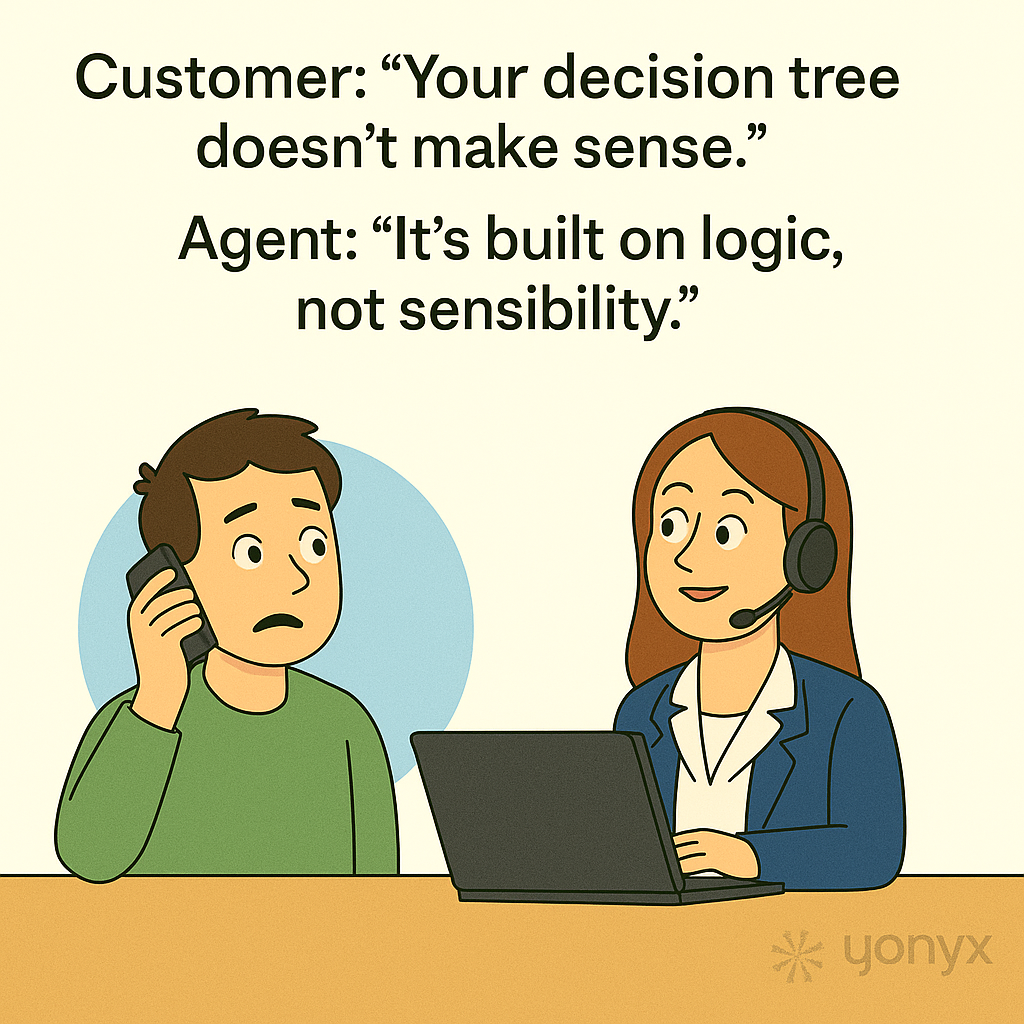
At some point in every support organization, a customer says, “Your decision tree doesn’t make sense.” And the agent, holding back a smile, replies, “It’s built on logic, not sensibility.”
It’s a funny exchange because it reveals something true: decision trees don’t always align with how customers feel troubleshooting should work — they’re built to reflect how troubleshooting actually does work.
Why Customers Expect Troubleshooting to “Feel Right”
When something stops working, customers approach the problem intuitively. They expect the first step to match what seems obvious to them — not necessarily what’s technically correct. Their mental model is emotional, practical, and often guided by past experiences.
So when the interactive decision tree asks a question that doesn’t match their expectations, they may assume something is wrong with the flow. In reality, the logic is doing exactly what it should: uncovering root causes that intuition can’t catch.
Decision Trees Are Designed to Fix Problems, Not Feelings
Decision trees are authored by SMEs who know every odd corner case, every non-obvious symptom, and every hidden dependency. The flow is logical because the problems are logical — even if the customer doesn’t experience them that way.
This mismatch creates moments like:
- “Why are you asking me that? My issue is completely different.”
- “How can restarting relate to my problem?”
- “This question doesn’t make any sense in my situation.”
But to the decision tree — and the SME behind it — those questions are essential checkpoints in a diagnostic process that must be consistent, accurate, and thorough.
Logic Over Sensibility Produces Better Outcomes
When troubleshooting is driven by logic instead of emotion, support teams see measurable improvements:
- Fewer repeated calls
- More accurate diagnoses
- Faster resolutions
- Reduced escalation
- Consistent customer experiences
It may not always “feel” right to customers in the moment, but it leads them to the correct solution far more reliably than instinct-driven troubleshooting.
AI Becomes More Reliable When Logic Leads the Way
AI can interpret language and provide conversational explanations, but without structured logic behind it, AI risks hallucinating steps or skipping important diagnostics. Pairing AI with a deterministic decision tree ensures that explanations remain grounded in real, validated logic — not assumptions.
In this partnership, sensibility becomes the tone, but logic remains the backbone.
Conclusion
When customers say the decision tree “doesn’t make sense,” what they really mean is: “It doesn’t match the way I expected this problem to work.” And that’s perfectly normal. Troubleshooting logic isn’t always intuitive — but it is effective.
Decision trees bring structure to chaos, accuracy to uncertainty, and resolution to problems that intuition alone can’t solve. Sensibility guides feelings — but logic resolves issues.