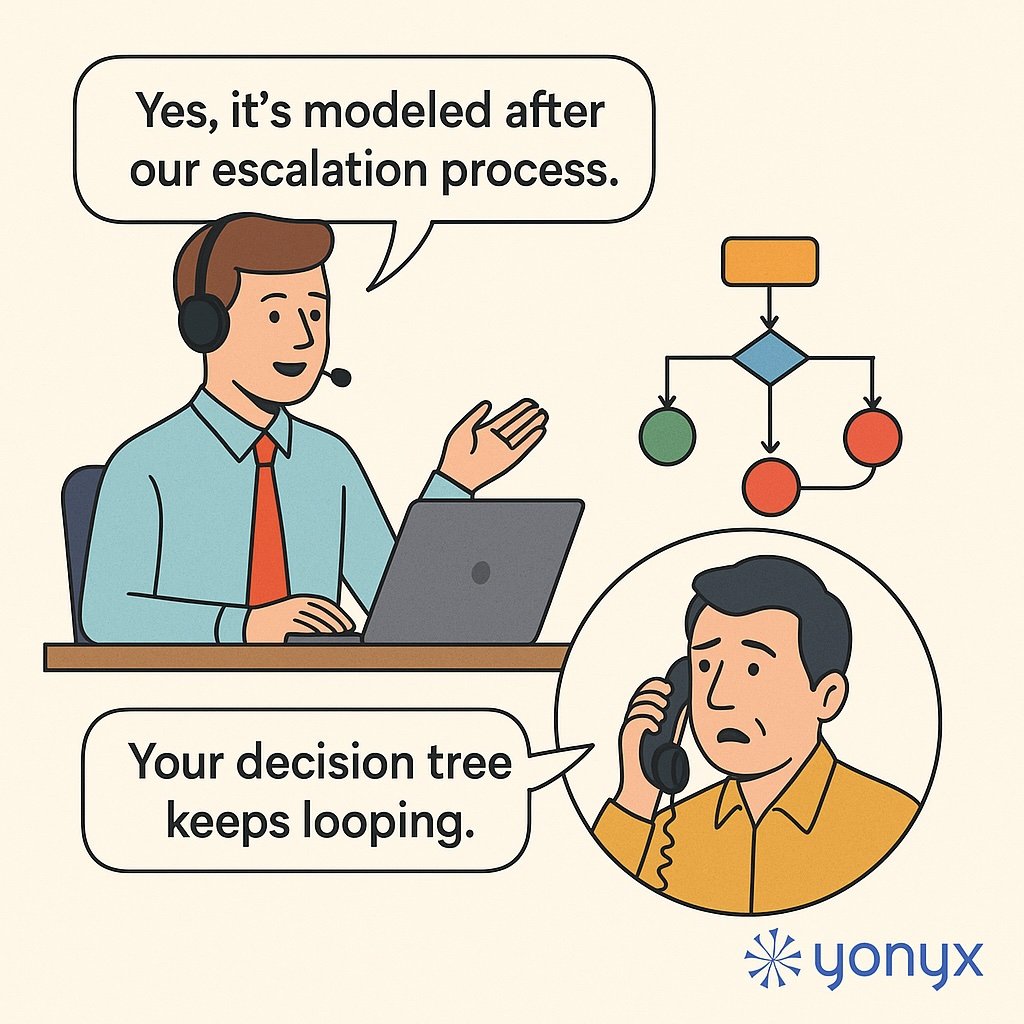
Customer: “Your decision tree keeps looping.” And the agent’s reply? “Yes — it’s modeled after our escalation process.”
It’s a joke, of course… mostly. Anyone who has worked in technical support knows that some issues live in an endless cycle of “Please hold while we escalate” — only to land back where they started.
Why Troubleshooting Sometimes Feels Circular
Customers rarely see the internal chaos that happens when an issue doesn’t fit neatly into the standard playbook. Support teams juggle product updates, inconsistent documentation, edge cases, and workarounds discovered by “that one agent from 2018.”
When knowledge is scattered across multiple systems, tribal memory, and bookmarked links, it’s no surprise that troubleshooting sometimes leads people right back to Step One.
The Real Problem: Tribal Knowledge Turns Into Loops
Most looping happens because knowledge lives in the heads of experienced agents rather than in a structured, unified format. As a result:
- New agents don’t know where the real answer lives
- Escalations jump between teams without resolution
- Customers repeat the same steps with different reps
- Support workflows depend on who picks up the call
Without standardized logic, inconsistency becomes the default — and escalation loops become a way of life.
Decision Trees Break the Loop (When Built Correctly)
A well-authored interactive decision tree doesn’t loop; it guides. It diagnoses. It narrows. It prevents agents from chasing dead ends or repeating unnecessary steps. By capturing every known issue path — including the quirky ones — decision trees create clarity instead of cycles.
The key is expert authorship: the SME who has already solved the problem a hundred times documents the path so the next hundred callers don’t experience the same loop.
AI Works Even Better When the Logic Behind It Is Structured
Generative AI without structure can make things worse — inventing steps that feel technically correct but go nowhere. Pairing AI with deterministic logic (like a decision tree) ensures answers stay grounded in actual support knowledge instead of wandering into creative fiction.
AI gains consistency. Customers gain confidence. And escalation queues finally start to shrink.
Conclusion
Loops are great for music playlists — not for troubleshooting. When decision trees reflect real SME knowledge and guide agents logically through every scenario, the endless escalation cycle finally breaks.
And for once, support workflows move forward instead of around in circles.