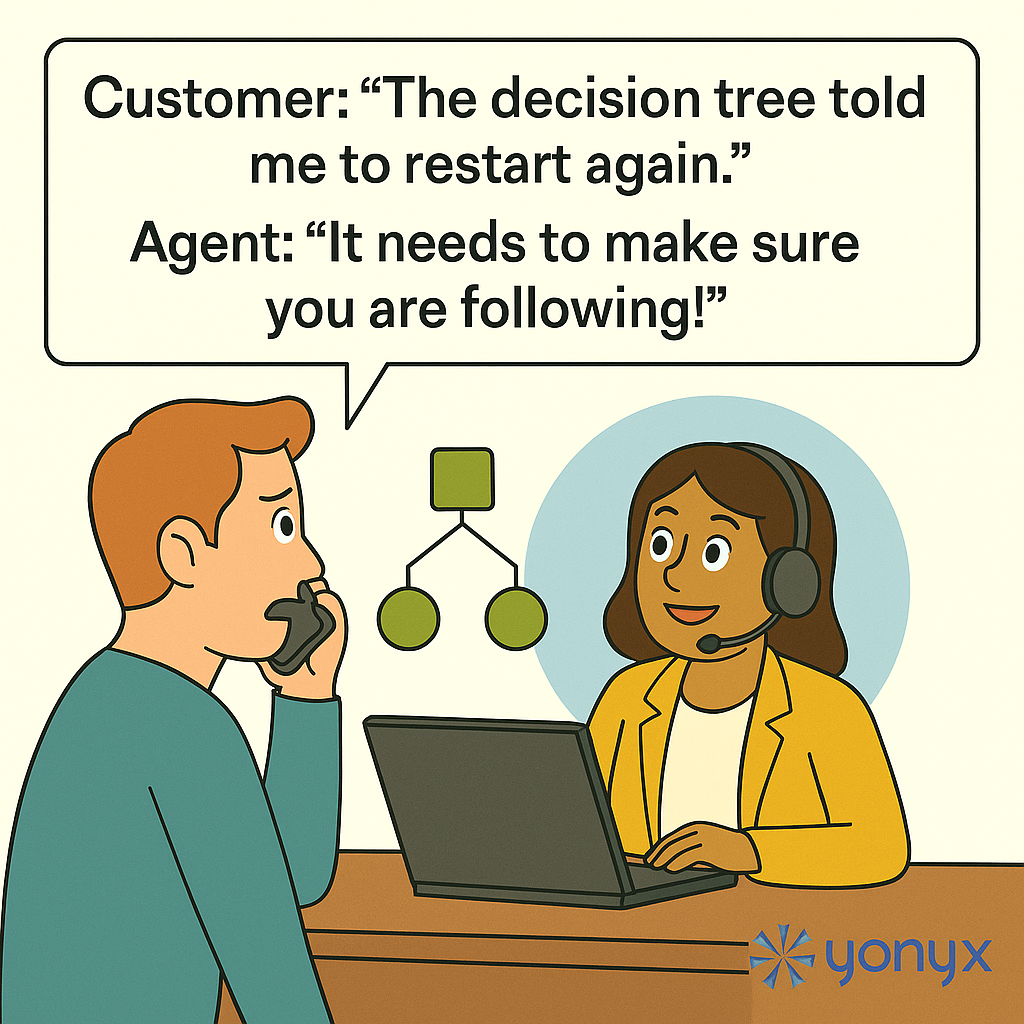
Every customer has experienced the moment: “The decision tree told me to restart again.” And every support agent has delivered the line — sometimes jokingly, sometimes seriously — “It needs to make sure you are following!”
It’s funny because it’s accurate: restarting may feel repetitive, but it remains one of the most universally effective troubleshooting steps. And decision trees know it.
Why Restarting Fixes So Many Problems
Restarting clears temporary states, resets stalled processes, reinitializes services, frees locked resources, and restores configurations that may have been stuck in memory. It solves everything from stalled applications to network hiccups.
But customers rarely connect the symptom they see with what’s happening behind the scenes — so the instruction feels repetitive, even suspicious.
Why the Decision Tree Asks You to Restart More Than Once
Interactive Decision trees don’t rely on assumptions. They rely on confirmed steps.
When a customer says, “Yes, I restarted,” the system thinks:
- Did they restart the right thing?
- Did they restart fully or partially?
- Did they restart before or after the issue emerged?
- Did they restart the device, the app, the browser, or the component that actually matters?
The second restart is often about validation, not redundancy. It’s the tree ensuring the foundation is correct before deeper steps begin.
Decision Trees Need Certainty, Not Assumptions
Human support agents sometimes skip steps because the customer “sounds confident.” Decision trees don’t. They require certainty in order to proceed — and certainty often means repeating a step that solves a surprising number of issues.
This ensures:
- Diagnostics remain accurate
- Symptoms aren’t misinterpreted
- Future steps aren’t wasted
- Escalations only happen when all baselines are solid
It may not always feel intuitive, but it’s methodical — and effective.
AI + Decision Trees Reinforce Each Other
AI may handle the conversation, tone, and clarifying questions. But the underlying logic — especially for technical workflows — comes from decision trees authored by SMEs.
When the AI says, “Let’s restart once more,” there’s real logic behind it. The decision tree anchors the recommendation, ensuring the AI doesn’t gloss over crucial steps.
Conclusion
The second restart isn’t punishment — it’s precision. Decision trees aren’t trying to test the customer’s patience; they’re validating the problem the same way an expert would.
Because in troubleshooting, accuracy isn’t just helpful — it’s essential.