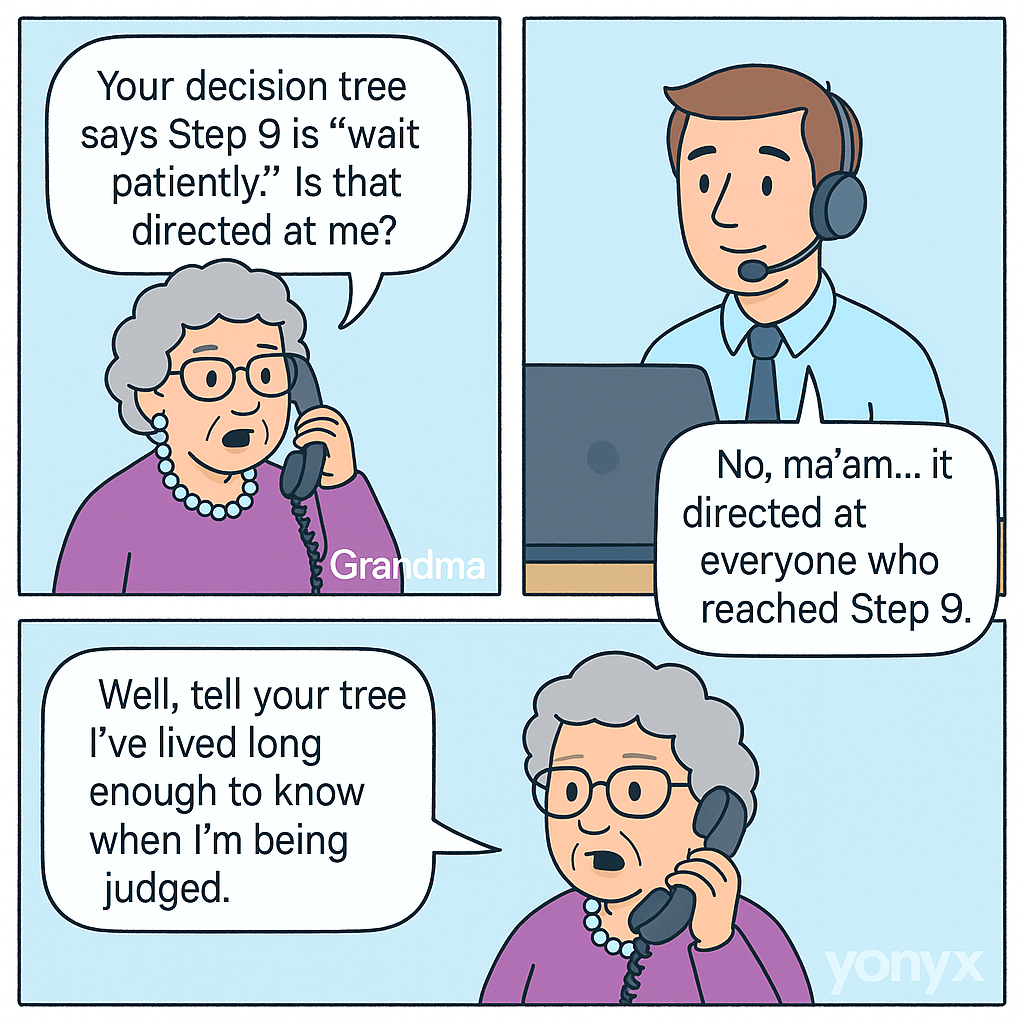
Some troubleshooting steps feel neutral. Others feel technical. And then there’s Step 9 — the one that politely (and suspiciously) tells users to “wait patiently.” For Grandma, this felt less like an instruction and more like a subtle accusation.
Grandma: “Your decision tree says Step 9 is ‘wait patiently.’ Is that directed at me?”
Agent: “No, ma’am… it’s directed at everyone who reached Step 9.”
Grandma: “Well, tell your tree I’ve lived long enough to know when I’m being judged.”
And with that, Grandma exposes a truth no UX designer wants to admit: sometimes our decision trees do sound a little judgmental.
Why Decision Trees Include a “Wait Patiently” Step 9
In support workflows, certain actions simply require time: devices rebooting, servers responding, caches clearing, progress bars progressing at a pace that mocks humanity.
Support teams include “wait patiently” not because they want to judge users, but because they’ve learned that:
- Users don’t actually wait unless explicitly told to
- People often interrupt the process and cause new issues
- Impatience is the root of 40% of “It’s still not working” follow-up calls
- Waiting feels optional unless labeled otherwise
But to Grandma — who has lived through dial-up internet, six-hour software installations, and printers that refuse to cooperate — patience isn’t the problem. It’s the perceived judgment.
Decision Trees Aren’t Personal — They’re Prepared
Interactive Decision trees don’t call out Grandma specifically. They simply collect every common human behavior and turn it into a safeguard.
Step 9 exists because past users:
- Pressed buttons during reboot
- Closed programs mid-update
- Unplugged things too early
- Clicked again… and again… and again
Step 9 is the digital version of “Hands off the stove; it’s hot.” It’s not personal. It’s preventative.
Why It Still Feels Personal to Grandma
Grandma has dealt with decades of instructions telling her what not to do:
- “Do not touch the VCR during recording”
- “Do not remove the floppy disk”
- “Do not disconnect the modem”
After a lifetime of warnings, one more “wait patiently” feels like a challenge to her character — and she’s not having it.
Conclusion
Step 9 isn’t judging Grandma — it’s protecting the process from the collective impatience of humanity. But her reaction highlights something important: language matters, especially in support.
If a single step can feel personal, it’s a reminder that even automated flows need thoughtful voice and tone.
Still, it’s hard not to appreciate Grandma’s honesty when she says:
“I’ve lived long enough to know when I’m being judged.”