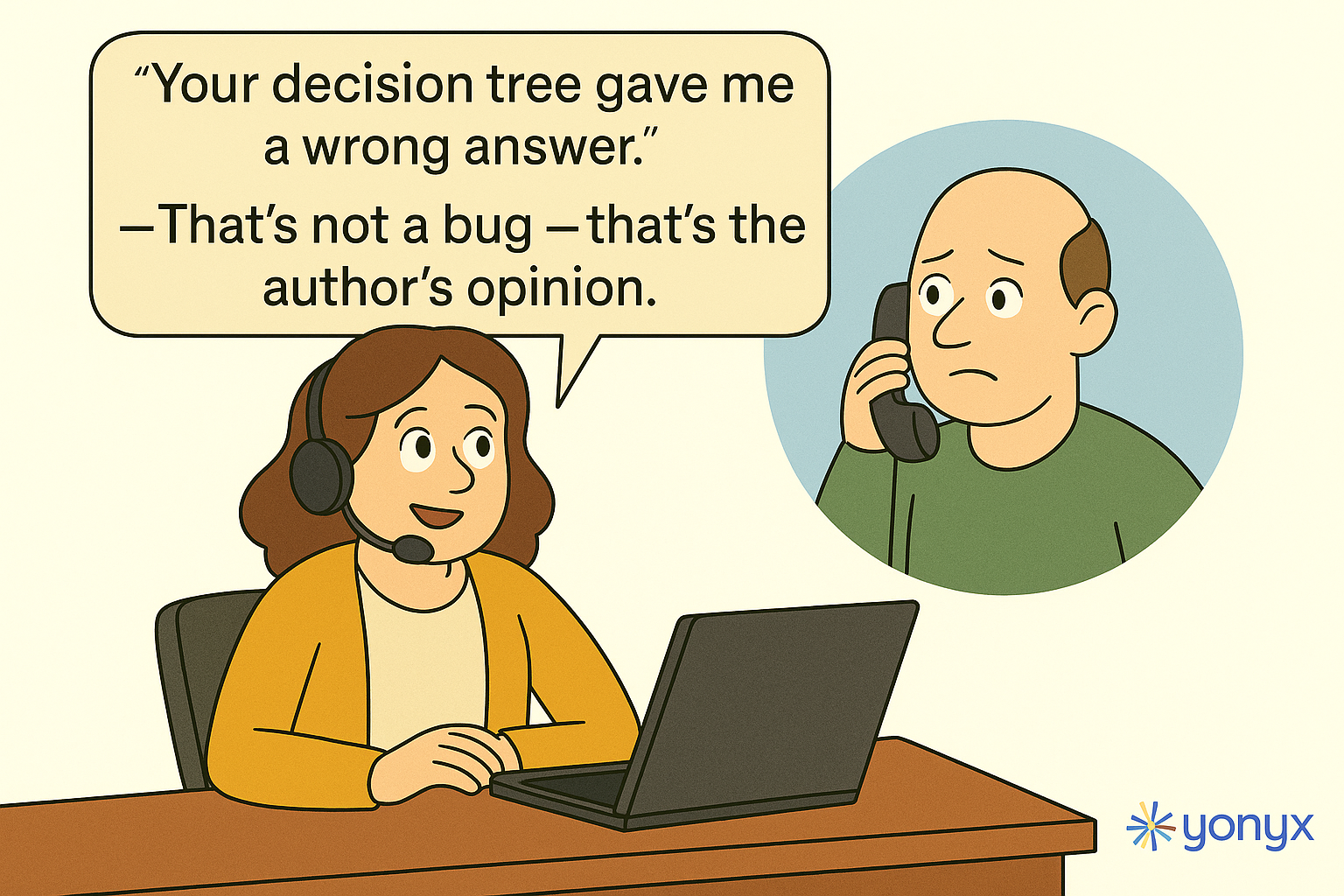
Some customers worry when a decision tree leads them somewhere unexpected. But one of the great joys of support work is explaining that the answer they received isn’t an error — it’s simply the perspective of the subject matter expert who built the flow.
As one agent famously told a customer:
Customer: “Your decision tree gave me the wrong answer.”
Agent: “That’s not a bug… that’s the author’s opinion.”
And honestly, that might be the most accurate description of how troubleshooting content has worked since the dawn of documentation.
Decision Trees: Where Logic Meets Human Interpretation
Interactive Decision Trees are structured, consistent, and based on logic — but logic is still filtered through human experience. SMEs bring their expertise, biases, and battle-tested scenarios into the process. Sometimes what looks “wrong” to a user is simply the SME saying, “Trust me, this is the best path. I’ve seen things.”
It’s not an error — it’s a philosophy.
Why Different Authors See the Same Problem Differently
No two experts troubleshoot the same way. That’s why documentation styles vary so widely across industries. Decision trees capture these differences, including:
- Preferred troubleshooting sequences: What one SME saves for later, another front-loads
- Interpretation of user behavior: Authors assume different common mistakes
- Real-world tribal knowledge: Some steps come from years of field observations
- “Trust me” logic: The kind of reasoning that works even when it’s hard to explain
So when a customer disagrees with the decision tree outcome, they’re unintentionally debating the lived experience of the SME behind it.
The Value of Author-Driven Logic
Decision trees intentionally preserve the author’s reasoning. This is a strength, not a limitation. It ensures:
- Consistency across agents
- Accurate replication of SME logic
- Reduction of guesswork
- Shared understanding of best practices
Human judgment isn’t a flaw — it’s the foundation.
Where AI Differs
AI generates responses probabilistically. It attempts to be helpful, but sometimes goes off track. Decision trees, meanwhile, reflect the exact steps an SME intends. If an answer seems unorthodox, it’s because the expert decided that was the best approach.
AI improvises. Decision trees follow doctrine.
Conclusion
The next time a customer insists the decision tree gave “the wrong answer,” it may be worth reminding them that behind every click is the wisdom (and personality) of a human expert. And sometimes, what feels like a mistake is really just… an opinionated optimization.
Because in customer support, even logic has a point of view.