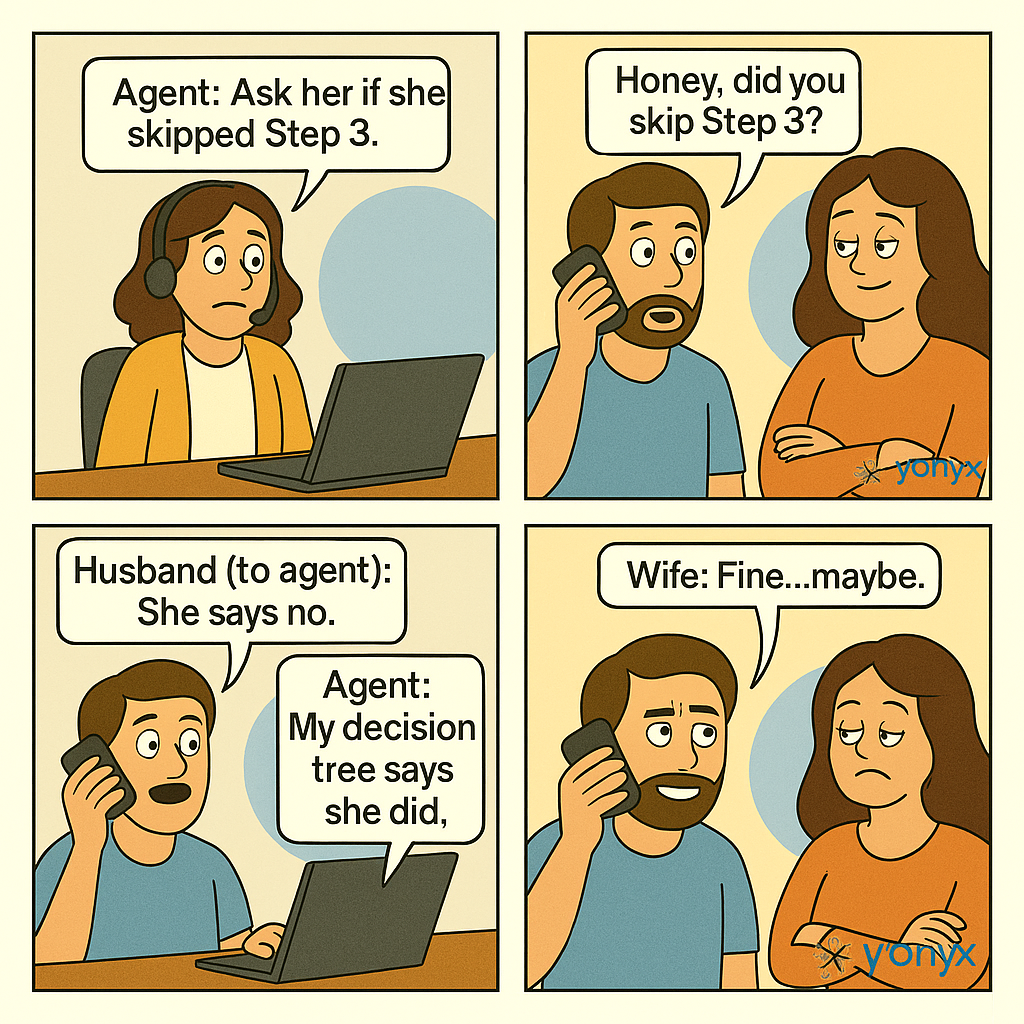
Sometimes troubleshooting involves more than just technology — it becomes a full family negotiation. Few scenarios capture this better than the moment when logic, honesty, and a decision tree collide.
Agent: “Ask her if she skipped Step 3.”
Husband: “Honey, did you skip Step 3?”
Wife: “Of course not.”
Husband (to agent): “She says no.”
Agent: “My decision tree says she did.”
Wife: “Fine… maybe.”
In the never-ending quest to fix household technology, the decision tree remains the only unbiased witness in the room.
Why Step 3 Is Always the First to Go Missing
If there’s one universal truth in troubleshooting, it’s this: the step someone swears they completed is usually the one they didn’t. This is not malicious — it’s human nature.
People skip steps because:
- They think they already did it
- It looked optional at the time
- They were “saving time”
- They were confident they knew better
- They were tired, frustrated, or hungry
Interactive Decision trees, however, don’t rely on enthusiasm or memory. They rely on logic, outcomes, and the statistical likelihood of human shortcuts.
Decision Trees Are Built to Catch the Unspoken Truth
Support authors know exactly which troubleshooting steps people love to ignore. That’s why decision trees are designed to verify those moments — politely, gently, and unavoidably.
They include:
- Validation checks
- Fallback conditions
- Branching logic for skipped actions
- Clear indicators that something was missed
Because decision trees are not guessing — they’re remembering the patterns of thousands of calls before.
The Family Troubleshooting Dynamic
When a spouse becomes the messenger between tech support and the person actually touching the device, the conversation becomes a comedy of conflicting confidence:
- The agent trusts the decision tree
- The husband trusts the wife
- The wife trusts her memory
- And the decision tree quietly trusts no one
The beauty of guided troubleshooting is that it cuts through all of this — kindly but firmly — until the truth emerges.
When Admitting “Maybe” Is a Breakthrough
That moment when the wife says “Fine… maybe” is not a failure. It’s progress. And it’s exactly what the decision tree was guiding toward.
Troubleshooting improves the second the actual state of the system matches the assumed state of the logic. Everything becomes easier once Step 3 is truly completed.
Conclusion
Decision trees don’t judge, blame, or take sides — but they do know exactly which steps people forget. And when emotions enter the process, the tree remains the only cool-headed participant.
So the next time someone insists, “I definitely didn’t skip that step,” remember:
The decision tree has seen enough to know better.
And it will gently guide everyone back to Step 3 — as many times as it takes.