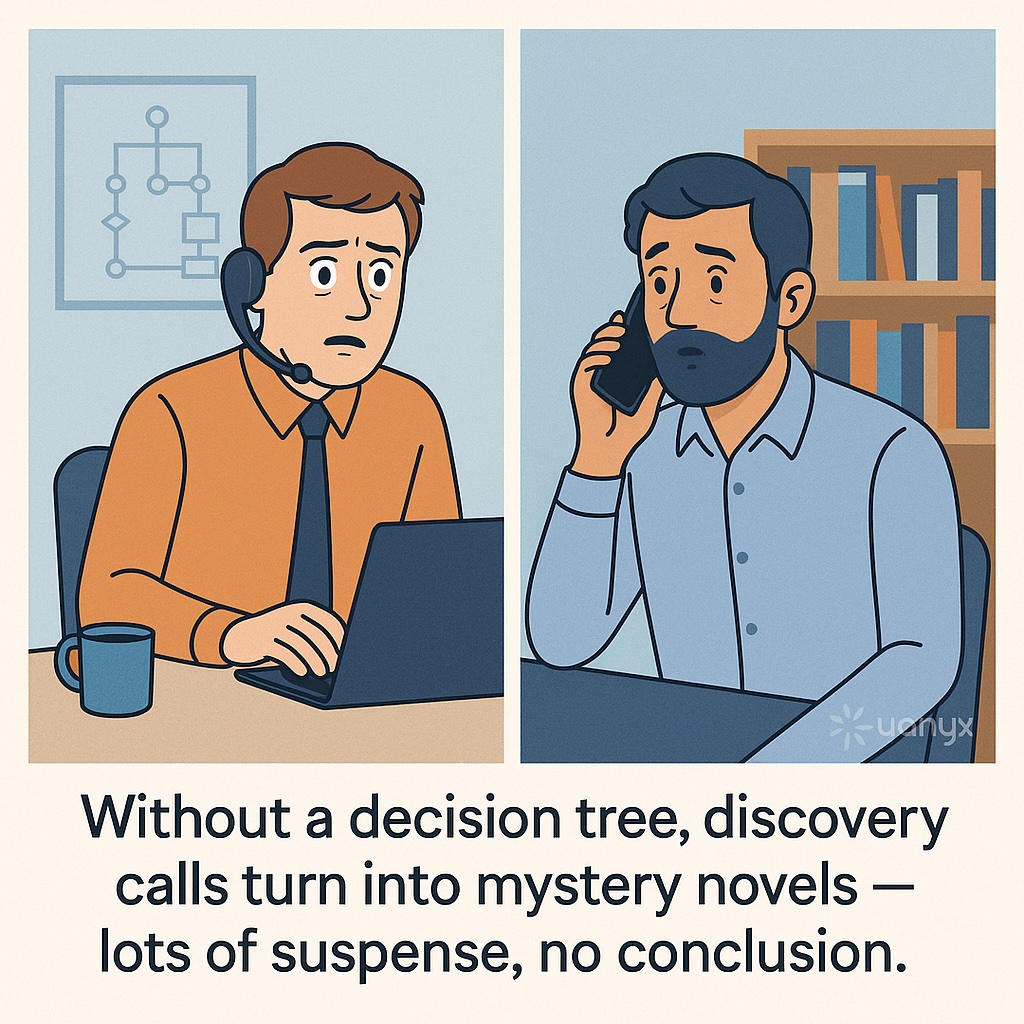
When Discovery Calls Become Mystery Novels Without a Decision Tree
Discovery calls are supposed to clarify customer needs. But without a decision tree? They start to feel more like mystery novels — plenty of suspense, dramatic pauses, unexpected twists, and absolutely no conclusion.
Every SDR has lived this plot: the prospect answers questions vaguely, introduces unrelated details, forgets key facts, and by the time the call ends, nobody is entirely sure what the original problem was.
Why Discovery Calls Drift Off Course
Most prospects don’t arrive with clean descriptions of their needs. They show up with:
- Half-formed ideas
- Multiple internal opinions
- Old assumptions from previous tools
- Details they remember only after you’ve moved to the next topic
Without structure, a discovery call becomes a narrative that wanders through subplots and side characters before ever arriving at the main point.
The Hidden Challenge: Cognitive Load on SDRs
SDRs must simultaneously ask questions, take notes, identify pain points, qualify fit, interpret vague statements, and maintain rapport. It’s easy for the conversation to drift when everything relies on real-time improvisation.
This is why inconsistent qualification happens — the process depends on who picked up the call rather than a repeatable logic flow.
Decision Trees Bring Order to the Chaos
A well-designed decision tree turns discovery from an abstract conversation into a guided path. Instead of relying on memory or instinct, SDRs move through structured branches that:
- Ensure no critical question is skipped
- Surface real needs hidden behind vague statements
- Prevent premature deep dives into irrelevant areas
- Lead the call to clear qualification outcomes
Prospects feel more confident too — the call becomes focused, efficient, and reassuringly logical.
AI + Decision Trees = Even Better Discovery
Generative AI can help draft follow-up questions or summarize context, but without a structured foundation, AI risks amplifying the chaos. Pairing AI with a decision tree ensures:
- Consistency across SDRs
- Accurate qualification paths
- Summaries grounded in real logic rather than AI guesswork
The result is discovery that feels less like detective work and more like a reliable, repeatable process.
Conclusion
Suspense is great in novels — not in your pipeline. Decision trees keep discovery calls focused, guided, and conclusively answered, ensuring every conversation ends with clarity instead of cliffhangers.