Some troubleshooting moments reveal a truth as old as technology itself: everyone — regardless of age, skill, or confidence — has clicked the wrong button at least once. Even grandmas aren’t immune.
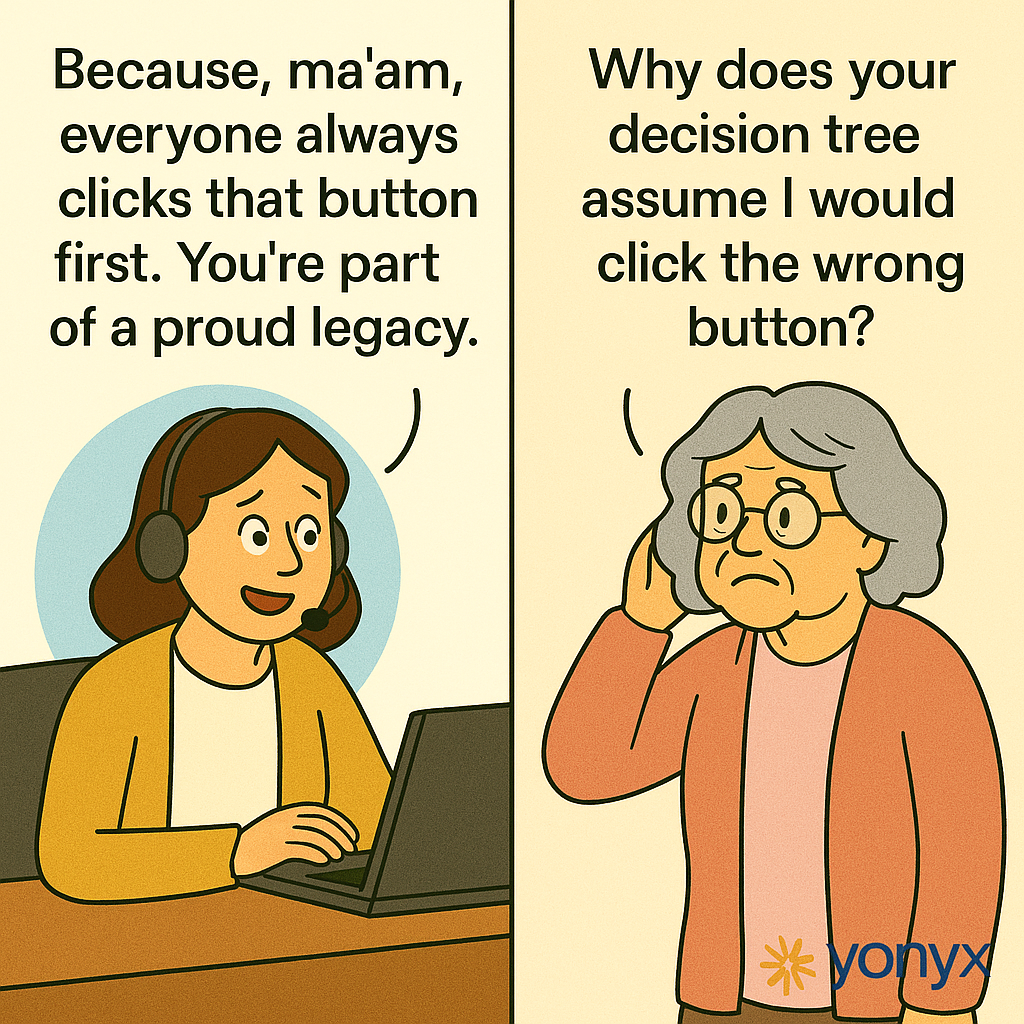
Grandma: “Why does your decision tree assume I would click the wrong button?”
Agent: “Because, ma’am, everyone always clicks that button first. You’re part of a proud legacy.”
And just like that, she learns she is not the exception — she is part of a tradition shared by millions of users throughout digital history.
Decision Trees Aren’t Judging — They’re Remembering
Decision trees don’t predict mistakes through intuition. They predict mistakes through data — lots of it. Over years of support calls, one pattern stands undefeated: the button users shouldn’t click is always the one they click first.
It’s not a flaw. It’s human nature.
Common examples include:
- Clicking “Cancel” when trying to continue
- Clicking “Restart Now” instead of “Save and Restart”
- Clicking “Reset All Preferences” instead of “Back”
- Clicking the biggest button because it looks the most important
Interactive Decision Trees simply acknowledge this predictable pattern — respectfully and efficiently.
Why the Wrong Button Is So Tempting
Designers try to make interfaces intuitive. Users try their best to interpret them. Somewhere in the middle — things happen.
Grandma isn’t clicking the wrong button because she’s inexperienced. She’s clicking it because:
- It looks like it should be the right button
- It’s highlighted or bold or bigger
- She’s in a hurry to get the task done
- She assumes she remembers what it does
- Her instincts guide her before the instructions do
And the decision tree? It has learned those instincts the hard way — through thousands of user journeys.
The Legacy of the Wrong Button
The agent is right: clicking the wrong button is a legacy. A shared, universal moment in the human–technology relationship.
Every time it happens, support teams document it. Authors refine the flow. Decision trees get smarter.
What feels like a personal mistake becomes a contribution to troubleshooting science.
Grandma isn’t being singled out — she’s participating in a tradition that spans generations of computer users.
Conclusion
Decision trees don’t make assumptions based on stereotypes. They make predictions based on evidence. And the evidence overwhelmingly shows that the “wrong” button is the first button most people click.
So when Grandma asks why the system anticipated her choice, the agent can proudly say:
“Because you’re part of a proud legacy.”
It’s not a mistake — it’s a rite of passage.