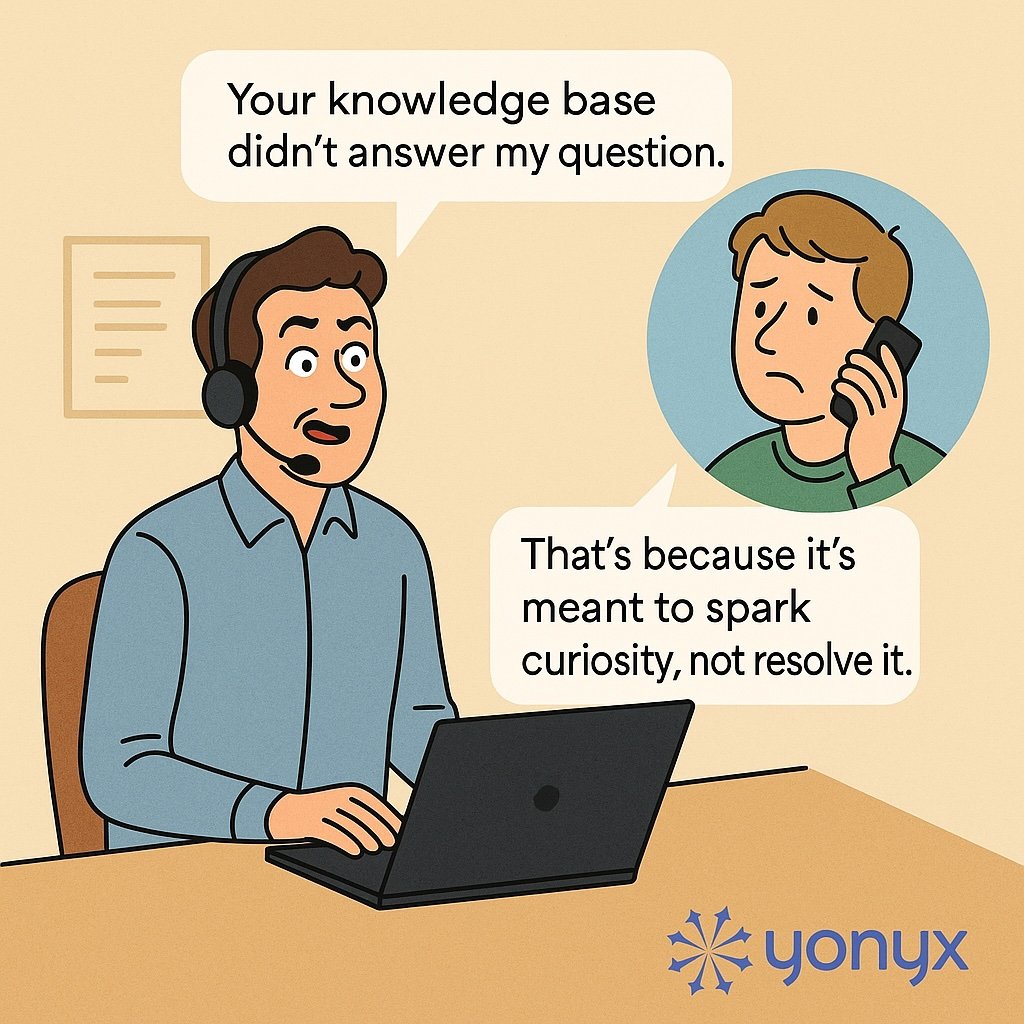
Customer: “Your knowledge base didn’t answer my question.” And the Agent replies, “That’s because it’s meant to spark curiosity, not resolve it.”
It’s a joke with a sting of truth. Many customers click into a knowledge base hoping for clarity… and instead find themselves on a journey of vague hints, unrelated articles, and philosophical breadcrumbs that lead everywhere except the solution they needed.
The Knowledge Base Problem Nobody Mentions
Most knowledge bases aren’t built intentionally — they grow organically over time. New articles get added whenever someone remembers, updates happen inconsistently, and before long you have a library where:
- Articles contradict each other
- Critical steps are buried in unrelated posts
- Generic advice replaces real troubleshooting
- Customers must “interpret” the answer instead of following it
This is how a KB slowly transforms into something closer to a museum exhibit — interesting to look at, but not immediately useful.
Why Customers Struggle With Static Content
The typical knowledge base assumes the customer already knows:
- Which article applies to their situation
- What terminology the company uses internally
- What steps they’ve already tried (and which ones matter)
- How to translate vague instructions into concrete actions
But customers don’t think in “articles.” They think in problems. And they expect the content to adapt to their scenario — not the other way around.
Decision Trees Turn Curiosity Into Clear Next Steps
This is where interactive decision trees excel. Instead of forcing customers to sift through dozens of pages, the flow adapts based on their responses. Every step narrows the possibilities, eliminates irrelevant paths, and leads the customer toward the correct resolution.
Decision trees give customers:
- Clarity instead of guesswork
- Structured guidance instead of vague suggestions
- Personalized logic instead of one-size-fits-all documentation
Support teams benefit too — fewer escalations, fewer repeated questions, and far fewer surprises.
When AI Joins the Party
AI-powered knowledge retrieval becomes dramatically more reliable when it sits on top of structured decision logic. Instead of generating its own ideas (which may be brilliant or hallucinated), the AI is anchored to the SME-authored flow.
The result? Customers get answers, not riddles.
Conclusion
A knowledge base should do more than spark curiosity — it should guide customers to solutions with clarity and confidence. With structured decision trees, your support content stops being a scavenger hunt and becomes a direct path to resolution.