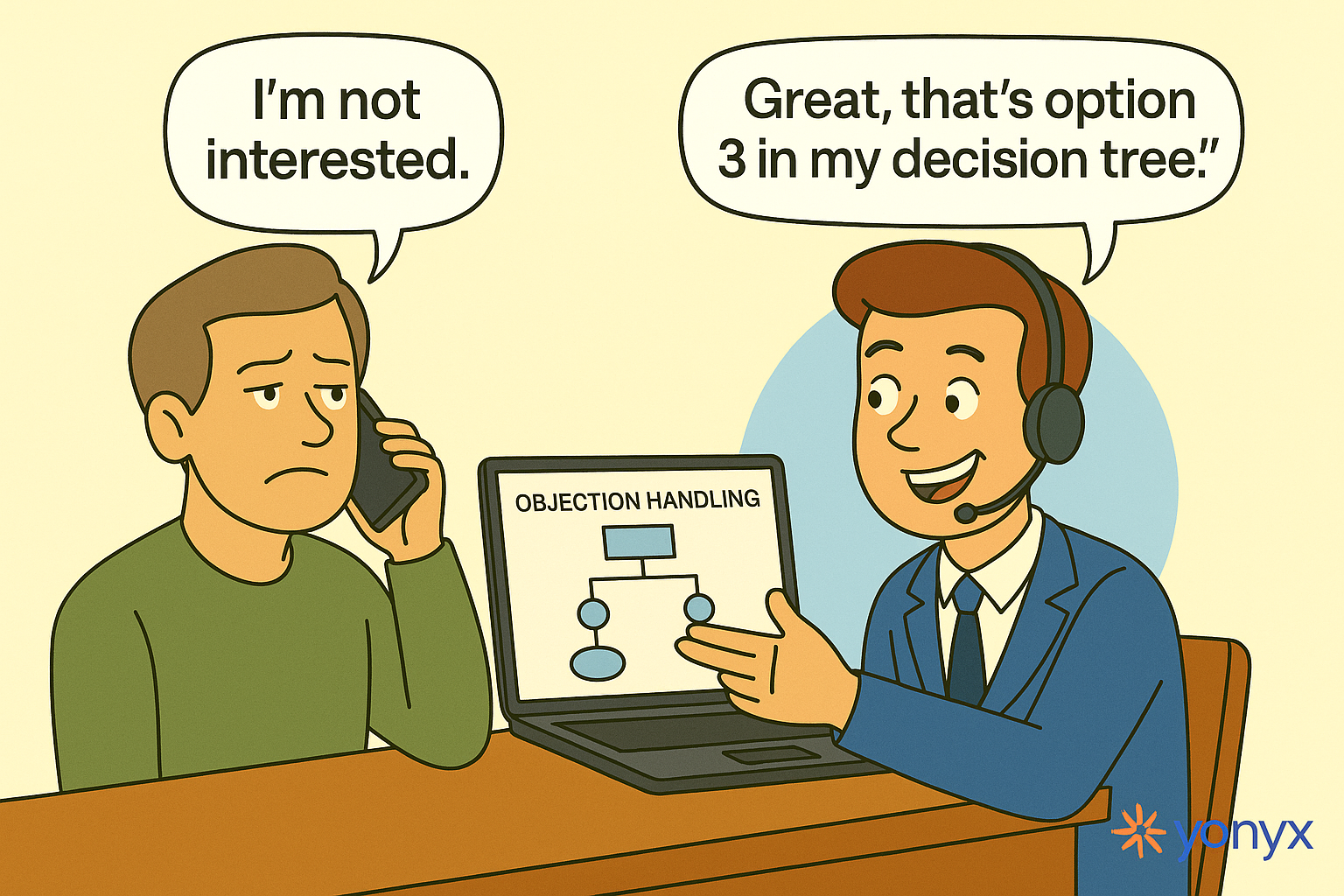
Every sales rep has heard the classic shutdown: “I’m not interested.” But only a seasoned SDR armed with an interactive decision tree can reply with the type of confidence that turns rejection into a workflow checkpoint.
One rep summed it up perfectly:
Customer: “I’m not interested.”
Sales Rep: “Great, that’s option 3 in my decision tree!”
When your objection handling is mapped out step-by-step, even rejection becomes a predictable milestone. And honestly, that’s the kind of emotional stability sales deserves.
Why Decision Trees Make Objections Less… Personal
Sales calls are unpredictable — but objections aren’t. People say the same handful of phrases in hundreds of different tones. Decision trees give SDRs a structured playbook so the rep never has to react emotionally or improvise under pressure.
No matter the objection, there’s a branch for that.
- “Not interested.” — Route to Option 3.
- “Send me something.” — Route to Option 7.
- “Now’s not a good time.” — Route to Option 11.
- “Who are you again?” — Route to Option 1 (re-introduction).
A good decision tree makes the rep sound consistent, confident, and calm — even when the customer is providing the conversational equivalent of a slammed door.
The Hidden Benefit: Rejection Becomes Data
When objections are structured paths instead of emotional moments, sales teams can actually measure them. Decision trees help organizations understand:
- Which objections happen most often
- Which responses lead to re-engagement
- Which branches consistently drop
- Where messaging needs tuning
Suddenly, “I’m not interested” isn’t a dead end — it’s a datapoint with a direction.
Consistency Builds Confidence
High-performing SDRs don’t wing it. They use guided flows so they can focus on listening while letting the decision tree handle the logic. That’s why the best responses often sound effortless — they’ve been engineered by subject matter experts, tested in the real world, and refined over hundreds of calls.
It’s not robotic. It’s reliable.
Conclusion
Objections are part of the job — but stress doesn’t have to be. With a well-built decision tree, every rep knows exactly what to say next, even when the conversation swerves. So when the customer says, “I’m not interested,” the rep can smile and reply:
“Perfect. That’s option 3 in my decision tree.”
Because with the right logic guiding the call, even rejection becomes just another step in the flow.