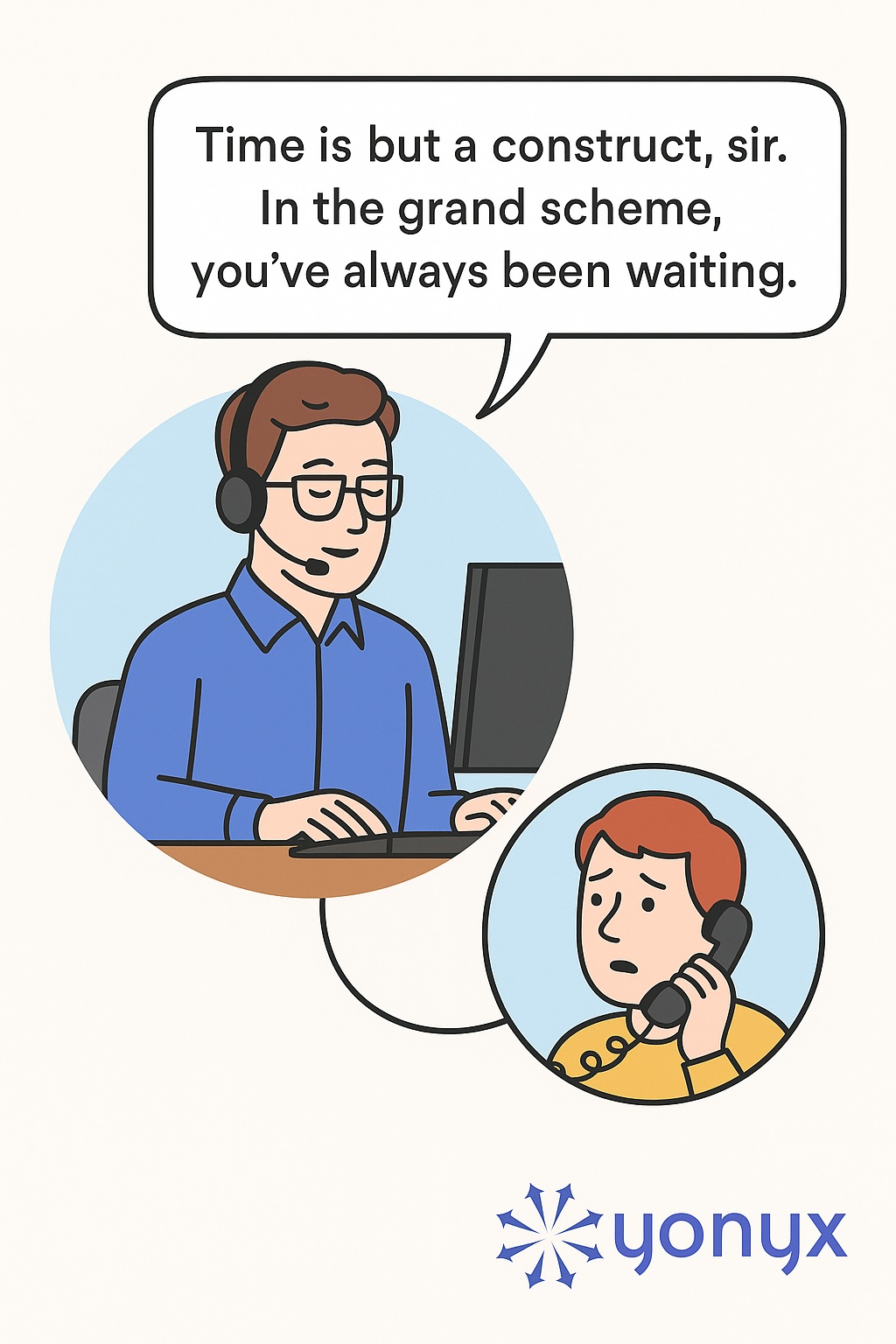
Every support caller knows the dreaded question: “How long will I be on hold?” But every once in a while, you get an agent who skips practical answers and jumps straight to philosophy — “Time is but a construct, sir. In the grand scheme, you’ve always been waiting.”
It’s absurd. It’s hilarious. And it’s painfully accurate for anyone who has ever watched their estimated wait time bounce between 4 minutes and 27 minutes with no explanation.
Why Hold Time Feels Longer Than It Is
Psychologists will tell you: time feels slower when you’re waiting for something important — like a solution, a refund, or the chance to explain that you’ve already rebooted the modem twice. Hold music doesn’t help either. After a few loops, even cheerful melodies start to resemble existential background noise.
The problem isn’t just the wait. It’s the uncertainty behind it. “How long?” is really another way of asking, “Do I have any control here?”
When Support Needs More Than Guesswork
Most contact centers rely on systems that estimate wait times based on historical averages. But real customer conversations rarely follow averages. Some callers need two minutes. Some need twenty. And occasionally, someone needs to be talked out of plugging their router into the microwave outlet “just to see what happens.”
That unpredictability creates long queues, inconsistent experiences, and frustrated customers. What’s missing is a structured approach to solving problems quickly and consistently.
How Decision Trees Reduce Hold Time
Decision trees introduce clarity where call centers often have chaos. By guiding agents step-by-step through expert-authored troubleshooting paths, they reduce the time spent guessing, searching knowledge bases, or escalating unnecessarily.
Agents resolve issues faster. Customers spend less time waiting. And no one needs to hear anything about “the grand scheme of the universe.”
AI + Decision Trees = Fewer Calls, Faster Answers
When AI leverages decision-tree logic, it can resolve many issues before a customer ever reaches the queue. AI becomes predictable, helpful, and grounded in expert knowledge — not philosophical musings.
The more accurate the guidance, the fewer calls reach live agents, and the shorter the lines become for those who do.
Conclusion
Humor aside, hold time is one of the most frustrating parts of customer support. But with structured troubleshooting, intelligent decision flows, and AI that actually knows what it’s doing, companies can reduce wait times dramatically.
And maybe — just maybe — callers won’t feel like they’ve been waiting since the dawn of time.