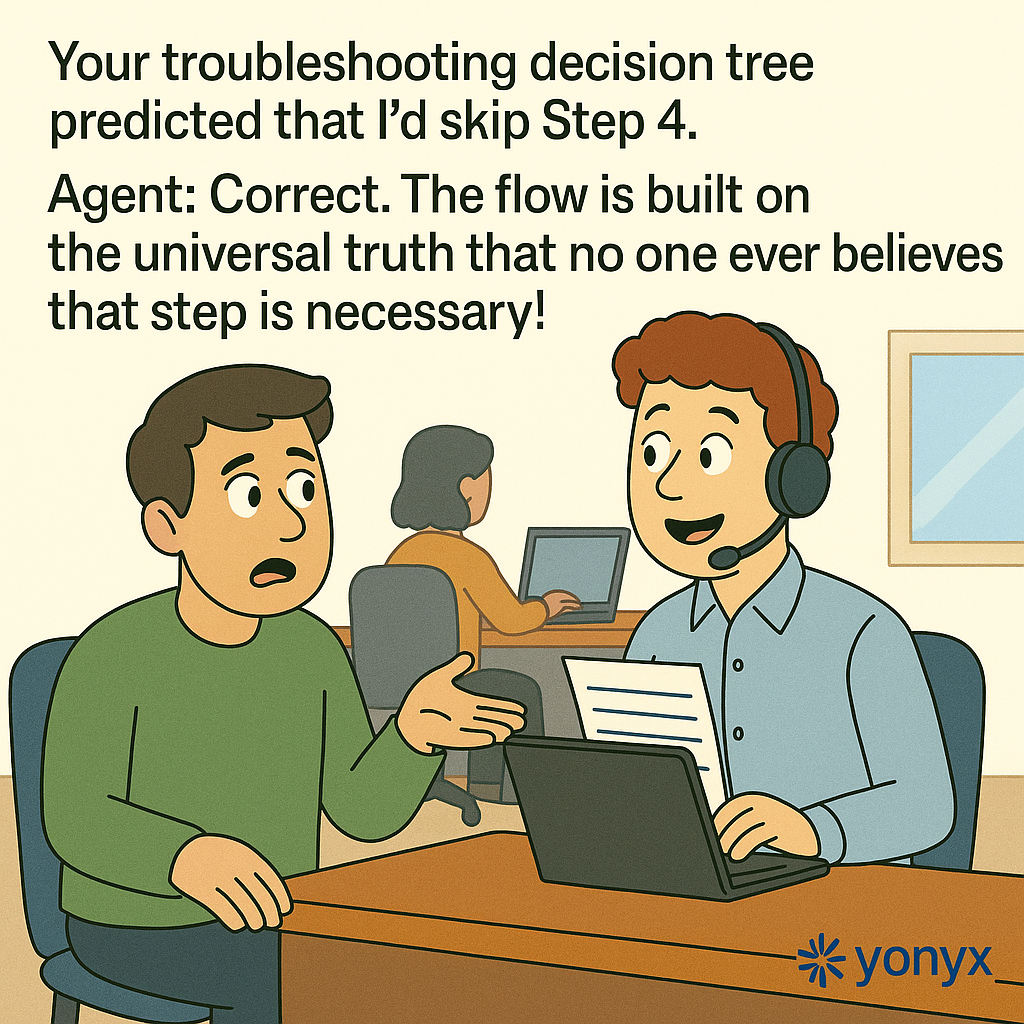
There comes a moment in every troubleshooting flow when the customer realizes the system knows their habits a little too well.
Customer: “Your troubleshooting decision tree predicted that I’d skip Step 4.”
Agent: “Correct. The flow is built on the universal truth that no one ever believes that step is necessary!”
And with that, the customer discovers an uncomfortable reality: decision trees aren’t just logic — they’re psychology.
Why Everyone Skips “That One Step”
In every troubleshooting guide, there’s a step that feels optional even though it absolutely isn’t. Maybe it looks too simple. Maybe it looks too obvious. Maybe it’s just inconvenient.
But no matter the reason, Step 4 is always the first casualty.
Support teams know this, because they’ve seen the pattern:
- Customers follow Steps 1–3 perfectly
- They glance at Step 4
- They decide they’re above it
- And later, they wonder why Step 9 didn’t work
This is exactly why interactive decision trees account for skipped steps long before the customer admits it.
Decision Trees Are Built on Universal Truths
While decision trees are powered by logic, they’re built on real-world experience. Support authors know the steps customers love to ignore — because they ignored them too when they first learned the system.
So they design flows that gently bring the user back to the missing step without shame or blame.
It’s not about catching mistakes. It’s about guiding people toward the inevitable truth:
“You really do have to do Step 4.”
Why Customers Think the Tree Is Psychic
When a decision tree predicts a skipped step, it can feel uncanny. But the system isn’t reading the customer’s mind — it’s reading history.
The steps are sequenced with full awareness that humans:
- Overestimate their tech skills
- Underestimate the importance of “minor” steps
- Assume they already did the step… even when they didn’t
- Get impatient and jump ahead
Decision trees simply put guardrails where human nature tends to drift.
The Real Purpose of Step 4
If a decision tree highlights a step so prominently, it means the system depends on it. Skipping it isn’t just inconvenient — it breaks the flow.
That’s why the best troubleshooting trees include validation checks, reminders, confirmations, and fallback steps to ensure nothing gets overlooked.
In other words: Step 4 isn’t optional. It’s foundational.
Conclusion
When a customer realizes the decision tree predicted their skipped step, they’re witnessing the power of documented experience.
Decision trees don’t judge — they just remember. And they use that memory to help users avoid the most common pitfalls.
So the next time someone questions how the system “knew,” the agent can simply say:
“Because no one ever believes Step 4 is necessary — but it always is.”
And that’s exactly why the tree is there to catch it.