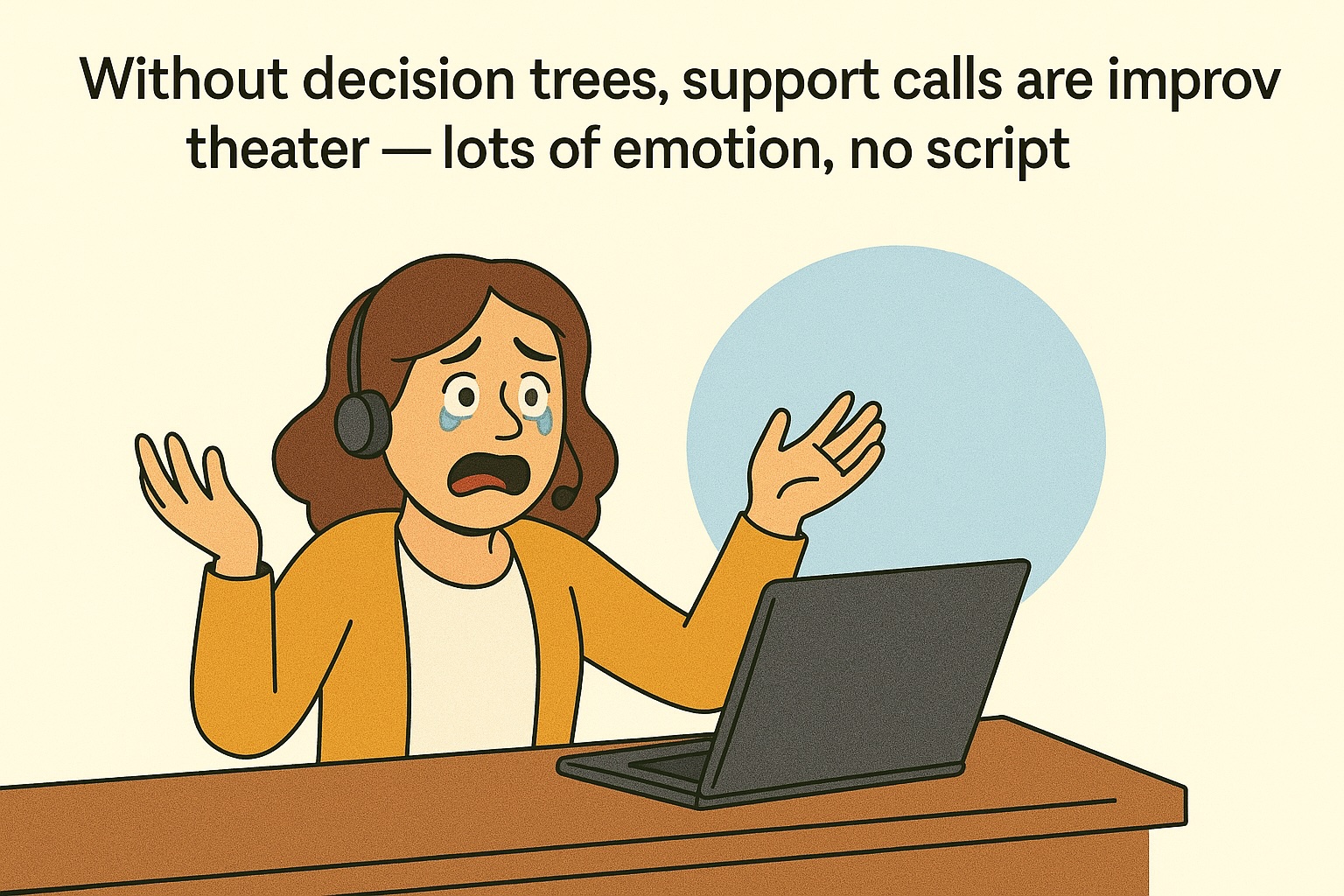
Some support calls are calm, predictable, and neatly resolved. And then there are the others — the calls where the customer arrives stressed, the agent arrives hopeful, and what unfolds next feels less like troubleshooting and more like improv theater. Lots of emotion. No script. Endless possibilities.
When interactive decision trees aren’t guiding the flow, support becomes a performance art: agents improvise steps, customers throw in surprise twists, and the final resolution depends entirely on who is “on stage” that day.
Why Support Without Structure Becomes Chaotic
Most customers don’t describe their issue the exact same way. They skip important details, get emotional, or start the story in the middle. Meanwhile, agents try to diagnose the problem while staying calm, empathetic, and efficient.
Without a structured process behind them, this leads to:
- Agents guessing the next best step
- Customers repeating information multiple times
- Unnecessary resets or escalations
- Different agents giving different answers
- Handle times that vary wildly
It’s not that the agents aren’t capable — they simply don’t have the script.
Emotional Calls Need Logical Guidance
Support issues often surface when something isn’t working and the customer is already frustrated. Emotions run high, and without a clear pathway, the conversation can veer off course quickly.
A scripted process doesn’t remove empathy — it actually supports it. When an agent isn’t scrambling to remember troubleshooting steps, they can focus on listening, de-escalating, and reassuring the customer.
Decision Trees Bring Order to the Improvisation
Decision trees transform unpredictable conversations into guided, structured flows. Instead of relying on improvisation, agents follow a logic path written by SMEs who already encountered every possible scenario.
With a strong decision tree, support agents:
- Always start in the right place
- Never skip essential diagnostics
- Ask questions in a consistent order
- Adapt the flow to customer responses
- Resolve issues faster and with confidence
Customers feel the difference immediately — the call becomes grounded, predictable, and reassuring.
AI Works Best With a Script Behind It
AI can summarize, respond, and generate explanations, but it still needs logical guardrails. When paired with a decision tree, AI delivers answers rooted in expertise rather than improvisation.
This combination removes ambiguity and creates consistency across every support interaction.
Conclusion
Improv theater is great entertainment, but it’s not ideal for customer support. Decision trees give agents the structure they need to resolve issues reliably, turning chaotic calls into calm, guided experiences.
With a clear script, support becomes efficient — and customers finally feel heard, understood, and helped.