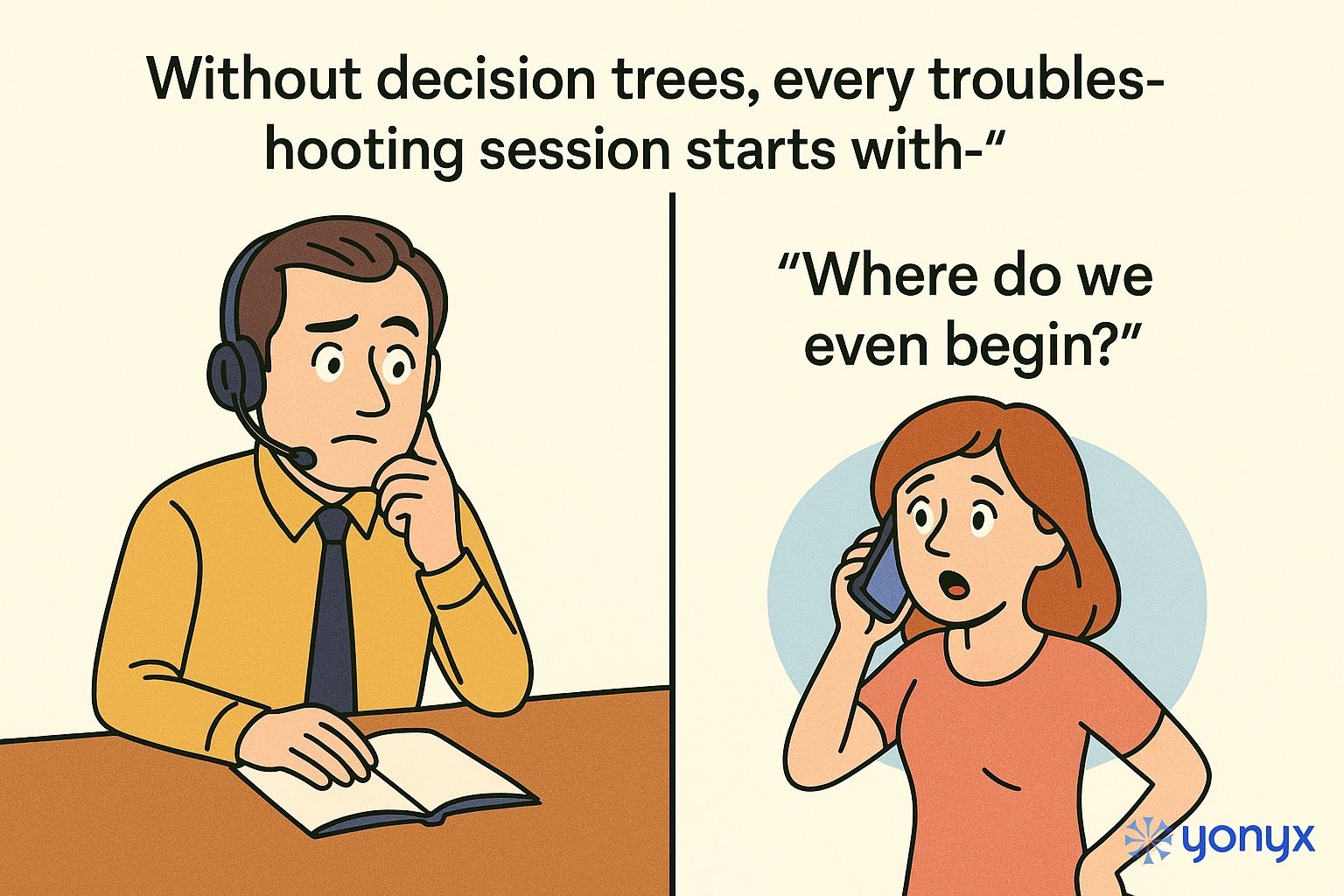
Some troubleshooting sessions begin with confidence, clarity, and a known path forward. And then there are the other ones — the sessions where everyone takes a deep breath and asks, “Where do we even begin?”
Without an interactive decision tree, support teams often rely on a mix of intuition, memory, bookmarked articles, and “what worked last time.” Customers feel it. Agents feel it. And the troubleshooting path feels more like wandering into a forest without a map.
Why Troubleshooting Derails Without Structure
Technical issues rarely present themselves cleanly. Customers describe symptoms differently, skip important details, or unintentionally hide the true root cause. Meanwhile, agents must interpret incomplete information in real time.
Without a structured path, this leads to:
- Asking the customer to repeat steps they’ve already tried
- Overlooking essential diagnostics
- Jumping to solutions too early
- Restarting the process multiple times
- Multiple unnecessary escalations
In other words — troubleshooting becomes random exploration instead of deliberate diagnosis.
The Cost of “Let’s Just Start Somewhere” Troubleshooting
When every session begins from scratch, support quality depends heavily on the individual agent. Some agents know the shortcuts. Others know the historical quirks. But most rely on their best guess in the moment.
This inconsistency affects:
- First-call resolution rates
- Handle times
- Escalation volumes
- Customer trust
- Training and onboarding speed
Customers notice the uncertainty — and that’s when frustration starts to build.
Decision Trees Eliminate the Guesswork
A well-authored decision tree gives support teams a logical, reliable, repeatable troubleshooting path. Instead of improvising, agents follow a flow that narrows the issue step-by-step, capturing SME knowledge in a structured way.
Decision trees ensure that:
- Agents never skip critical steps
- Customers receive consistent guidance
- Diagnostics progress in a deliberate order
- Edge cases are built into the logic
- Resolution moves forward instead of circling endlessly
The question shifts from “Where do we begin?” to “What’s the customer seeing right now?” — and the tree guides the rest.
Structured Troubleshooting Also Improves AI Accuracy
AI can assist with summarization, suggestions, and customer responses, but it needs guardrails. When paired with a decision tree, AI becomes far more reliable, grounded in the logic authored by experts.
The combination gives customers both the clarity of structured logic and the conversational ease of AI.
Conclusion
When troubleshooting begins with uncertainty, both agents and customers feel it. Decision trees replace that uncertainty with confidence — ensuring every session starts with direction rather than confusion.
Because no one should begin support with “Where do we even begin?” when they could begin with clarity.