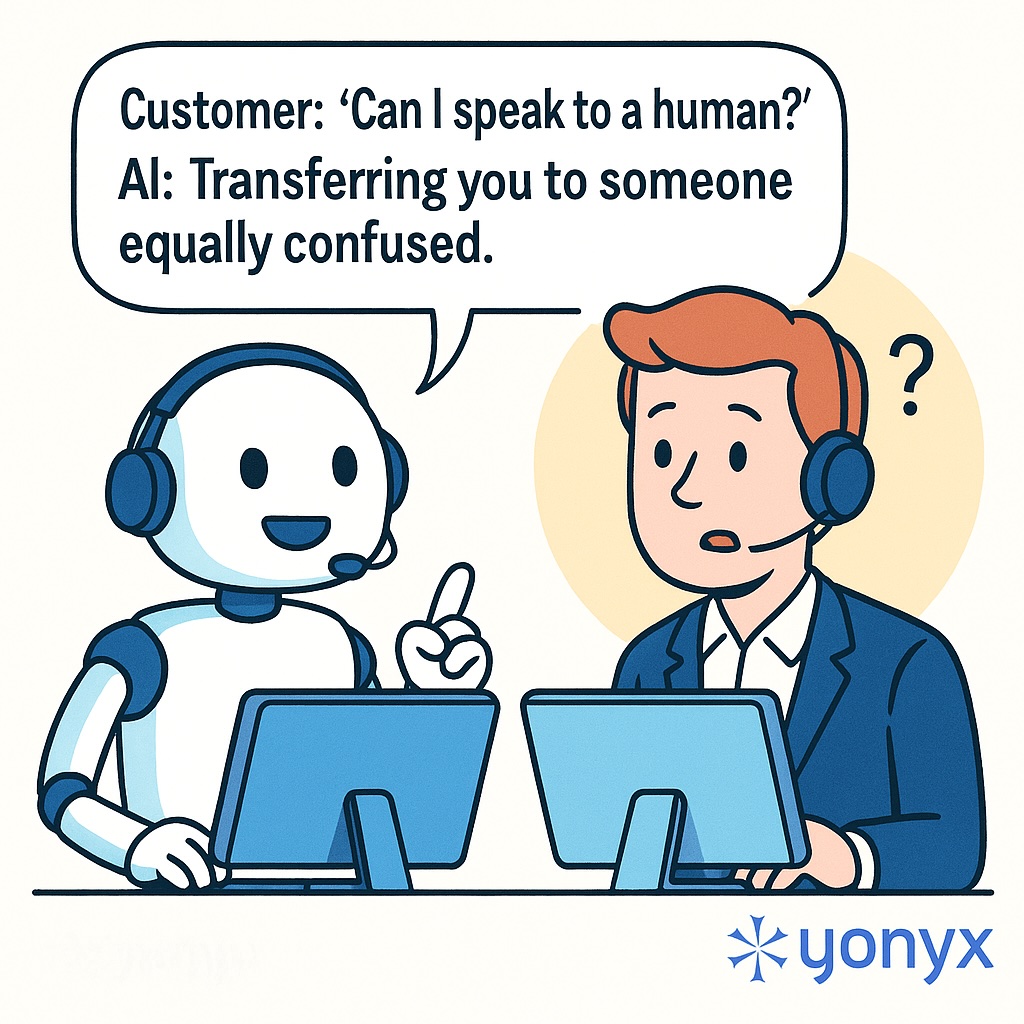
There’s a special moment in modern customer service when a customer, tired of automated prompts, finally asks: “Can I speak to a human?” It’s the digital equivalent of waving a white flag. And sometimes, the AI responds with surprising honesty — by admitting that the human it’s transferring to might be just as confused.
It’s a joke, of course, but it also reflects a real challenge: automation is fast, but meaningful resolution still depends on clarity, structure, and reliable processes behind the scenes.
When Customers Want a Human, Not a Guess
Most customers don’t dislike automation. They dislike uncertainty. They dislike being routed in circles, misinterpreted, or asked the same question five different times. When that happens, “I want a human” really means, “I want someone who can understand my situation without guessing.”
AI can process information quickly, but without a structured flow to guide it, its answers may drift into creativity rather than accuracy. That’s where the humor comes from — a system confidently passing the customer to a human who may not be better equipped unless the workflow behind them is solid.
Why Human Agents Need Structure Too
Even the best support agents can struggle when documentation is scattered, instructions are outdated, or processes vary team to team. Without a unified guide, troubleshooting becomes inconsistent. One agent improvises. Another relies on memory. A third searches through disconnected knowledge bases.
In that environment, the AI isn’t wrong: the human may indeed be “equally confused.” Not because they lack skill, but because the organization lacks structured support.
Decision Trees Reduce the Confusion
Interactive decision trees give both AI and human agents a proven blueprint for resolving issues consistently. The tree breaks down complex processes into clear, logical steps based on actual expert knowledge. No guessing. No improvising. No contradictory answers.
For the customer, that means faster resolutions. For the agent, it means fewer moments of uncertainty. And for the AI, it means a reliable fallback path instead of handing off confusion.
AI + Decision Trees: A Stronger Handoff
AI excels at gathering details, routing requests, and identifying urgency. Once the conversation requires precise, domain-specific troubleshooting, a decision tree ensures the next steps are accurate.
It’s a partnership: AI handles speed, while decision trees handle correctness. Together, they prevent the classic “human escalation” from turning into another dead end.
Conclusion
When a customer asks for a human, what they really want is clarity — not just empathy. AI might joke about transferring them to someone “equally confused,” but with the right structured workflows behind the scenes, neither AI nor human needs to be confused at all.
In customer support, the best outcomes come from combining AI’s efficiency with decision trees’ reliability. And when that happens, the handoff becomes seamless, predictable, and far more reassuring than any joke.