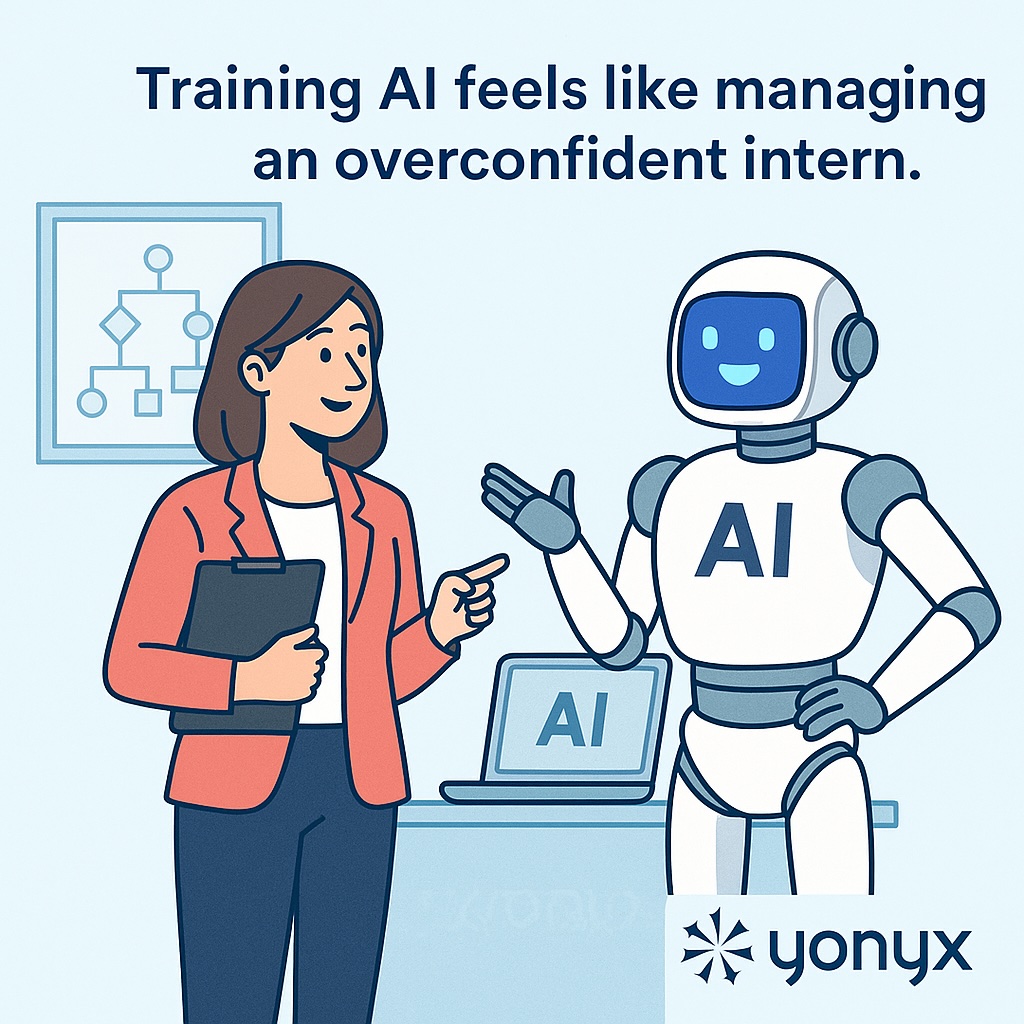
Every leader knows the type: the well-meaning intern who answers questions with bold enthusiasm, even when they have no idea what the question really meant. Modern AI, in its more entertaining moments, behaves remarkably similarly.
You ask for a simple explanation, and it delivers a confident monologue that sounds brilliant until you realize it’s built on assumptions that never should have been made. It’s humorous — and occasionally impressive — but rarely predictable.
The Overconfident Intern Problem
AI systems are designed to generate fluent responses. That fluency often makes them sound certain, even when the underlying reasoning is shaky. Much like eager interns, they want to be helpful, they want to sound capable, and they want to fill in the gaps without asking for clarification.
But in troubleshooting and customer support, certainty without accuracy becomes a liability. Confidence alone doesn’t solve real problems.
Why Logical Thinking Is Hard for AI
AI excels at recognizing patterns, generating summaries, and predicting likely next words in a conversation. What it does not naturally excel at is deterministic reasoning — the kind of step-by-step, conditional thinking required for real troubleshooting.
That’s why AI occasionally provides answers that feel creative, imaginative, or even slightly rebellious against the rules of logic. It’s not misbehaving — it’s doing what it was trained to do: provide helpful-sounding language, even when the situation requires strict logic instead.
Where Decision Trees Step In
Interactive decision trees offer what AI naturally lacks: structure, boundaries, and precision. They don’t assume. They don’t fill in blanks. They don’t improvise their way through a workflow.
Instead, they follow exactly the logic created by subject matter experts. Each branch has a purpose. Each condition is validated. Each path has been used, refined, and tested in the real world. It’s the difference between an intern trying to “figure it out” and a senior engineer who already knows the right sequence of steps.
AI + Decision Trees: A Stronger Combination
Despite its quirks, AI is incredibly useful when paired with structured logic. It can route tickets, extract details, provide summaries, or identify missing information. Then, when precision matters, the decision tree guides the user through the exact steps needed.
The humor comes from the contrast: AI behaves like the overly eager intern, while the decision tree behaves like the clear, dependable SOP binder everyone ultimately relies on.
Conclusion
Teaching AI to reason logically will continue to improve with better models and training, but decision trees remain essential for workflows where accuracy is non-negotiable. The next time AI responds with confident creativity, just remember: even the brightest interns need structure — and decision trees provide exactly that.