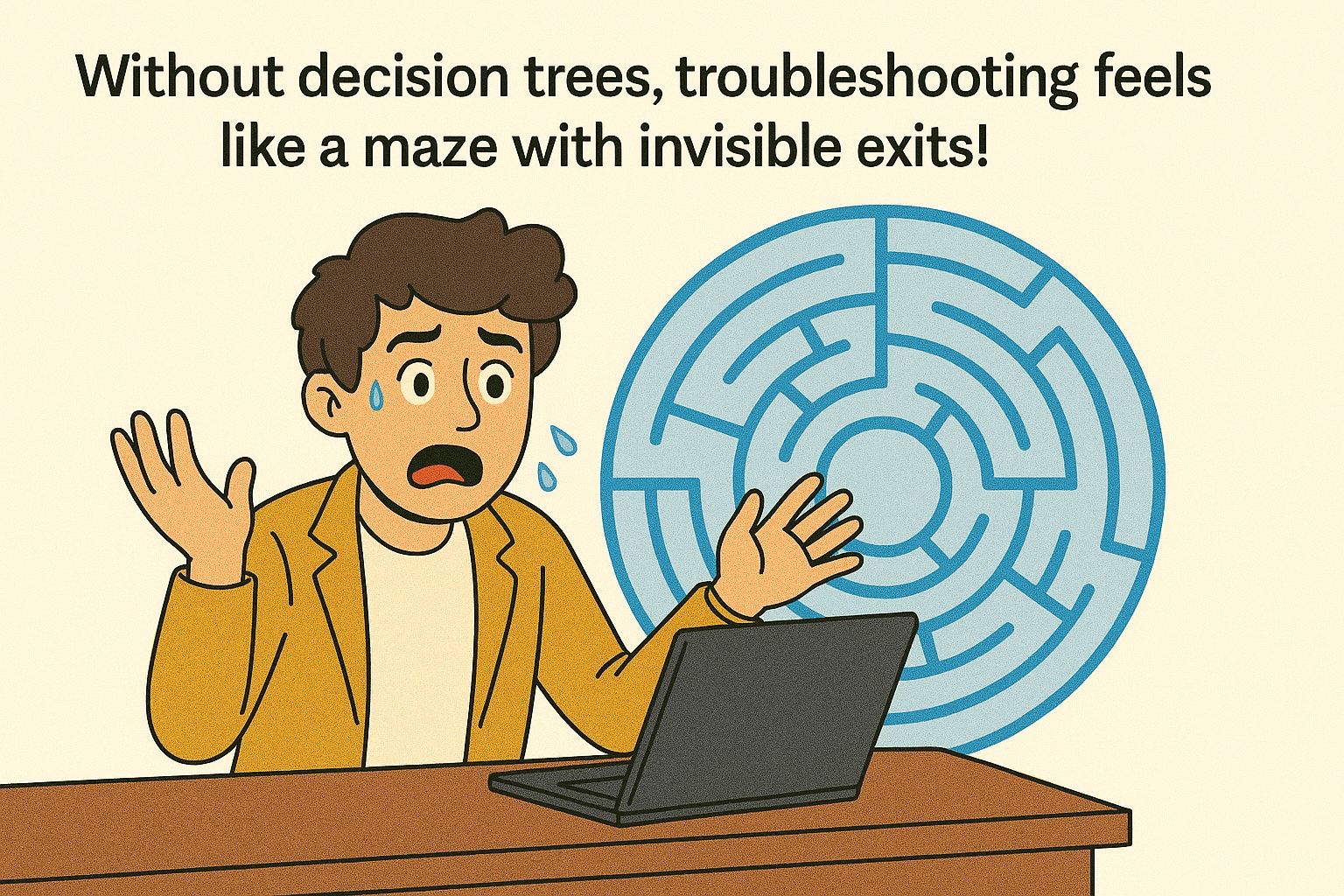
Some troubleshooting sessions are straightforward… and then there are the others — the ones that feel like stepping into a maze with invisible exits. You take a turn, hit a dead end, retrace your steps, try another path, and eventually wonder whether the exit was ever real to begin with.
Without an interactive decision tree guiding the process, troubleshooting becomes guesswork layered on top of hopeful intuition. Agents try one approach, then another, and customers feel like they’re wandering in circles without any sense of progress.
Why Troubleshooting Without Structure Feels Confusing
Technical issues rarely follow a neat script. Customers describe symptoms differently, skip crucial details, or remember key facts only after several steps have been attempted. Meanwhile, agents must interpret incomplete clues in real time.
This creates an experience filled with uncertainty, where:
- Steps are repeated unintentionally
- Diagnostics happen out of order
- Agents choose the wrong path based on limited information
- Escalations become frequent “escape routes”
- Neither agent nor customer feels confident in the next step
In short, it’s the troubleshooting equivalent of wandering through a maze without a map.
The Human Cost: Confusion, Frustration, and Lost Time
When troubleshooting has no structure, both sides feel the impact. Customers get impatient, wondering why a simple issue takes so long to diagnose. Agents feel pressure to find the right answer quickly — often without the tools to do so.
Over time, this leads to:
- Longer handle times
- Higher escalation rates
- Training gaps among agents
- Inconsistent customer experiences
- Reduced first-call resolution
Everyone senses the maze — even if no one says it out loud.
Decision Trees Make the Exits Visible
Decision trees transform chaotic troubleshooting into a guided journey. Instead of feeling around in the dark, agents follow a logic path designed by SMEs who’ve already solved these issues countless times.
With a decision tree, troubleshooting becomes:
- Step-by-step
- Predictable
- Consistent across agents
- Easy for customers to follow
- Fast to resolve because dead ends are removed
Suddenly, the maze has clear markers, signposts, and a well-lit path forward.
Pairing Decision Trees With AI Enhances Accuracy
AI can support the flow by summarizing information, translating customer input, and suggesting next steps — but only when the underlying logic is sound. When AI is grounded in a structured decision tree, it stays accurate, reliable, and aligned with SME knowledge.
This combination turns troubleshooting from improvisation into precision.
Conclusion
No customer should feel like they’re trapped in a maze when they need help. Decision trees illuminate the troubleshooting path, ensuring agents and customers always know where they are — and where to go next.
With structure, the invisible exits become obvious.