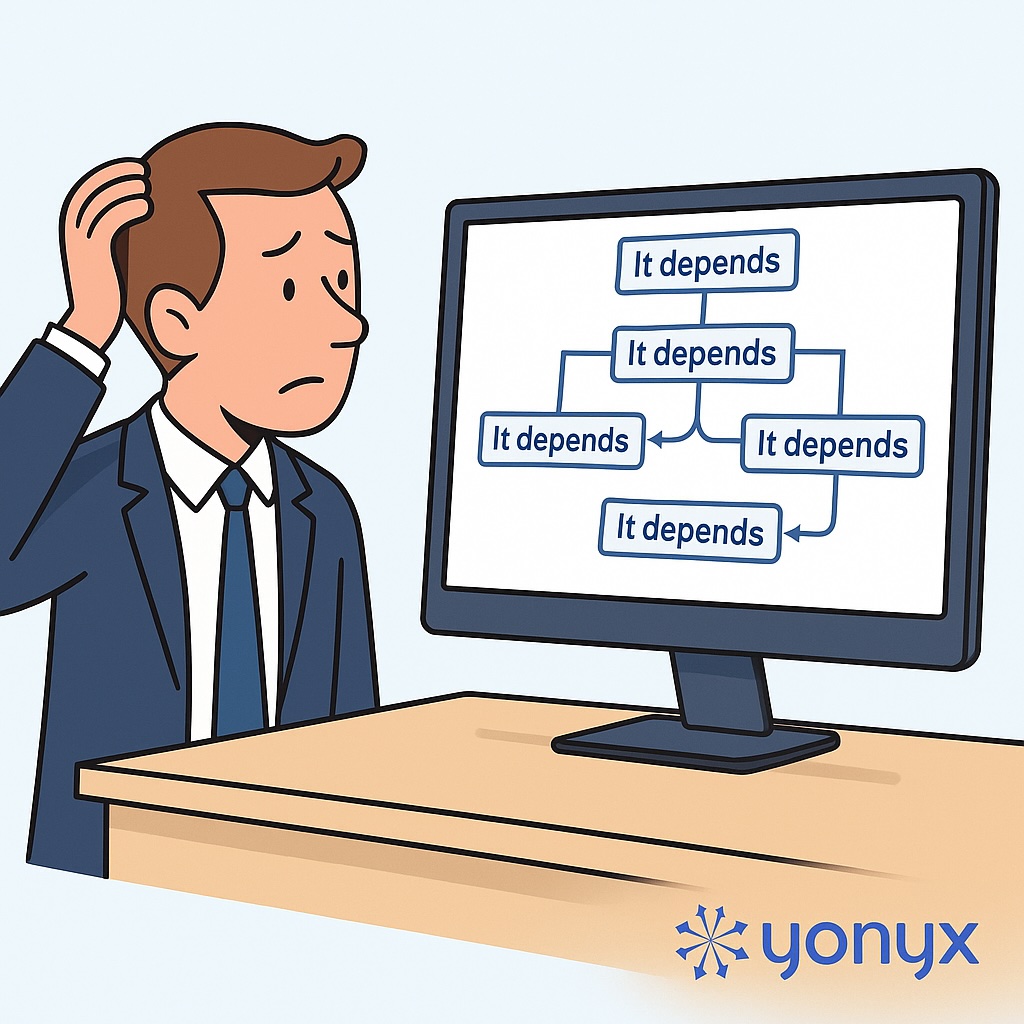
Every troubleshooting flow is designed to give clear answers — steps, outcomes, branches, logic. But every once in a while, you encounter the rarest of responses: a decision tree that seems to shrug and say, “It depends.”
For support teams and customers alike, it’s a moment of both humor and honesty. Because sometimes, the correct next step truly does depend on factors the system can’t assume on its own.
Why “It Depends” Isn’t a Wrong Answer
In customer support, few problems are truly binary. Systems differ. Environments differ. User actions differ. What worked yesterday may not work today, and what works for one customer may fail for another.
When a decision tree says “It depends,” it’s not avoiding the answer — it’s prompting the user to provide the one piece of context the system must know before giving accurate guidance. Instead of guessing, it pauses and asks.
The Moment a Decision Tree Needs Clarification
Decision trees excel because they follow a carefully structured path created by subject matter experts. But those experts also know when a workflow becomes conditional. A single input — version, setting, hardware type, prior action — can change the entire direction of troubleshooting.
Rather than making assumptions, a well-designed flow surfaces that branching moment. It invites the user to specify what applies before revealing the precise steps to follow.
Why This Is Better Than AI Guessing
AI systems often fill in missing information by making educated guesses. Sometimes they’re correct. Other times they generate a confidently stated mistake. That improvisation can be entertaining in a chat window, but it’s dangerous in a support environment where accuracy matters.
Unlike AI, decision trees avoid imaginative answers. If the right solution depends on a condition that hasn’t been identified, the tree stops, requests clarity, and only then proceeds with a validated path. No hallucinations. No assumptions. No risks.
Clarity Comes From Structure
Decision trees aren’t designed to predict everything — they’re designed to guide correctly. That guidance is built on steps that have been tested, verified, and refined over time. When a flow pauses to ask for context, it’s ensuring precision rather than improvisation.
Far from being a flaw, those conditional prompts are what make decision trees reliable tools for customer support, onboarding, sales, field operations, and internal processes.
Conclusion
When your decision tree says “It depends,” it’s not hesitating. It’s doing exactly what it was built to do: avoid incorrect assumptions and guide the user down the right path.
In a world full of improvising AI systems, structured logic that pauses for clarity isn’t just refreshing — it’s essential.