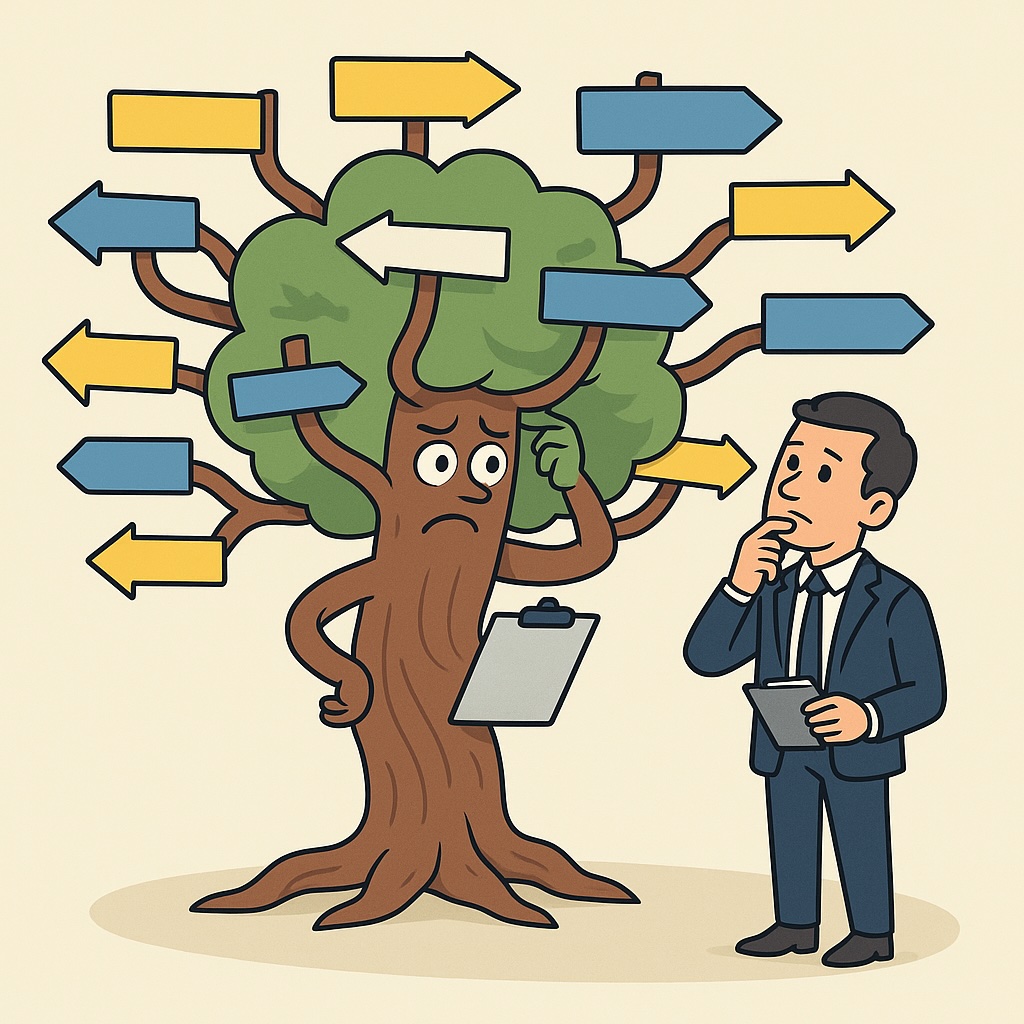
Every support agent eventually encounters a moment where the decision tree seems to be thinking a few steps ahead—sometimes too far ahead. The image for this article captures that feeling perfectly: a tree covered in arrows, looking just as confused as the person inspecting it.
But beneath the humor, there’s an important truth about why structured troubleshooting works so well.
When a Decision Tree Knows More Than the User
Decision trees often appear to “predict” what a customer is about to do—or about to do wrong. That’s not magic, and it’s not AI hallucination. It’s the accumulated wisdom of every agent, every customer, and every mistake that has ever happened in that workflow.
In other words: if the tree seems oddly intuitive, it’s because someone before you has already taken that incorrect turn, clicked that wrong button, or skipped that critical step. The tree simply remembers.
Why Troubleshooting Needs Structure
Without a decision tree, support teams rely on tribal knowledge—informal, inconsistent, and impossible to scale. Two agents may give two completely different answers to the same question. Customers may feel like they’re solving a mystery instead of resolving an issue.
Structured troubleshooting—especially when powered by an interactive decision tree—helps remove that uncertainty. Every agent follows the same logic. Every customer gets the same clarity. And every workflow evolves over time as new scenarios are discovered.
Decision Trees Learn From Experience
The humorous image highlights a serious point: decision trees look complex because they contain the accumulated intelligence of every path, failure, correction, and improvement. Unlike AI, they don’t hallucinate. They don’t guess. They don’t improvise. They document what experts already know to be true.
That makes them one of the most reliable tools in customer support, field service, sales, and onboarding.
Turning Complexity Into Confidence
A good decision tree doesn’t overwhelm—it guides. At first glance, the branching logic may look complicated, but once you follow the steps, everything becomes simpler, faster, and more predictable.
For teams that depend on accurate information and consistent workflows, that reliability is game-changing.
Conclusion
Decision trees may look intimidating, but they’re simply the result of hard-earned knowledge captured in a structured format. The next time one seems to know exactly what you will do next, remember: it’s not judging you. It’s remembering everyone who came before.
And if it prevents you from taking the wrong turn—well, maybe it is smarter than all of us.