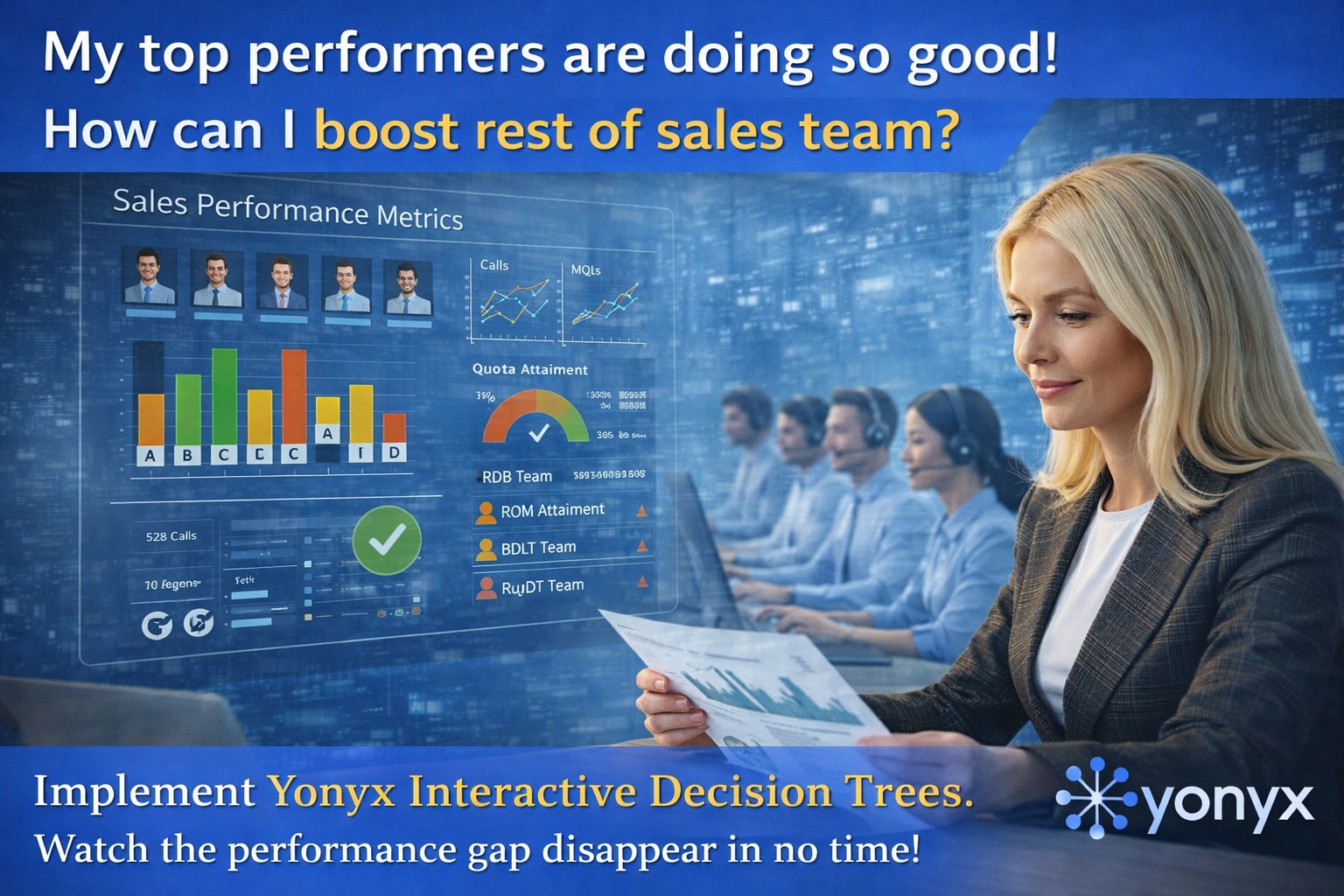
Decision Trees Close the Sales Performance Gap
Decision trees for sales enablement help close the performance gap between top performers and the rest of the sales team by turning best practices into repeatable execution.
Every sales leader encounters the same challenge: a small group of top performers consistently exceeds quota, while the rest of the team struggles to reach the same level of effectiveness. Despite investing in training sessions, playbooks, and coaching, performance gaps often persist. The problem is rarely effort or intent—it is inconsistent execution during live sales conversations.
Why Top Performers Outperform the Rest
Top sellers excel because they instinctively ask the right questions, qualify prospects thoroughly, and handle objections with confidence. These behaviors are learned through experience, but they are often undocumented, inconsistently taught, or difficult to apply in real time. As a result, only a few reps operate at peak effectiveness, while others are left guessing during critical moments.
Turning Best Practices Into Repeatable Workflows
Interactive decision trees capture the proven conversational paths used by top performers and make them available to every BDR and sales rep. Instead of relying on memory or improvisation, reps are guided step by step through discovery questions, qualification criteria, objection handling, and next-best actions. This ensures consistent execution across the team, regardless of experience level.
Faster Ramp Time for New Hires
Decision trees significantly reduce ramp time for new sales hires. Rather than learning through trial and error, new reps gain immediate confidence by following structured, guided conversations. This reduces early-stage mistakes, improves message consistency, and ensures that no critical questions are missed during customer interactions.
Guardrails for Experienced Sellers
Even experienced reps benefit from decision trees. In high-pressure situations, seasoned sellers can skip steps or make assumptions. Decision trees act as guardrails, ensuring best practices are followed consistently without limiting authenticity or flexibility. The result is more predictable outcomes and higher-quality sales conversations.
Combining Guided Sales With Self-Service
Many organizations complement guided sales workflows with self-service tools like AskYourFAQ.com, which helps prospects find accurate answers before engaging with a sales rep. This reduces friction and allows sales conversations to start at a higher level of intent.
Scaling Sales Success With Decision Trees
Scaling sales performance isn’t about cloning top performers—it’s about systematizing what makes them successful. By implementing Yonyx Interactive Decision Tree(s), sales leaders can standardize execution, shorten ramp time, and steadily eliminate performance gaps across their teams.