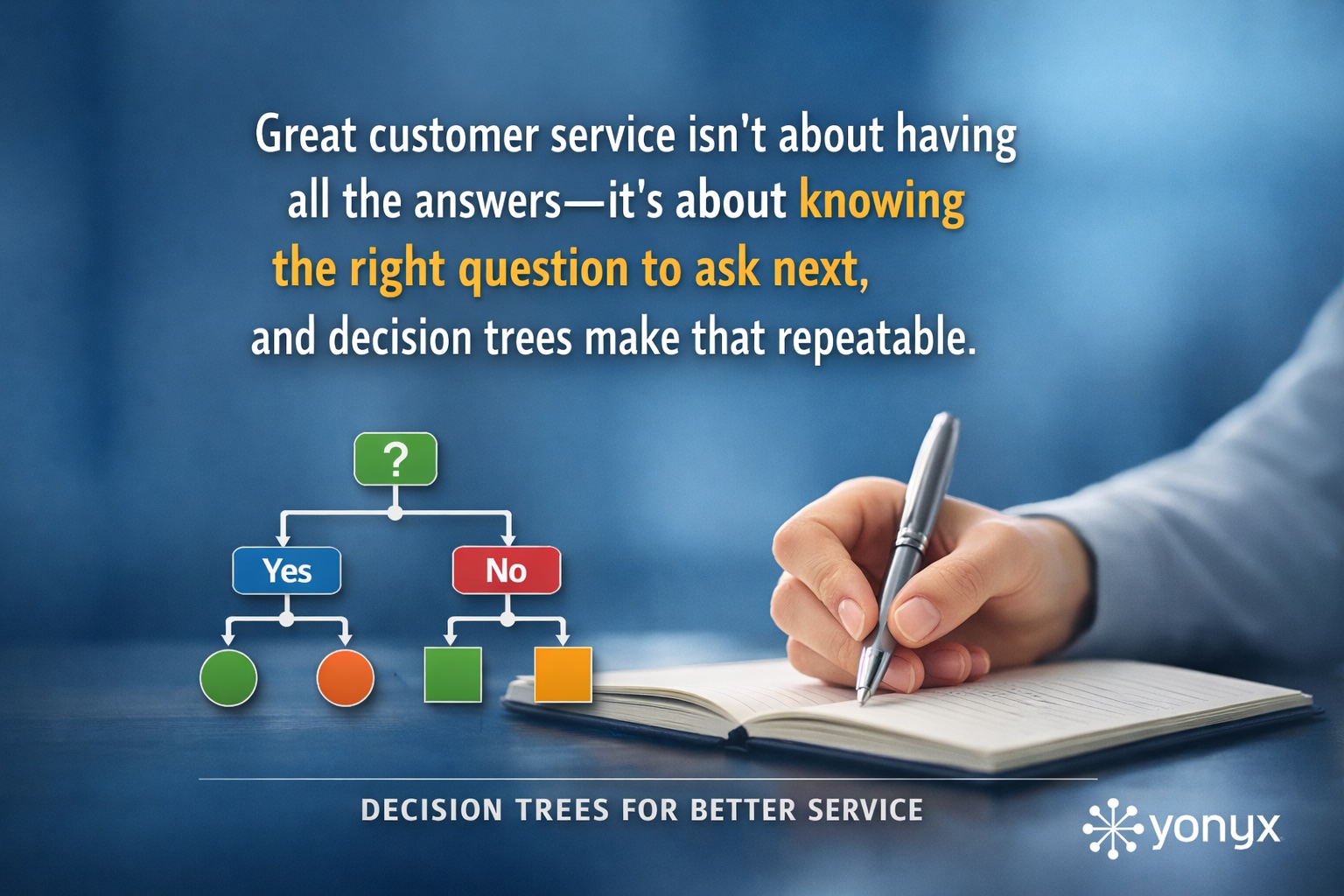
Great customer service isn’t about having all the answers—it’s about knowing the right question to ask next, and decision trees make that repeatable.
In customer service, confidence doesn’t come from memorizing every possible answer. It comes from having a structured way to navigate uncertainty. Customers rarely arrive with perfectly articulated problems, and agents rarely have the luxury of time to “figure it out as they go.” This is where decision trees fundamentally change the game.
A decision tree turns a complex support interaction into a guided conversation. Instead of guessing, agents follow a logical sequence of questions that narrow down the issue step by step. Each question is purposeful, and each response determines the next best action. The result is consistency, clarity, and faster resolution—regardless of who is handling the interaction.
Without decision trees, customer service often relies on tribal knowledge. Experienced agents perform well, while newer agents struggle, leading to longer handle times and inconsistent outcomes. Customers sense this immediately. When an agent hesitates or jumps between unrelated questions, trust erodes. A decision tree eliminates this uncertainty by ensuring every agent follows the same proven path.
Decision trees also reduce cognitive load for agents. Instead of holding multiple possibilities in their head, they can focus on listening to the customer and asking the next right question. This improves accuracy and creates a calmer, more confident interaction—especially during high-pressure or emotionally charged support scenarios.
From an operational standpoint, decision trees make customer service scalable. They enable faster onboarding, easier updates to support processes, and measurable improvements in resolution rates. When policies change or new products are introduced, updating a decision tree is far more effective than retraining entire teams from scratch.
Ultimately, customers don’t judge support by how much an agent knows. They judge it by how quickly and confidently their issue is resolved. By embedding structured logic into every interaction, decision trees ensure that great service isn’t dependent on individual heroics—it’s built into the process itself.
That’s why modern customer service teams increasingly rely on Yonyx Interactive Decision Tree(s) to deliver consistent, high-quality support at scale.