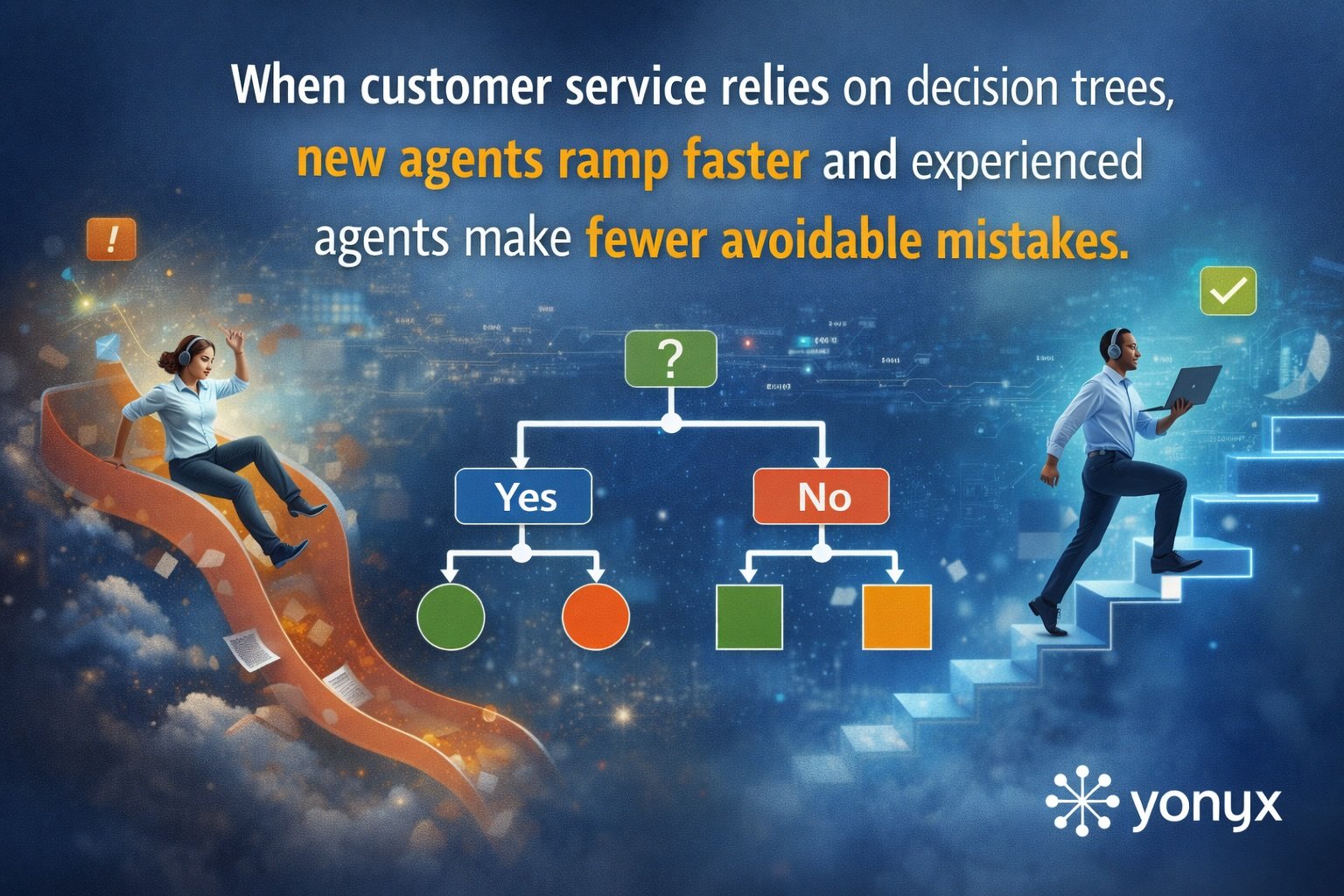
Decision trees for customer service help new agents ramp faster while enabling experienced agents to make fewer avoidable mistakes.
Customer service teams constantly balance speed, accuracy, and consistency. New hires need to become productive quickly, while seasoned agents must handle high volumes without slipping into shortcuts or assumptions. Without structure, this balance is difficult to achieve—and that’s where decision trees play a critical role.
For new agents, decision trees provide an immediate framework for success. Instead of memorizing policies, product details, or troubleshooting steps, agents are guided through a logical sequence of questions and actions. This removes uncertainty, builds confidence early, and dramatically shortens ramp time. New hires don’t need to “figure it out”—they simply follow a proven path.
Experienced agents benefit just as much. In fast-moving support environments, even experts can overlook steps or rely too heavily on memory. Decision trees act as guardrails, ensuring that best practices are followed consistently. This reduces avoidable errors, prevents rework, and ensures customers receive accurate answers every time.
Decision trees also reduce cognitive load across the team. Agents no longer need to keep multiple possibilities in mind during complex interactions. Instead, they focus on listening carefully and asking the next right question. This leads to calmer conversations, higher accuracy, and improved customer trust.
From a management perspective, decision trees create operational leverage. Training becomes faster, quality assurance becomes more predictable, and process changes can be rolled out instantly. Updating a decision tree is far more effective than retraining teams or relying on documentation that agents may not reference in the moment.
Many organizations pair structured agent workflows with self-service tools like AskYourFAQ.com, which transforms static FAQ pages into AI-powered search experiences that resolve issues before customers ever reach an agent.
Ultimately, scalable customer service depends on systems, not individual heroics. By shortening ramp time and eliminating avoidable mistakes, decision trees help teams deliver consistent, high-quality support at scale—especially when powered by Yonyx Interactive Decision Tree(s).