
Customer service roles are evolving into something more intuitive, fast, and human, thanks to AI. It’s no longer just about resolving tickets; it’s about understanding people and their needs. Behind every instant reply or smart suggestion, AI is quietly learning, predicting, and helping teams deliver more value with less effort.
Rather than replacing agents, AI is redefining customer service roles, allowing professionals to focus on empathy, creativity, and problem-solving. This shift isn’t distant or theoretical; it’s happening now, reshaping how every interaction unfolds and how service teams grow with technology.
How AI Is Changing Customer Service
AI is quietly reshaping how customer service roles function, streamlining workflows, improving accuracy, and making support more responsive across every channel.
Automating Routine Tasks
Many customer service requests repeat: password resets, delivery updates, ticket sorting, and FAQ replies. Automation handles these tasks at scale so agents can focus on issues that need context or human judgment.
Advanced automation capabilities:
- Intent detection: Classifies what the customer wants and triggers the correct workflow automatically.
- AI-based routing: Sends inquiries to the right team or agent based on topic, urgency, or complexity.
Example: A retail brand uses an AI chatbot to give instant delivery updates, while intent detection routes product-related issues directly to support specialists.
Key benefits:
- Consistency: Stable, aligned responses across all channels.
- Efficiency: Shorter wait times and fewer manual steps.
- Better focus: Agents spend more time on complex, high-value problems.
Automation streamlines routine service tasks and improves overall support capacity.
Providing 24/7 Service
Customers expect support anytime, anywhere, and AI delivers exactly that. With chatbots and virtual assistants, businesses can offer round-the-clock help across multiple time zones and languages.
Example: A global travel platform uses AI-powered chat to assist travelers with booking changes or check-in issues, even at 2 AM.
Why It Matters:
- Always available: AI never sleeps, ensuring customers are never left waiting.
- Cost-effective: Reduces the need for large overnight teams.
- Scalable: Handles thousands of queries simultaneously.
This level of 24/7 AI customer support has become essential for maintaining customer satisfaction and continuous engagement.
Personalizing Interactions
Customers crave recognition and relevance, and AI makes personalization scalable.
AI analyzes:
- Past purchase history
- Browsing behavior
- Communication tone
- Preferences and feedback
With this data, it tailors messages, product suggestions, and even tone of voice.
Example: A streaming service uses AI to suggest shows a user might love based on viewing history and sentiment from previous ratings.
What It Achieves:
- Predictive personalization: Anticipates needs before customers voice them.
- Higher loyalty: Personalized service builds trust and emotional connection.
- Smarter recommendations: AI learns and adapts with each interaction.
AI-driven CX is no longer a luxury; it’s the foundation of memorable customer experiences.
The Human + AI Partnership
Effective customer service combines machine efficiency with human judgment. Each side contributes distinct strengths.
What AI does:
- Delivers fast responses
- Analyzes data and detects patterns
- Flags sentiment shifts or frustration
- Suggests next actions or recommended replies
- Routes inquiries to the right team
What humans do:
- Apply empathy and emotional understanding
- Resolve ambiguous or sensitive issues
- Make judgment calls when context is unclear
- Build trust through tone, reassurance, and flexibility
- Handle exceptions, escalations, and high-impact cases
Example
An AI system detects frustration in a customer’s message and drafts a recommended reply. The human agent adjusts the tone, adds reassurance, and guides the customer through the next step.
Takeaway
AI handles analysis, routing, and routine workflows. Humans provide emotional clarity and nuanced decision-making. Together, they create a support model that is efficient, accurate, and human-centered.
Importance of Empathy and Emotional Intelligence
As AI handles speed and accuracy, empathy and emotional intelligence ensure each interaction feels understood, respected, and genuinely human-driven.
Builds Genuine Connection
- Customers remember how they’re treated, not how fast the issue was closed.
- A calm, empathetic response can reduce frustration and create calm in tense situations.
Fills the Emotional Gap AI Can’t Bridge
- AI can read tone and detect sentiment, but only humans can interpret emotion.
- Real empathy helps respond to feelings, not just keywords.
Creates Trust and Loyalty
- Empathetic responses make customers feel seen and valued, increasing long-term satisfaction.
- Loyalty grows when service feels personal, not procedural.
Enhances AI Effectiveness
- Agents with emotional intelligence use AI insights wisely, balancing efficiency with empathy.
- Together, they deliver faster yet more human-centered support.
Defines the Human Advantage
- Emotional intelligence helps agents interpret context and respond with sensitivity, something AI can’t fully grasp.
- It allows service teams to handle nuanced situations, preserve brand empathy, and build genuine human trust even when automation is part of the process.
As AI reshapes the structure of support, the next step is knowing how to use it well, making technology an asset that improves service without losing clarity or control.
How to Use AI Effectively in Customer Service
Using AI effectively isn’t about scale; it’s about precision. When applied the right way, it strengthens workflows, decisions, and the quality of every interaction.
1. Integrate AI with CRM and Support Platforms
- Connect AI to existing platforms so it can access full customer histories and context. This enables precise, real-time responses without customers repeating information.
- Example: An AI assistant can pull recent interactions to personalize replies instantly.
2. Continuously Train AI Models with Real Conversations
- Feed real conversations, feedback, and new scenarios into your system.
- Updated models improve tone detection, intent recognition, and accuracy over time.
- Continuous learning ensures AI stays aligned with changing customer expectations.
3. Set Clear KPIs and Measure Performance
Define metrics that track both efficiency and experience.
Key measures include:
- First-response time
- Resolution accuracy
- Customer Satisfaction (CSAT)
Evaluate where automation is effective and where human support is still required.
Track AI-specific KPIs to understand system quality:
- Automation accuracy
- Containment rate (issues resolved without human involvement)
- Agent-takeover rate (how often humans intervene)
Clear KPIs help teams optimize workflows, refine automation, and deliver more consistent customer experiences.
4. Maintain Human Oversight
- Let AI assist, not decide. Keep humans in control for sensitive or emotional issues.
- Review AI outputs regularly to maintain empathy, tone, and brand consistency.
5. Empower Teams with AI Insights
- Train agents to interpret AI data and use predictive insights to guide conversations.
- When employees understand the “why” behind AI recommendations, they deliver service that’s efficient yet personal.
Before implementation, careful planning ensures AI fits naturally within existing customer service roles and workflows.
Things to Consider When Implementing AI-Powered Customer Service
Implementing AI in customer service isn’t about new tools; it’s about aligning technology, people, and ethics through thoughtful planning, reliable data, and ongoing improvement.
1. Data Accuracy and Reliability
AI performance depends on the quality of the data feeding it. Inconsistent, incomplete, or biased data leads to unreliable outputs.
Risks:
- Incorrect answers
- Misrouted inquiries
- Reinforced bias in recommendations
Planning Steps:
- Audit existing data sources
- Standardize formats and tagging
- Set ownership for data hygiene
2. Privacy and Responsible Data Handling
Customer data must be protected, stored correctly, and used within clear boundaries.
Risks:
- Compliance violations
- Loss of customer trust
- Misuse of sensitive information
Planning Steps:
- Define data-access rules
- Apply encryption and retention controls
- Review compliance requirements (GDPR, CCPA, etc.)
3. Ethical and Explainable AI Practices
Users and employees should understand how the system works and why it makes certain decisions.
Risks:
- “Black box” behavior
- Undetected bias
- Difficulty resolving escalations
Planning Steps:
- Document decision logic
- Build monitoring dashboards for anomalies
- Review AI outputs for fairness and clarity
4. Preparing Teams for Change
Teams need to know what AI will handle and what remains human-led.
Risks:
- Misaligned workflows
- Agent pushback or confusion
- Poor customer handoff between the bot and the human
Planning Steps:
- Train agents on AI capabilities and limitations
- Define clear escalation paths
- Provide ongoing support materials and examples
5. System Compatibility and Integration
AI must work smoothly with your CRM, ticketing platform, knowledge base, and analytics tools.
Risks:
- Data silos
- Broken workflows
- Delayed or incorrect responses
Planning Steps:
- Map system connections before deployment
- Test API and data sync reliability
- Set up fallback paths if an integration fails
6. Continuous Monitoring and Refinement
AI performance changes as customer behavior evolves. Regular reviews keep outputs accurate.
Risks:
- Outdated responses
- Declining accuracy over time
- Missed insights on new customer issues
Planning Steps:
- Track KPIs like automation accuracy and fallback rates
- Review decision logs weekly or monthly
- Update training data and workflows as needed
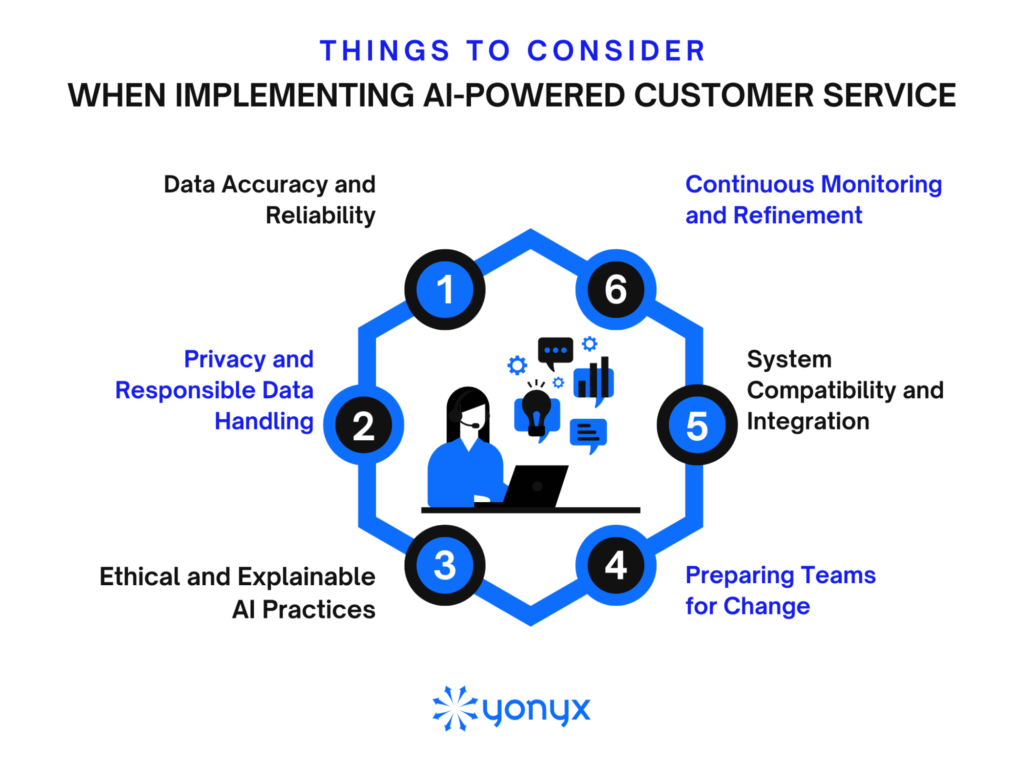
| Key Takeaway: Effective AI implementation requires structured data, transparent practices, trained teams, and dependable system integration. Adding risk controls and clear planning steps ensures the AI improves service quality without interrupting established workflows or customer experience. |
The Future of Customer Service
Customer service roles are no longer defined by who answers a query, but by how intelligently it’s resolved. The shift from human-only support to human + AI collaboration is already shaping daily interactions, faster, clearer, and more contextual. The teams that adapt will be the ones that stay relevant, using AI to strengthen human understanding, not replace it.
Adopt AI to streamline operations, reduce manual workload, and give agents more time for conversations that influence customer loyalty.
Related Reads
How To Use a Decision Tree Template for Customer Support
How To Improve Customer Service in Healthcare
FAQs on AI in Customer Service Roles
1. How can small businesses start using AI in customer service roles?
Start with simple tools like AI chat widgets or automated ticket sorting. They’re affordable, easy to integrate, and can help small teams manage high volumes without hiring additional staff.
2. What skills should customer service agents develop alongside AI adoption?
Agents should strengthen problem-solving, communication, and emotional intelligence. Understanding how to interpret AI data and use digital tools effectively is also key for modern service roles.
3. Can AI improve training for customer service employees?
Yes. AI-driven analytics can highlight knowledge gaps, track agent performance, and provide personalized training modules based on real interactions, helping employees learn faster and perform more confidently.
4. How does AI affect customer feedback management?
AI tools can automatically categorize feedback, detect recurring issues, and summarize sentiment trends, helping teams respond strategically instead of manually sorting every comment.
5. What future trends will shape AI in customer service roles?
Expect growth in conversational AI, real-time emotion detection, and multilingual support tools. These advancements will make AI more adaptive, helping teams offer faster, context-rich, and globally accessible service.