
Customer service is no longer limited to resolving issues. The focus has shifted to preventing them before they affect the customer. Proactive customer service, also known as proactive customer support or proactive customer care, focuses on anticipating what customers might need before they have to ask.
Research shows that 87% of customers appreciate proactive solutions in customer service, which directly boosts satisfaction and loyalty. This shift moves businesses from reactive problem-solving to designing service experiences that remain reliable throughout the customer journey.
When supported by strong monitoring, clear communication, and appropriate technology, proactive service reduces friction, builds trust, and minimizes avoidable frustrations. From proactive IT support to personalized outreach, the goal of proactive services is to create reliability that customers can feel.
This approach does not replace human support. It strengthens it and creates a more thoughtful, timely, and attentive customer experience.
What Is Proactive Customer Service?
Proactive customer service means helping customers before they ask for help. It’s about noticing problems early and taking action to fix them before they turn into complaints.
Instead of waiting for customers to contact support, the company reaches out first. This could mean sending a quick update, solving a technical issue in advance, or sharing useful information that prevents confusion.
The goal is simple: to make the customer’s experience smooth and worry-free. A business that works this way shows that it understands its customers and truly cares about their time and comfort.
Real-World Examples
- SaaS company: The platform detects an unusual spike in error logs or downtime and immediately notifies users: “We’re aware of a temporary issue, and our team is already on it.” By the time users read the message, the company has likely started addressing the root cause.
- Bank: A system flags a transaction pattern that looks out of place and alerts the customer instantly: “We noticed an unusual purchase attempt. Please confirm if it was you.” This prevents both financial loss and the stress of discovering it too late.
- Retail brand: A logistics dashboard predicts a delay in delivery. Rather than letting customers wonder where their order is, the company reaches out: “Your package is running a day late, we’ve upgraded your shipping or added a discount for the inconvenience.”
At its core, proactive customer service is a mindset built on anticipation over reaction. It’s not about responding faster; it’s about ensuring there’s less to respond to in the first place.
Proactive vs Reactive Customer Service
Both proactive and reactive customer service are important, but they work in different ways and create very different experiences for customers.
Reactive service is what most people are used to; the company responds after something goes wrong. A customer faces a problem, reaches out for help, and then the business steps in to fix it. It’s necessary and often unavoidable, but it means the customer already felt some level of inconvenience before getting support.
Proactive service, on the other hand, happens before a problem reaches the customer. The company monitors situations, spots risks, and steps in early. This keeps issues small and prevents frustration altogether. It shows attention and care, not because a customer asked, but because the company was already watching out for them.
Here’s a simple way to see the difference:
| Aspect | Proactive | Reactive |
| Timing | Before the issue arises | After the issue occurs |
| Goal | Prevent frustration | Resolve complaints |
| Customer Feeling | Valued and reassured | Heard but possibly frustrated |
| Example | “We noticed your payment didn’t go through. Here’s an easy way to fix it.” | “Why was my payment declined?” |
Benefits of Proactive Customer Service
When a company starts acting before problems appear, the effects reach further than faster replies or fewer tickets. The real benefits are built into the way customers experience reliability.
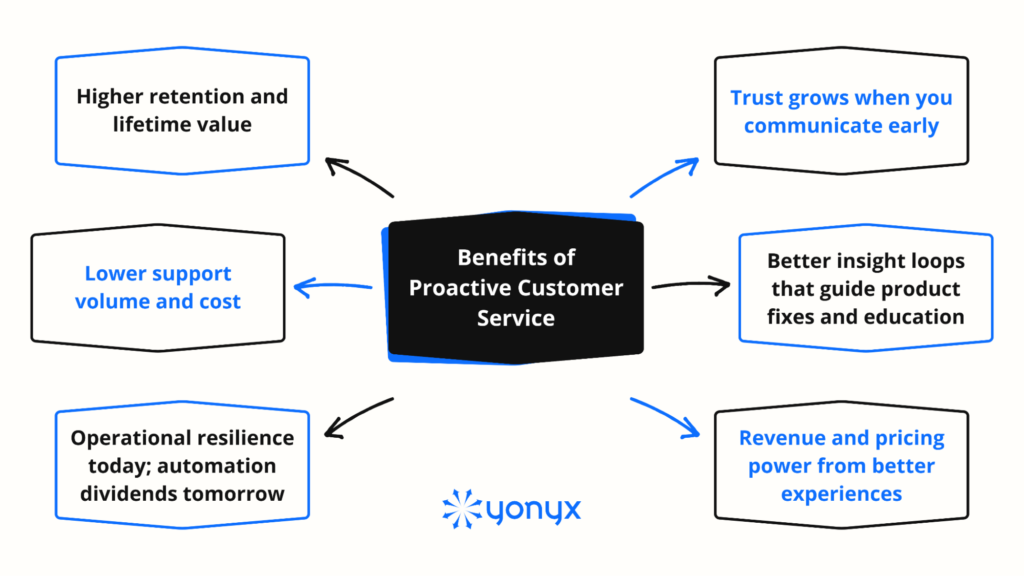
Knowing why proactive service matters sets the stage for the next question: how to make it happen before the customer even notices a problem.
Strategies to Solve Issues Before They Happen
Preventing problems before they reach customers isn’t about luck; it’s about design. Proactive service relies on systems, habits, and communication that keep customers informed and supported at every step. Below are practical ways to make that happen.
1. Automated Alerts & Proactive Monitoring
Tracking performance and user activity to spot unusual patterns before customers notice them.
How to implement: Set up monitoring tools or CRM integrations that track order status, system performance, or account activity. Create triggers that automatically send alerts or updates when issues arise, like failed transactions or delivery delays.
Example: An e-commerce platform detects a shipping delay and automatically emails customers with a new delivery date and tracking link before they contact support.
2. Proactive Communication
Informing customers about changes, updates, or issues before they have to ask.
How to implement: Use scheduled notifications through email, SMS, or in-app messages to share details about planned maintenance, feature updates, or disruptions. Keep the message clear and specific.
Example: A cloud service provider emails users: “We’ll be performing maintenance on Sunday from 2–3 PM. Some services may be briefly unavailable during this time.”
3. Knowledge Base and FAQs
A self-service library where customers can find clear, verified answers to common questions.
How to implement: Regularly review customer queries and support tickets to identify repeating topics. Use this insight to update or expand your knowledge base. Add visuals or step-by-step guides for better clarity.
Example: A software company notices frequent questions about billing settings and adds a short video tutorial to the FAQ, reducing related support tickets by half.
4. Customer Education
Teaching customers how to get the most value from your product or service.
How to implement: Offer tutorials, product walkthroughs, or short onboarding emails that address common learning gaps. Focus on real user challenges instead of generic feature lists.
Example: A digital marketing platform sends a three-step onboarding email to new users explaining how to set up their first campaign, reducing first-week support requests.
5. Customer Surveys
Gathering insights directly from customers to detect early friction or dissatisfaction.
How to implement: Send short, event-based surveys after interactions or milestones. Combine responses with behavioral data to identify problem patterns and prioritize fixes.
Example: A subscription app sends a quick two-question survey after each billing cycle. When multiple users mention confusion about pricing, the team updates its invoice design and adds a billing FAQ.
6. Personalized Outreach
Reaching out to customers with tailored guidance or reminders that improve their experience.
How to implement: Use CRM data to segment customers by behavior or activity level. Send customized messages offering help, tutorials, or suggestions that fit their usage.
Example: A productivity app notices that a user hasn’t used its “task automation” feature and sends a short guide showing how it can save time, encouraging re-engagement.
How Technologies Help Proactive Customer Service
Behind every seamless customer experience is a layer of technology quietly doing the hard work of prediction, connection, and coordination.
AI and Predictive Analytics
AI helps detect patterns that people might overlook. By studying customer actions, usage habits, and past data, it can spot early signs of problems, like reduced engagement or login failures. This allows teams to act before issues grow, turning AI into a steady, behind-the-scenes support partner.
- Predictive analytics platforms can study usage patterns and highlight early indicators of risk or dissatisfaction.
- Machine learning tools like Microsoft Azure Machine Learning can be used to build custom risk detection models for churn or issue prediction.
- Integrate AI-driven dashboards into CRM systems to automatically surface high-risk accounts or performance anomalies.
CRM Integrations
A connected CRM brings all customer details, interactions, preferences, feedback, and past issues into one view. With unified data, teams can spot unusual patterns early, like delayed orders or rising support requests. This shared visibility helps them respond faster and consistently, without losing context between departments or communication channels.
- Use integrated CRMs like HubSpot, Salesforce Service Cloud, or Zoho CRM to unify data from sales, support, and marketing.
- Add workflow automations that flag inconsistencies or trigger alerts based on customer activity (e.g., low engagement, missed delivery updates).
- Enable API connections with support tools (like Zendesk or Freshdesk) to ensure real-time updates and cross-department collaboration.
Chatbots and Automation
Chatbots can do more than reply quickly; they can anticipate what customers might need. When someone visits a help page, a chatbot can offer guided steps or ask clarifying questions. Automated reminders for renewals or new features make support timely and relevant, offering help before it’s requested.
IoT Monitoring
IoT monitoring enables real-time tracking for connected products like smart devices or machinery. When sensors detect unusual activity, they instantly alert both the company and the customer. This quick response reduces downtime and shows that the company is attentive and reliable, not waiting for problems to be reported.
- Implement AI chatbots using Intercom, Drift, or Zendesk Answer Bot to deliver proactive prompts and contextual help.
- Set up automation triggers for renewals, billing, or feature usage via HubSpot Workflows or Zapier.
- Combine bots with live agent handoff to ensure complex issues still get personal attention without losing momentum.
Omnichannel Platforms
Omnichannel platforms connect all customer communication channels, email, chat, phone, and social media, into one unified system. This ensures every interaction stays consistent and informed. When a customer switches from email to chat, agents already have the full context, creating smooth, continuous support and eliminating the need for repeated explanations.
- Use IoT management platforms such as AWS IoT Core, Azure IoT Hub, or Google Cloud IoT to monitor product health and performance remotely.
- Integrate alert systems that automatically generate service tickets or customer notifications when anomalies are detected.
- Connect IoT data with CRM or analytics tools to map service responses directly to affected users or assets.
Turning Anticipation into Customer Confidence
Proactive customer service changes from reacting to anticipating. When businesses act early, spotting issues, communicating clearly, and using technology with purpose, they prevent disruptions before they surface.
This approach focuses on consistent, reliable execution rather than showmanship. The result is steadier relationships built on awareness, trust, and consistency, where customers feel that their experience is cared for, not managed.
Related Reads
40+ Proven Customer Service Script Examples for Difficult Situations
How To Improve Customer Service in Healthcare
FAQs on Proactive Customer Service
1. What makes customer service proactive?
Proactive customer service focuses on anticipating and addressing potential issues before customers report them. It involves using data, technology, and communication to identify risks early, like delays or errors, and taking steps to fix or inform customers, ensuring a smoother and more reliable experience overall.
2. Why is proactive customer service important for businesses?
It helps reduce support requests, builds trust, and strengthens loyalty. When customers see a company acting before problems occur, it signals competence and care. Over time, this leads to fewer escalations, better satisfaction scores, and stronger long-term relationships with customers.
3. How can small businesses offer proactive customer service?
Small businesses can start simply, by tracking common issues, sending early updates about orders or changes, and maintaining clear self-service resources. Even basic tools like automated emails or surveys can make a big impact by keeping customers informed and showing attentiveness.
4. What technologies support proactive customer service?
AI tools, CRM systems, chatbots, IoT monitoring, and omnichannel platforms are key enablers. They help companies predict issues, centralize data, automate alerts, and maintain consistent communication. When used together, these technologies create a connected, real-time service experience that feels effortless to customers.
5. How can proactive service improve customer loyalty?
By preventing frustrations before they surface, customers feel respected and secure. Proactive service shows that the brand values its time and experience. This builds emotional trust, a foundation for loyalty, where customers are more likely to stay, repurchase, and recommend the brand to others.