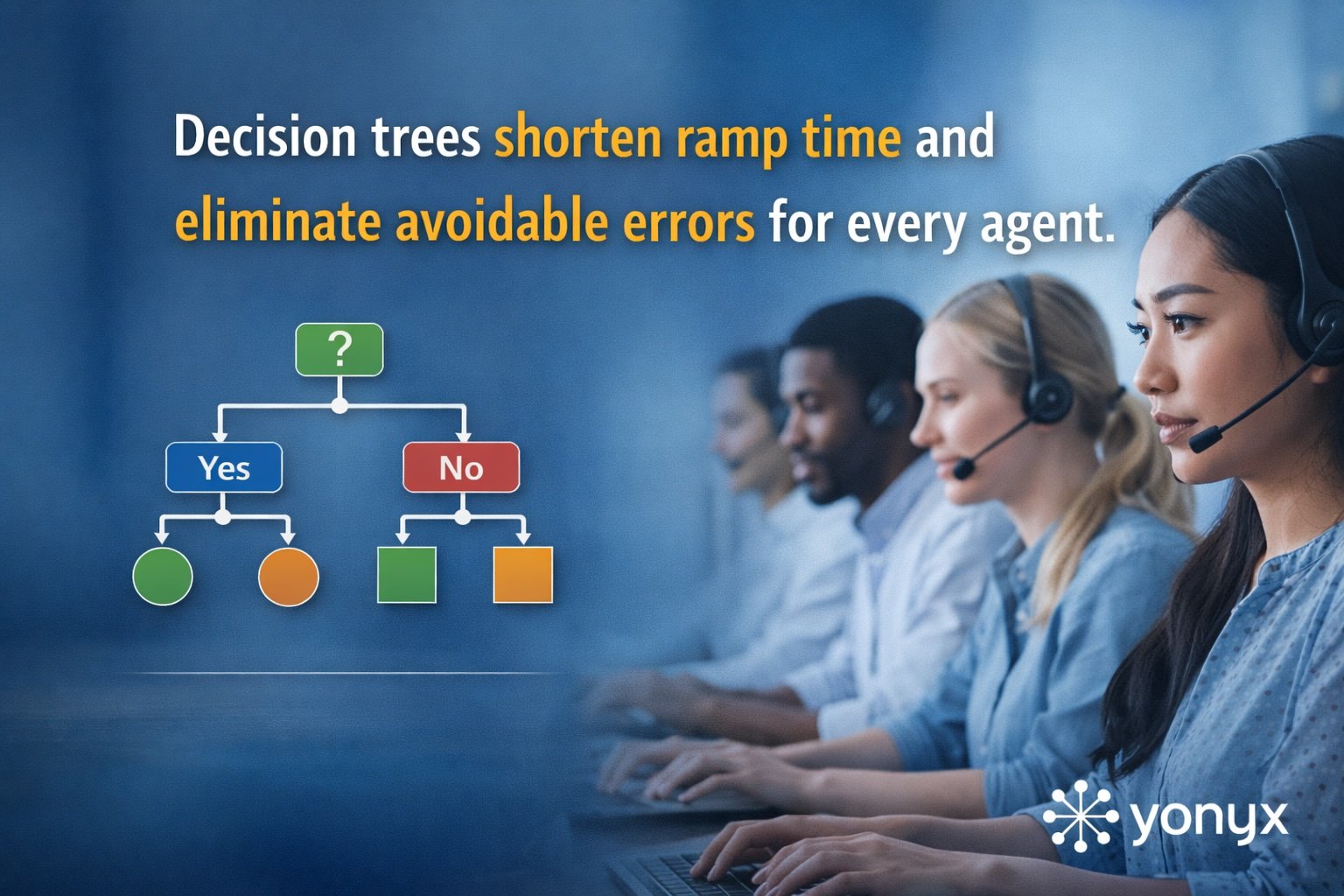
Decision Trees That Reduce Ramp Time and Errors eliminate avoidable errors for every agent by bringing structure and consistency to customer service workflows.
One of the biggest challenges in customer service is variability. New agents struggle to ramp up quickly, while experienced agents—despite their knowledge—still make avoidable mistakes under pressure. This inconsistency directly impacts customer experience, handle time, and operational costs. Decision trees address this problem at its root.
For new agents, decision trees act as a built-in mentor. Instead of memorizing policies, product details, or troubleshooting steps, agents are guided through a clear sequence of questions and actions. Each step builds confidence and ensures the conversation stays on track. As a result, ramp time is dramatically reduced, and new hires begin handling real customer interactions sooner and more effectively.
Experienced agents benefit just as much. In fast-paced support environments, even seasoned professionals can skip steps, assume answers, or overlook edge cases. Decision trees remove guesswork by enforcing proven best-practice paths. This consistency minimizes errors, reduces rework, and ensures that every customer receives the same high-quality service—regardless of who answers the call.
Decision trees also lower cognitive load. Agents no longer need to juggle multiple possibilities in their head or rely on memory during complex interactions. Instead, they can focus on listening to the customer, building rapport, and asking the next right question. This leads to calmer interactions and more accurate resolutions.
From a management perspective, decision trees create operational leverage. Training becomes faster, quality assurance becomes easier, and updates to processes can be rolled out instantly across teams. Rather than retraining entire departments, organizations can simply update the decision logic and ensure every agent follows the new standard immediately.
Ultimately, scalable customer service depends on systems—not heroics. Decision trees make expertise repeatable, reduce ramp time, and eliminate avoidable errors across teams. That’s why modern support organizations rely on Yonyx Interactive Decision Tree(s) to deliver consistent, high-quality customer experiences at scale.
In addition to decision-tree–driven agent workflows, many teams also use AskYourFAQ.com to turn static FAQs into AI-powered search experiences that reduce agent load before a ticket is ever created.