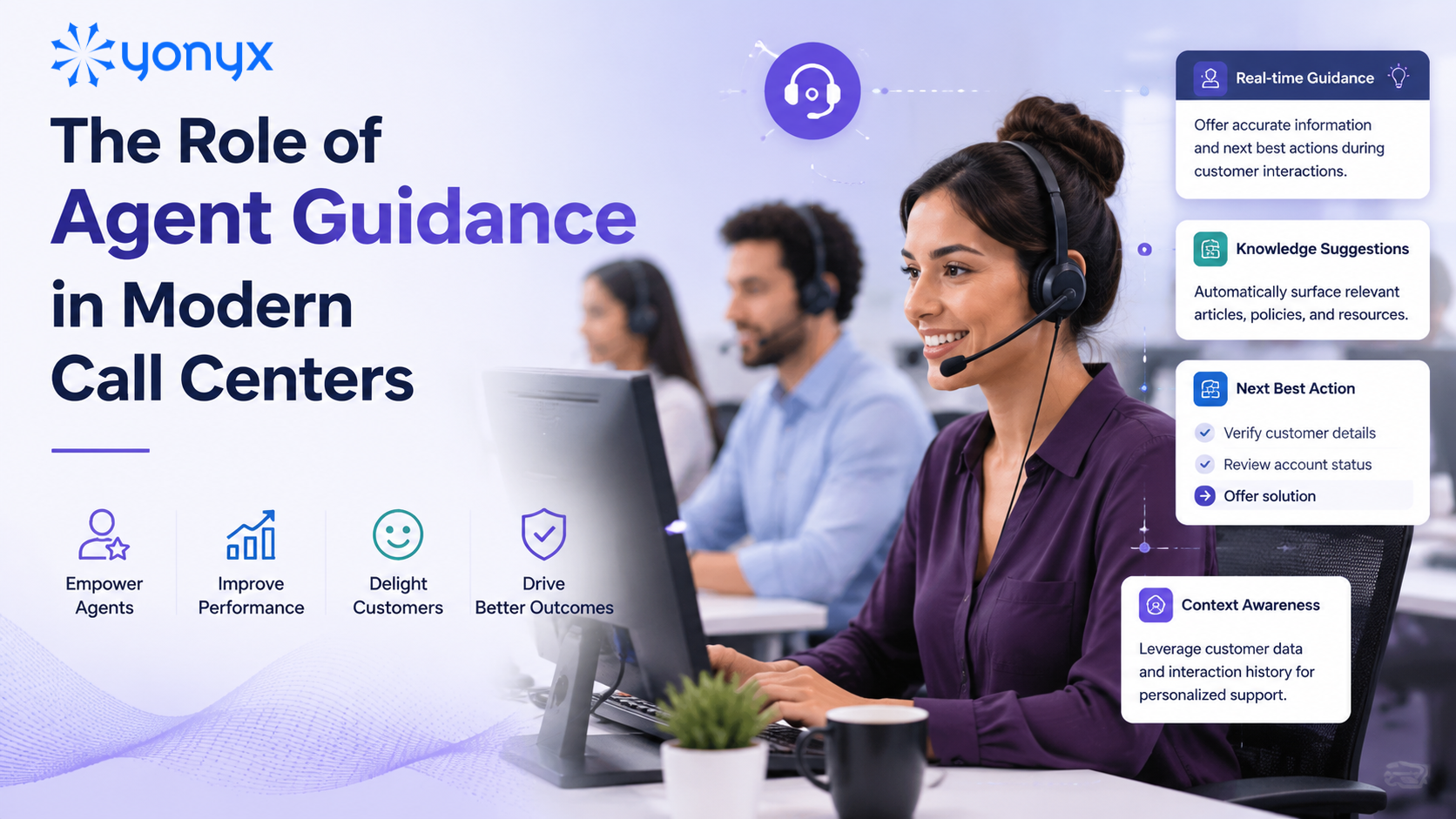
Agent guidance in modern call centers uses real-time AI, contextual knowledge, workflow automation, and live coaching to help representatives resolve customer issues accurately and efficiently. It provides agents with the right information, recommended action, or compliance instruction during an interaction rather than requiring them to search multiple systems or rely on memorized scripts.
Modern call center agent assist tools can transcribe conversations, identify customer intent, detect sentiment changes, retrieve relevant knowledge, recommend next steps, complete approved tasks, and automate post-call documentation.
The result is not simply faster calls. Effective agent guidance helps contact centers improve resolution quality, reduce agent effort, maintain compliance, and deliver more consistent customer experiences.
| Quick Answer: Why Agent Guidance Matters in Modern Call Centers? By embedding expert workflows into every interaction, agent guidance standardizes service quality, shortens ramp time, improves compliance, and helps teams resolve complex issues with greater consistency and confidence at scale. |
What Is Agent Guidance in a Call Center?
Agent guidance is a framework for providing frontline representatives with contextual support before, during, and after customer interactions.
It typically includes:
- Customer history and case context
- Real-time prompts and suggested responses
- Relevant knowledge base articles
- Troubleshooting workflows
- Compliance reminders
- Sentiment and escalation alerts
- Next-best-action recommendations
- Automated call summaries and CRM updates
Unlike traditional scripts, real-time agent guidance adapts to what the customer is saying. It can change its recommendations as the conversation, customer intent, account data, or emotional tone changes.
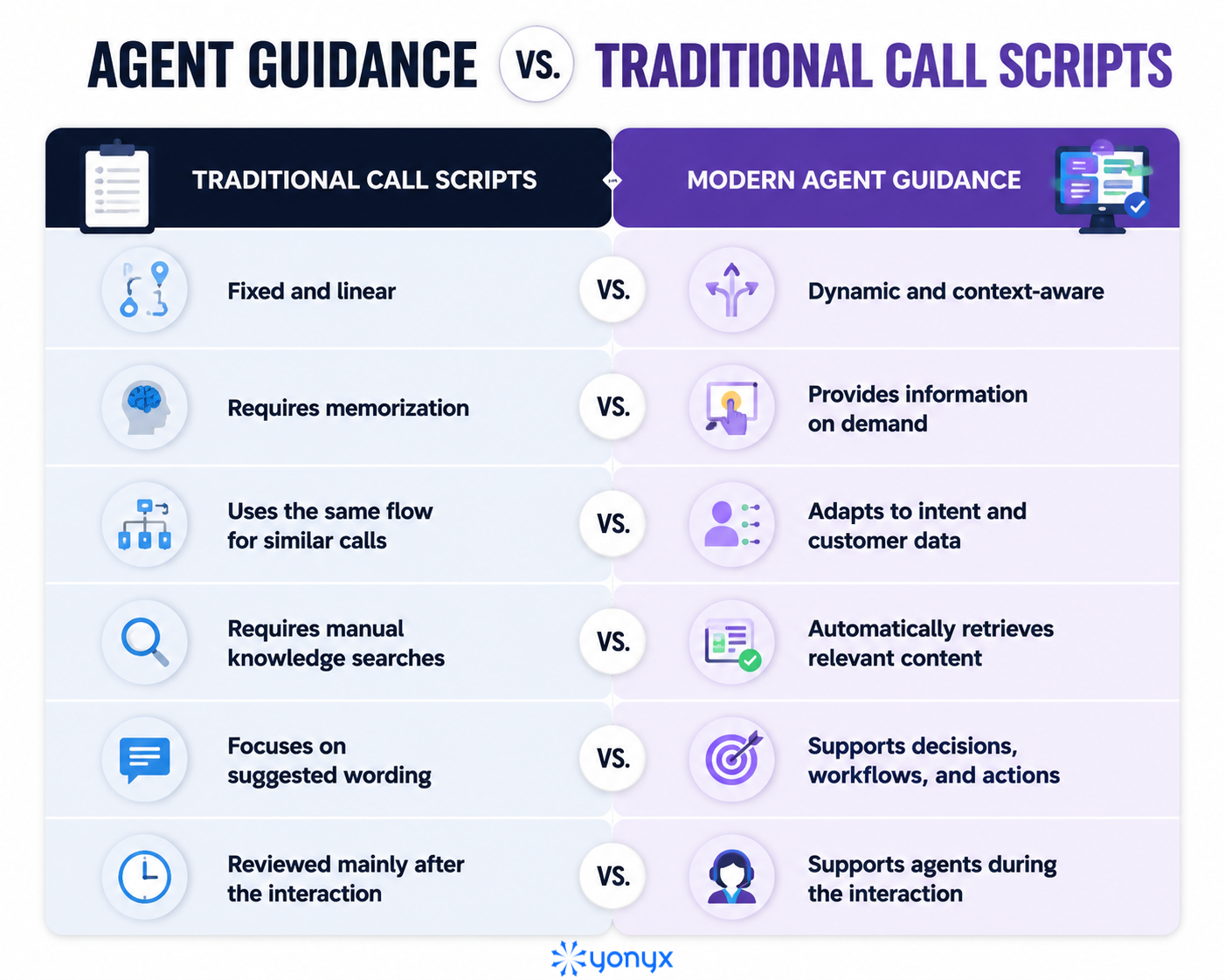
Scripts remain useful for mandatory disclosures and standardized processes. However, they cannot provide the flexibility required for complex customer situations.
Why Is Agent Guidance Important?
Today’s agents frequently handle the difficult interactions that self-service systems cannot resolve. These calls may involve multiple previous contacts, billing disputes, technical issues, cancellation requests, or regulatory requirements.
At the same time, agents may need to navigate a CRM, ticketing platform, knowledge base, order system, payment platform, and communication interface.
This creates significant cognitive load.
Contact center agent guidance reduces that burden by bringing information and actions into the agent’s active workflow. Instead of asking agents to remember every policy or search several applications, the system presents the most relevant support at the moment it is needed.
Its strategic value can be summarized in four areas:
- Decision support: Helps agents determine the appropriate next step.
- Knowledge delivery: Surfaces reliable information without manual searching.
- Process consistency: Reinforces approved workflows and disclosures.
- Task automation: Reduces repetitive administrative work.
A Practical Perspective: Agent Guidance Compresses Decision Time
The biggest advantage of agent guidance is not automation alone. It is decision compression.
An agent may already have access to the required information, but finding it, validating it, and deciding how to use it takes time. Agent guidance shortens that process by connecting customer context, approved knowledge, and the recommended action in one place.
How Does Real-Time Agent Guidance Work?
A typical AI agent assist system follows six steps.
1. The Interaction Is Transcribed
The system processes a voice or digital conversation as it happens. Real-time transcription creates structured text that AI systems can evaluate.
Amazon Connect, for example, supports partial transcript streams designed for low-latency applications that assist agents during live calls.
2. Customer Intent and Context Are Identified
Natural language processing can recognize important conversation details, including:
- The reason for contact
- Product or service names
- Order information
- Cancellation intent
- Billing problems
- Account verification requirements
The system may combine these signals with CRM information and previous interaction history.
3. Sentiment and Escalation Signals Are Evaluated
Sentiment analysis in call centers evaluates language and conversational patterns to identify possible frustration, confusion, or dissatisfaction.
When negative sentiment rises, the system may suggest an empathy statement, recommend a de-escalation technique, or notify a supervisor. Amazon’s conversational analytics, for example, can analyze sentiment, contact themes, conversation characteristics, and potential compliance risks.
Sentiment analysis should be treated as a supporting signal, not a definitive assessment of a customer’s emotional state.
4. Contextual Guidance Is Displayed
The agent may receive:
- A suggested answer
- A relevant knowledge article
- A troubleshooting step
- A required disclosure
- A verification reminder
- An objection-handling prompt
- An escalation recommendation
- A next-best-action
The guidance should be brief, clearly prioritized, and easy to dismiss when it does not fit the situation.
5. Approved Workflows Are Triggered
Advanced platforms move beyond recommendations and help execute tasks.
Depending on permissions, an agentic AI in contact centers may:
- Update customer information
- Initiate a refund
- Reschedule a delivery
- Create a support case
- Process an approved account change
- Record details in the CRM
Microsoft describes contact center AI agents as tools that can automate routine tasks, assist representatives, collect context, and transfer conversations to human agents with the interaction history intact.
High-risk actions should still require agent or supervisor approval.
6. Post-Call Work Is Automated
After the interaction, the system can generate:
- A conversation summary
- CRM notes
- A disposition recommendation
- A wrap-up code
- Follow-up tasks
- Quality assurance data
This reduces after-call administration while creating more consistent customer records.
Core Technologies Behind Agent Guidance
Real-Time Agent Assist and AI Copilots
An AI copilot for call centers provides contextual support inside the agent workspace. It can answer questions, retrieve knowledge, summarize conversations, and recommend actions.
The copilot should complement the agent’s judgment rather than dictate every response.
Sentiment and Speech Analytics
Speech analytics examines conversation transcripts and acoustic signals to identify topics, customer concerns, silence, interruptions, and sentiment changes.
Supervisors can also receive real-time alerts when predefined phrases or conditions occur during a conversation.
Agentic AI and Workflow Automation
Traditional agent assist tells the representative what to do. Agentic AI can complete part of the process.
A responsible automation model progresses through five levels:
- Retrieve information
- Recommend a response
- Initiate a workflow
- Complete an action after approval
- Execute approved low-risk actions autonomously
Not every process should reach the fifth level.
Unified Agent Desktops
A unified workspace combines telephony, messaging, CRM data, tickets, knowledge, customer history, and AI recommendations.
This centralized agent desktop reduces system switching and makes guidance easier to use during live conversations.
Automated Quality Assurance
Automated quality assurance can review a much broader share of customer interactions than manual sampling alone.
It can evaluate:
- Required disclosures
- Process adherence
- Communication behaviors
- Customer sentiment
- Documentation quality
- Coaching opportunities
Human reviewers remain necessary for calibration, disputed scores, nuanced conversations, and complex performance decisions.
How Agent Guidance Supports the Interaction Lifecycle
Before the Interaction
Guidance prepares the agent with:
- Customer history
- Previous contact reasons
- Open cases
- Relevant account information
- Predicted customer intent
During the Interaction
The system provides live answers, workflows, compliance reminders, sentiment alerts, and recommended actions.
During an Escalation
Agents may receive de-escalation prompts or assistance from a supervisor through whisper coaching. Complete conversation context can also be passed during transfers, reducing the need for customers to repeat information.
After the Interaction
The system summarizes the conversation, updates connected records, creates follow-up tasks, and sends interaction data for quality review.
Between Interactions
Agents may receive contextual microlearning based on recent calls, recurring mistakes, policy changes, or quality results.
Which Call Center Metrics Can Agent Guidance Improve?
| Metric | Potential impact of agent guidance |
| First-Call Resolution | Provides complete information and actions during the first interaction |
| Average Handle Time | Reduces searching, system switching, and manual documentation |
| Customer Satisfaction | Supports accurate, timely, and more personalized responses |
| Agent Ramp Time | Helps new agents work without memorizing every process |
| After-Call Work | Automates summaries, notes, and dispositions |
| Transfer Rate | Helps agents resolve more issues without unnecessary escalation |
| Compliance Adherence | Reinforces disclosures and verification requirements |
| Quality Scores | Promotes consistent behaviors and processes |
Contact centers should not evaluate success through Average Handle Time alone.
A slightly longer interaction that completely resolves the issue may be more valuable than a short call that results in a repeat contact. First-Call Resolution, CSAT, compliance, transfer rate, and repeat contact rate should be assessed alongside AHT.
Benefits for Agents, Customers, and Managers
Understanding how agent guidance impacts every stakeholder helps demonstrate its broader business value. Here’s how agents, customers, and managers each benefit from a well-implemented guidance solution.
| For Agents | For Customers | For Supervisors |
| Faster access to approved information | Shorter holds | Earlier visibility into difficult interactions |
| Less dependence on memorization | Fewer repeated explanations | More targeted coaching opportunities |
| Fewer application switches | More consistent information | Wider QA coverage |
| Reduced administrative work | Faster issue resolution | Better identification of recurring problems |
| Greater confidence during complex calls | Better-informed agents | Reduced manual evaluation work |
Common Risks and Implementation Challenges
While agent guidance offers significant benefits, successful implementation requires addressing common challenges that can affect user adoption, accuracy, performance, and long-term effectiveness.
Information Overload
Too many prompts can distract the agent and disrupt the conversation. Guidance should prioritize essential information rather than display every possible recommendation.
Incorrect or Outdated Knowledge
AI assistance is only as reliable as the knowledge supporting it. Outdated policies, duplicate documents, and unclear ownership can produce incorrect recommendations.
Each knowledge item should have an owner, approval status, review date, and source.
Over-Reliance on AI
Agents may follow an unsuitable recommendation because the system appears authoritative. Organizations must train representatives to challenge guidance when it conflicts with the customer’s situation or approved policy.
Privacy and Security
Real-time transcription and analysis may involve sensitive customer information.
Deployment should address:
- Encryption
- Role-based access
- Data retention
- Sensitive-data redaction
- Consent requirements
- Data residency
- Audit logs
- Vendor data-use policies
Employee Trust
Agents should understand what data is collected, how performance scores are generated, and how automated evaluations affect coaching or employment decisions.
Agent guidance should be positioned as support, not invisible surveillance.
How to Implement Agent Guidance Successfully
1. Identify High-Friction Work
Review where agents spend time searching, switching systems, documenting calls, or asking supervisors for help.
2. Start With a Defined Use Case
Strong initial use cases include:
- Knowledge retrieval
- Call summarization
- Compliance reminders
- Guided troubleshooting
- CRM documentation
3. Improve Knowledge Governance
Remove duplicate or outdated content. Assign ownership and establish clear review schedules before connecting AI to the knowledge base.
4. Integrate Core Systems
Connect the guidance platform with the CRM, contact center software, ticketing system, knowledge base, and relevant workflow tools.
5. Keep Guidance Brief and Explainable
Agents should be able to see why a recommendation appeared and which approved source supports it.
6. Define Automation Boundaries
Specify which tasks can be automated, which require agent approval, and which require supervisor involvement.
7. Pilot and Measure
Test the system with a controlled group. Measure recommendation accuracy, adoption, agent feedback, customer outcomes, compliance, and error rates.
8. Continuously Calibrate
Review rejected prompts, incorrect recommendations, workflow failures, and knowledge gaps. Agent feedback should directly influence future guidance.
Final Thoughts
Agent guidance connects customer context, organizational knowledge, workflow automation, and human expertise.
Its role extends far beyond presenting scripts. Effective guidance helps agents understand what is happening, determine what should happen next, and complete the required work without navigating disconnected systems.
The strongest implementations share three characteristics:
- Guidance is relevant and easy to understand.
- Knowledge and recommendations are reliable.
- Agents retain control over complex decisions.
When these principles are followed, agent guidance can improve operational efficiency without sacrificing empathy, judgment, or customer trust.
FAQs on The Role of Agent Guidance in Modern Call Centers
1. What is real-time agent guidance?
Real-time agent guidance is AI-powered support delivered to representatives during customer interactions. It may include recommended answers, knowledge articles, workflows, compliance reminders, sentiment alerts, and next-best actions.
2. Does agent guidance replace call center agents?
No. It supports agents by handling information retrieval, documentation, and routine workflow steps. Human judgment remains essential for empathy, negotiation, exceptions, and complex decisions.
3. Can agent guidance reduce Average Handle Time?
It can reduce AHT by limiting manual searches, application switching, hold time, and post-call documentation. AHT should still be evaluated alongside resolution quality and customer satisfaction.
4. What is the difference between agent guidance and a chatbot?
A chatbot communicates directly with customers. Agent guidance primarily supports a human representative behind the scenes during a customer interaction.
5. How should call centers measure agent guidance?
Relevant measures include First-Call Resolution, CSAT, AHT, transfer rate, after-call work, compliance adherence, agent ramp time, recommendation accuracy, adoption, and employee feedback.