

“You need to improve your empathy.”
That might be feedback.
It isn’t coaching.
Useful call center coaching goes several steps further: Where did the conversation lose the customer? What should the agent have noticed? What could they have said differently? Can they practice it now? And did their performance actually improve afterward?
That level of specificity is what separates coaching that changes behavior from coaching that simply checks a box.
Because agents rarely improve from hearing that something went wrong. They improve when they understand what happened, why it mattered, and exactly what to do differently next time.
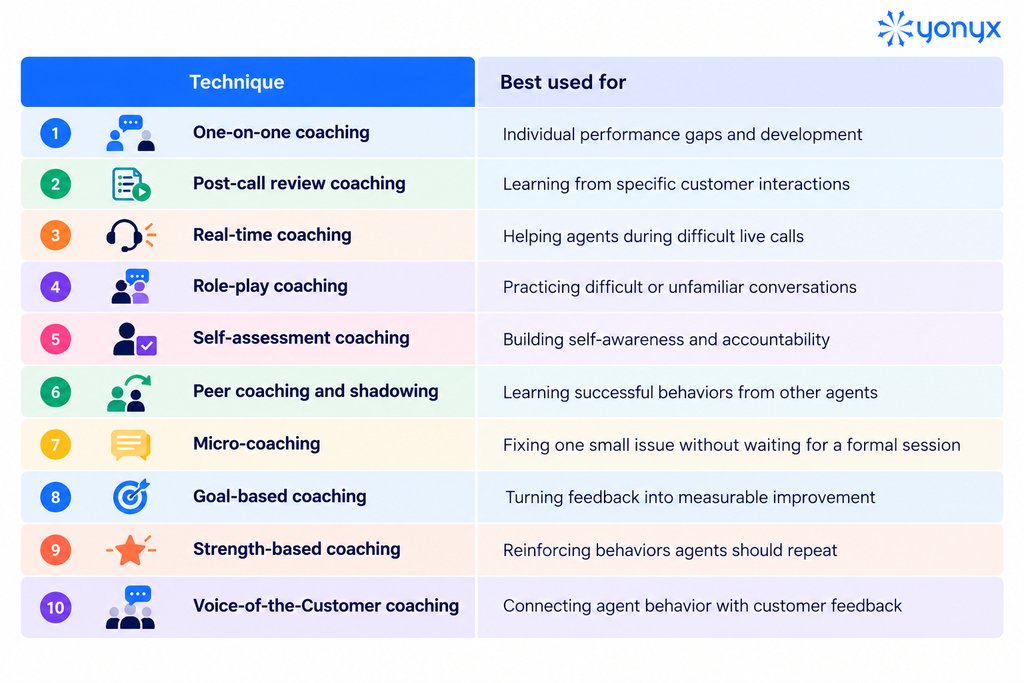
TL;DR: 10 Call Center Coaching Techniques
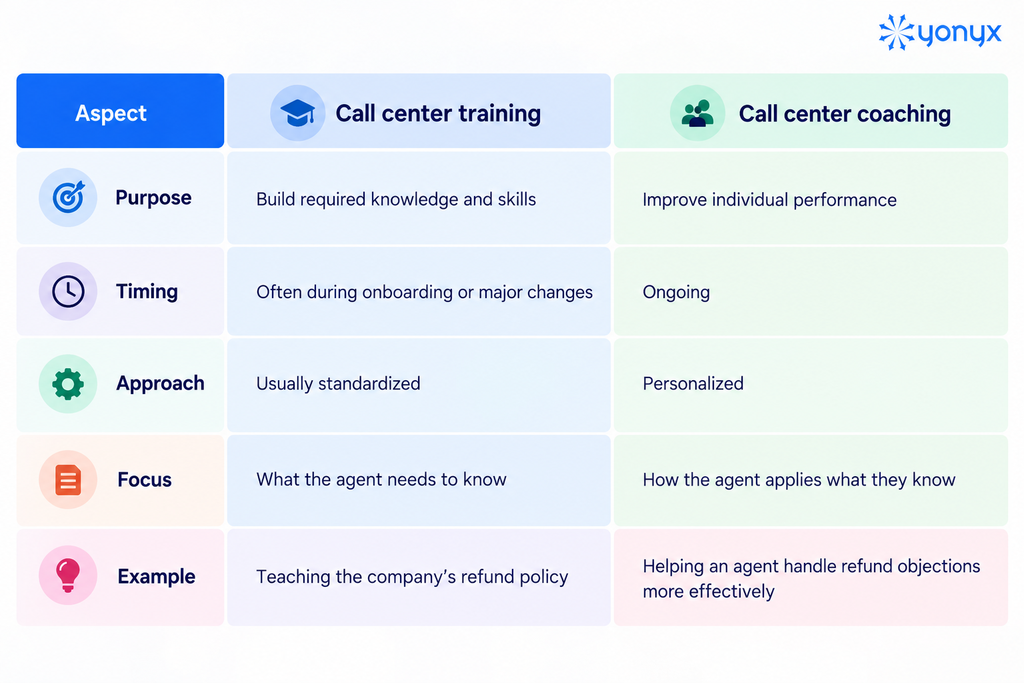
What Is Call Center Coaching?
Call center coaching is the ongoing process of helping individual agents improve specific skills and behaviors through feedback, practice, performance evidence, and follow-up.
Unlike training, which usually teaches employees what they need to know, coaching focuses on how an agent is performing now and what they should improve next.
10 Call Center Coaching Techniques
1. One-on-One Coaching
Best for: Individual performance gaps, development goals, and sensitive feedback.
One-on-one coaching gives managers time to focus on an agent’s specific behaviors without turning the conversation into a comparison with the rest of the team. The strongest sessions are based on evidence from actual interactions rather than general impressions. Start by explaining what you observed, ask the agent how they saw the situation, and agree on one or two behaviors to improve.
Avoid covering too many issues at once. Agents are more likely to apply a clear, focused change than remember a long list of corrections.
Example: An agent frequently interrupts customers. Review one call together and agree that, on future calls, the agent will pause, summarize the customer’s concern, and then respond.
2. Post-Call Review Coaching
Best for: Identifying specific behaviors in real customer conversations.
Post-call coaching turns a completed interaction into a learning opportunity. Instead of telling an agent to “ask better questions” or “show more empathy,” managers can point to the exact moment where the conversation changed.
Let the agent listen first and explain what they think worked or could have gone differently. This keeps the session collaborative rather than making it feel like a manager reading out mistakes.
Focus on the decision or behavior behind the outcome, not just the final QA score.
Example: During a billing call, the agent immediately assumes the problem is an incorrect charge. Pause the recording and ask: “What could you have asked here before deciding what the problem was?”
3. Real-Time or Side-by-Side Coaching
Best for: New agents, high-risk interactions, unfamiliar situations, and immediate correction.
Real-time coaching gives agents support while the customer interaction is still happening. A supervisor may listen to the call, send a private prompt, or sit beside the agent and provide discreet guidance.
It is useful when a mistake can still be prevented, particularly during onboarding or complex calls. But it should not become constant supervision. Too many prompts can increase cognitive load and make the agent dependent on the manager instead of developing confidence.
Use real-time coaching selectively, then review the interaction afterward.
Example: A new agent is about to approve a refund without checking eligibility. The supervisor privately prompts them to confirm the purchase date before continuing.
4. Role-Play Coaching
Best for: Difficult conversations, de-escalation, objections, cancellations, and unfamiliar scenarios.
Role-playing allows agents to practice challenging customer situations without the pressure of a real interaction. The manager, coach, or another agent plays the customer while the learner works through the conversation.
Effective role-play should recreate situations agents genuinely encounter rather than scripted, overly easy scenarios. After the exercise, discuss where the agent hesitated, which questions helped, and what could be phrased differently.
This approach is particularly useful when the problem involves communication rather than factual knowledge.
Example: The manager plays a frustrated customer who has already contacted support twice and now wants to cancel. The agent practices acknowledging the frustration, clarifying the unresolved issue, and offering a clear next step.
5. Self-Assessment Coaching
Best for: Building self-awareness, accountability, and independent problem-solving.
Before telling an agent what went wrong, ask them to assess the interaction themselves. Questions such as “What do you think went well?”, “Where did the conversation become difficult?”, or “What would you do differently next time?” reveal how accurately the agent evaluates their own performance.
This also changes the tone of coaching. Instead of the manager delivering a verdict, both sides work through the interaction together.
Self-assessment works especially well with recorded calls because agents can compare how they remembered the conversation with what actually happened.
Example: An agent notices that the solution was correct but that they spent too long diagnosing the issue. The coaching session can then focus specifically on discovery questions rather than simply telling them to reduce AHT.
6. Peer Coaching and Shadowing
Best for: Sharing proven behaviors and helping agents learn from stronger performers.
Managers do not have to be the only source of coaching. Experienced agents often develop effective ways of explaining complex topics, handling objections, controlling calls, or calming frustrated customers.
Pairing an agent with a strong peer allows them to observe those behaviors in context. Afterward, the two can discuss what happened and why certain approaches worked.
Peer coaching should still follow documented policies and approved processes. Otherwise, teams risk spreading shortcuts or individual interpretations that are inconsistent with company standards.
Example: An agent struggling with objections listens to several calls from a colleague who performs well in that area. They then identify the questions and phrasing the colleague consistently uses before proposing a solution.
7. Micro-Coaching
Best for: Small, specific performance improvements that do not need a formal session.
Not every coaching opportunity needs a 30- or 60-minute meeting. Micro-coaching focuses on one behavior and delivers feedback close to the moment when it happened.
A short, well-timed conversation can be easier for an agent to remember than a long review covering several unrelated issues. It also allows managers to coach more consistently without filling their calendars with formal sessions.
The key is to keep the feedback narrow and actionable.
Example: After reviewing a call, the manager says: “Your explanation was accurate, but the customer had to ask what happens next. On your next few calls, finish your explanation with one clear next step.”
One observation. One change. One follow-up.
8. Goal-Based Coaching
Best for: Turning vague feedback into measurable behavior change.
Goals make coaching useful only when they describe something the agent can actually do. “Improve confidence” or “lower AHT” tells the agent the desired outcome but not how to achieve it.
Instead, define an observable behavior and a reasonable period for practicing it. Managers can then review whether the behavior changed and whether the intended performance outcome followed.
This also prevents coaching from becoming overly focused on numbers.
Example: Rather than telling an agent to “improve call control,” agree that for the next week they will summarize the customer’s issue before moving into troubleshooting. Review several calls afterward to see whether the behavior occurred and whether it reduced unnecessary back-and-forth.
The metric measures the result; the coaching goal changes the behavior.
9. Strength-Based Coaching
Best for: Reinforcing successful behaviors and developing high-performing agents.
Coaching should not happen only when something goes wrong. If every coaching invitation follows a poor QA score, agents quickly associate coaching with failure.
Strength-based coaching identifies behaviors that produced a strong result and helps the agent understand why they worked. Those behaviors can then be repeated intentionally and, where appropriate, shared with the wider team.
This is particularly important for experienced agents who may have fewer obvious performance problems but can still refine their strengths.
Example: An agent successfully de-escalates an angry caller. Rather than simply saying “great job,” the manager points out how the agent slowed the conversation, acknowledged the customer’s frustration, confirmed the problem, and clearly explained what would happen next.
Specific praise is more useful than generic praise.
10. Voice-of-the-Customer Coaching
Best for: Connecting agent behavior with the customer’s actual experience.
Internal QA tells managers whether an interaction followed company standards. Customer feedback provides another perspective: how the interaction actually felt to the person receiving the service.
Use CSAT comments, survey responses, complaint themes, or positive customer feedback as coaching evidence. Then connect that feedback to a specific behavior rather than treating the customer’s score as proof that the agent alone caused the outcome.
Not every bad experience is an agent problem. Product failures, policies, system limitations, or long wait times may also affect the customer.
Example: A customer specifically praises how clearly an agent explained a technical issue. Review that interaction and identify what made the explanation easy to understand so the agent can repeat the approach in future calls.
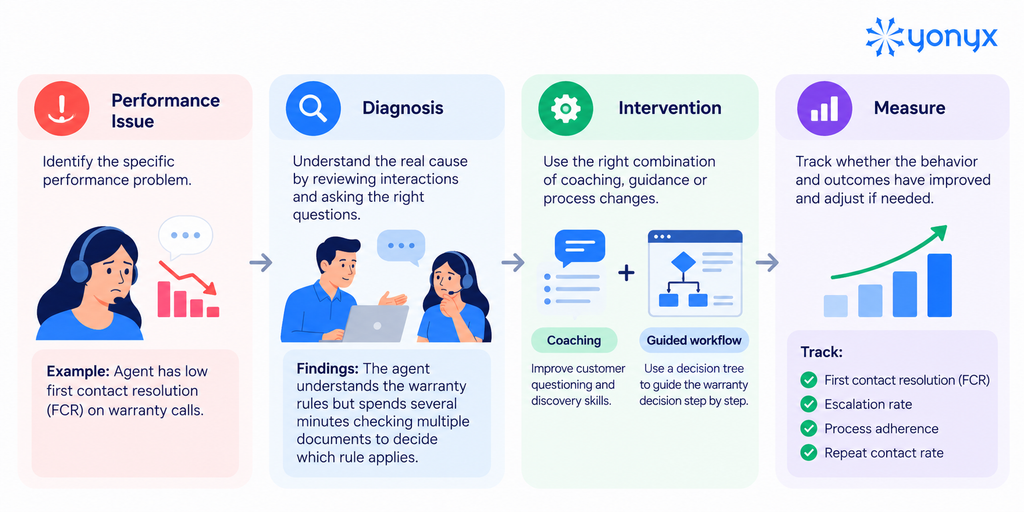
A Quick Example: When Low FCR Is Not Just a Coaching Problem
Suppose an experienced agent has low first contact resolution on warranty calls. A manager initially assumes the agent needs more product coaching.
After reviewing several calls, the manager finds that the agent understands the warranty policy. The real difficulty is checking product type, purchase date, damage category, prior claims, and escalation rules across several documents.
Diagnosis: Part coaching, part process problem.
Coach the agent on the questioning sequence, but use a guided workflow for the repeatable warranty decision. Then measure FCR, escalation rate, and process adherence together.
Which Metrics Should You Use to Measure Coaching?
A metric should help you understand whether the behavior being coached is changing. It should not become the coaching conversation by itself.
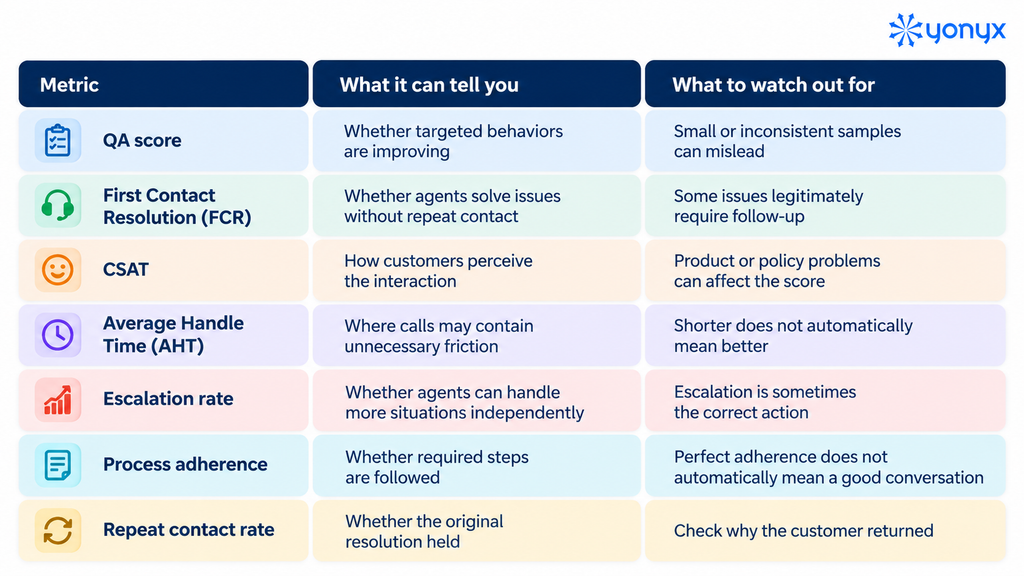
For example, pushing agents to reduce AHT while ignoring FCR can produce shorter first calls and more second calls. ICMI has similarly cautioned against treating AHT as something to minimize at all costs because rushed interactions can hurt resolution quality.
Measure outcomes together, then connect them back to observable behavior.
Common Call Center Coaching Challenges
Most coaching problems are not caused by managers failing to care. They are usually caused by limited time, limited evidence, inconsistent standards, or the wrong diagnosis.
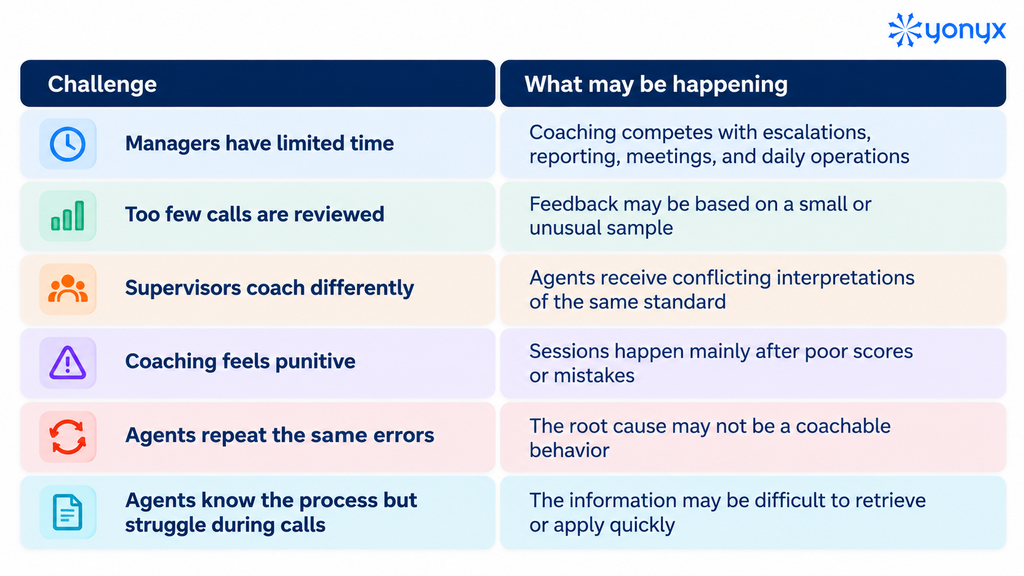
The sampling problem is easy to underestimate. McKinsey found that coaches may review only four to six calls out of the 500–600 an agent handles each month, making it easy to miss the actual pattern. The same research warns against “coaching to a number” without identifying the behavior driving it.
If the same issue keeps returning after coaching, diagnose the cause again instead of automatically scheduling another session.
Can Call Center Coaching Be Replaced by Software?
Not completely. Software can analyze more interactions, identify patterns, surface knowledge, provide prompts, and guide agents through repeatable processes. Human coaching still matters for empathy, communication, judgment, confidence, motivation, difficult conversations, and long-term development.
The more useful question is:
Which parts of the performance problem actually require coaching?
When Coaching Isn’t the Real Solution
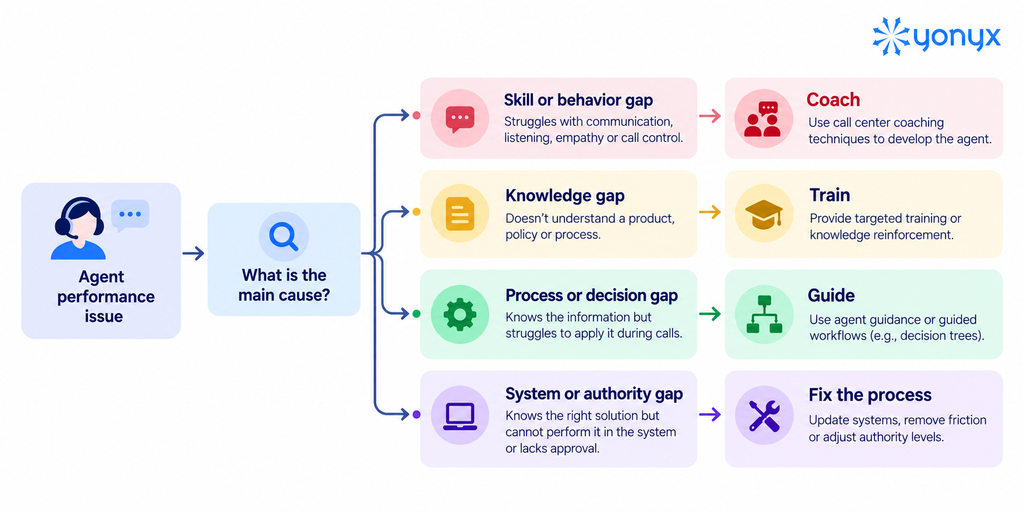
Before scheduling another session, identify what failed.
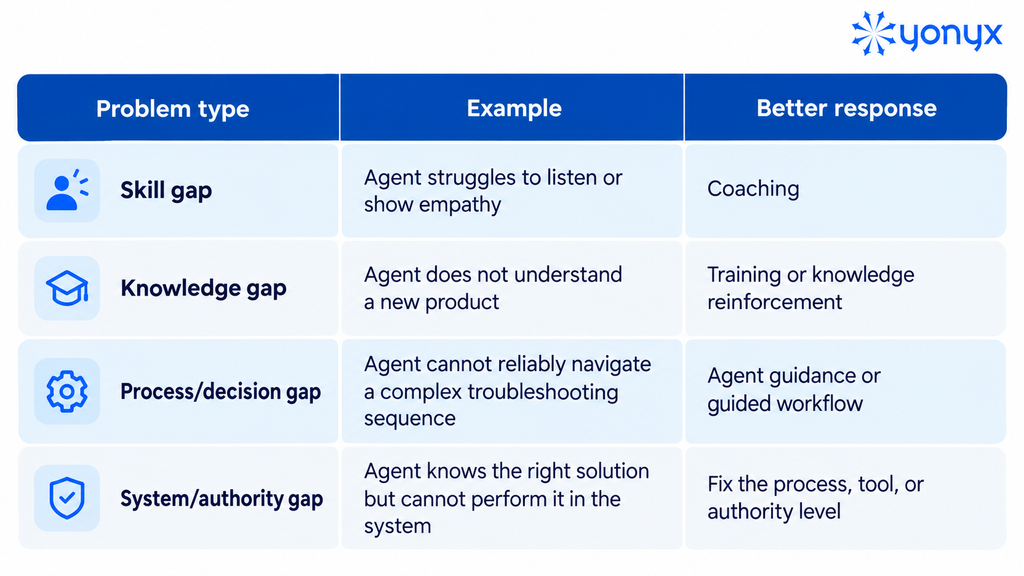
Suppose an agent understands the warranty policy but must search several sources, interpret multiple conditions, and choose the right next step while keeping the customer engaged.
Coaching them to “remember the policy better” does not remove that burden.
This is where guided decision trees for customer service can help. Instead of relying on memory alone, agents move through a defined sequence of questions and actions based on the customer’s situation.
Coaching vs. Agent Guidance
Coaching and agent guidance solve different parts of performance.
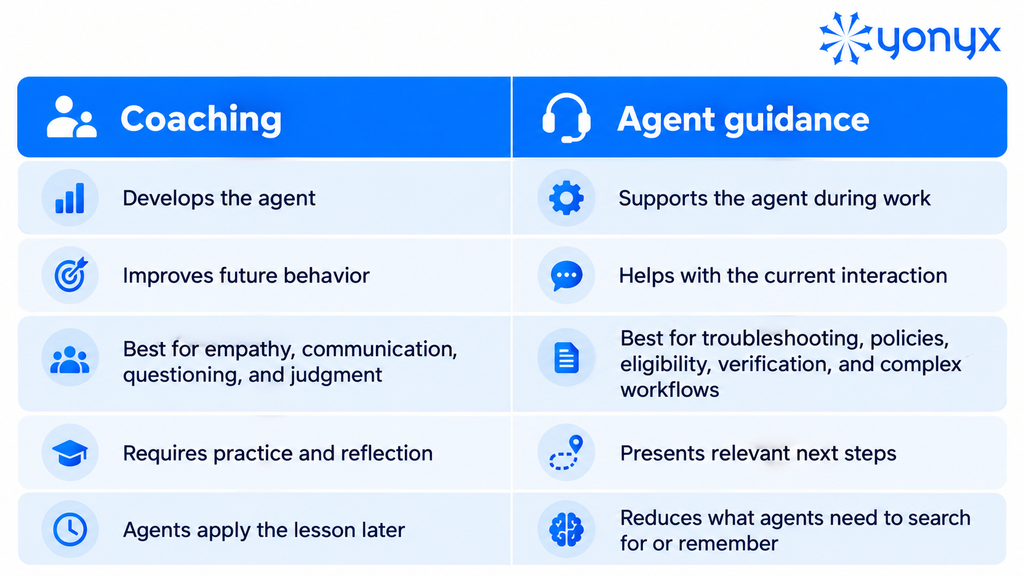
Coach what agents need to learn. Guide what they shouldn’t have to memorize.
Modern agent guidance can surface relevant knowledge, workflow steps, compliance instructions, and next actions during an interaction rather than requiring agents to search multiple systems or rely entirely on memorized scripts.
5 Tools for Call Center Coaching and Agent Performance
These tools solve different layers of the performance problem. The right choice depends on what is actually slowing your team down.
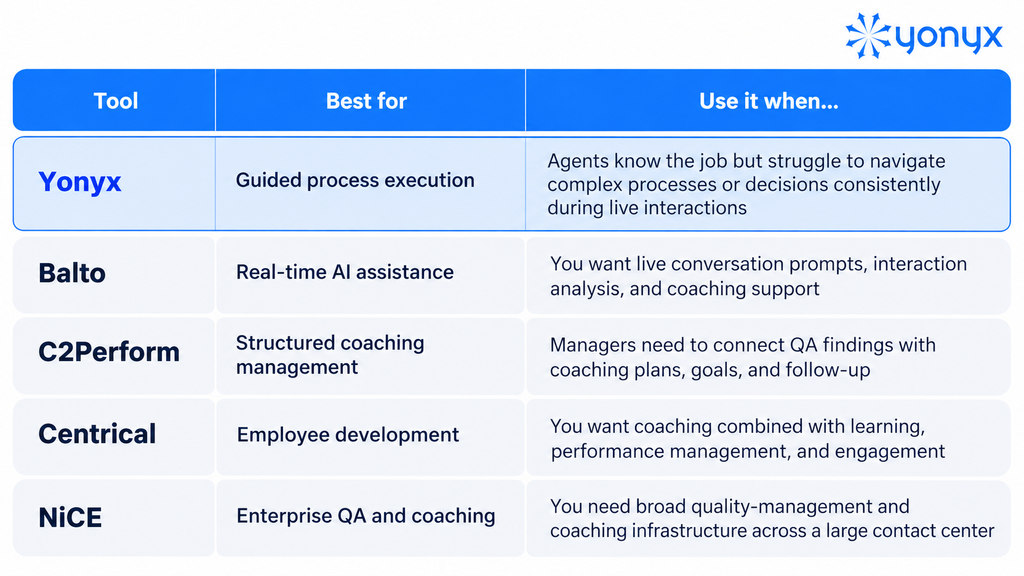
Yonyx sits in a different part of this stack from a dedicated coaching platform. Its interactive decision tree capabilities let teams turn business rules, troubleshooting logic, and scripts into step-by-step guidance. Guides can be embedded in CRM or dialer environments, exchange data with other systems, capture information, and track how workflows are used.
That makes it most relevant when agents already have the knowledge but still spend too much effort searching, remembering, interpreting, and executing complex conditional processes during a call.
If supervisors mainly need a better way to schedule, document, and manage coaching, choose a coaching-focused platform. If agents repeatedly struggle with process execution at the moment of need, guided workflows may address the underlying problem more directly.
Make Your Next Coaching Session More Useful
Effective coaching does not mean coaching more often. It means choosing the right intervention for the right problem.
Before your next session:
- Start with evidence, not assumptions.
- Focus on one meaningful behavior at a time.
- Ask the agent to assess the interaction before giving your opinion.
- Connect feedback to a specific moment or example.
- Agree on what should happen differently next time.
- Measure whether the behavior and outcome actually change.
- If the problem keeps returning, diagnose the cause again.
A skill problem may need coaching. A knowledge problem may need training. A repeatable decision problem may need guidance. And a broken workflow needs to be fixed rather than coached around.
That distinction lets managers spend coaching time where human judgment and development matter most.
Frequently Asked Questions
How often should call center agents receive coaching?
There is no single cadence for every agent. New hires or employees working through a specific performance issue may benefit from weekly coaching, while experienced high performers may need less frequent formal sessions. Coach often enough that feedback is still connected to recent behavior.
How long should a call center coaching session last?
The session should be long enough to understand the issue and agree on a next action. Some problems need only a five-minute micro-coaching conversation, while deeper behavioral or development issues need a longer one-on-one. Specificity and follow-through matter more than duration.
How do you coach remote call center agents?
Use the same principles as in-person coaching: review real interactions, make the discussion two-way, focus on observable behaviors, and document the next action. Shared recordings and video calls help, but remote coaching should not become a stream of automated messages with no manager conversation.
Should high-performing call center agents still receive coaching?
Yes. Coaching should not be reserved for struggling agents. High performers can use it to refine strengths, prepare for more complex interactions, develop leadership skills, or identify successful behaviors that can be shared across the team.
What should a call center coaching plan include?
A simple coaching plan should document the behavior being addressed, evidence from relevant interactions, the expected behavior, the action the agent will take, how improvement will be measured, and when the manager will follow up. Keep it focused enough that the agent knows exactly what to do next.
