
Giving an AI agent permission to issue a refund is easy. Proving that it checked the right conditions first is harder.
Customer service leaders are being pushed to automate more interactions and move AI beyond simple question answering. Gartner found that 91% of service leaders faced executive pressure to implement AI in 2026. Yet customers are not asking companies to remove human support: 87% say access to a person remains essential when generative AI is involved.
Contact centers need autonomy and control at the same time.
An agentic AI framework for customer support must understand requests, retrieve customer data, select tools, and complete tasks. It must also respect verification rules, refund limits, required disclosures, escalation policies, and data permissions.
Without that operational discipline, AI simply acts faster inside the same fragmented processes that already produce inconsistent service. Reliable automation starts with consistent customer support workflows, clear ownership, and rules that can be tested before they reach customers.
| Quick Takeaways: Agentic AI needs clear guardrails, permissions, and escalation rules to operate safely in customer support. AI handles ambiguity; structured workflows enforce policy. Sensitive actions should require verification, approvals, and human oversight. Every action should be traceable through workflow, tool, and outcome records. Success should be measured by resolution quality, compliance, and customer outcomes, not automation rate alone. |
What Is an Agentic AI Framework for Customer Support?
An agentic AI framework is the software foundation used to build AI agents that can interpret a goal, decide what to do next, use external tools, and complete multistep work with limited human direction.
OpenAI defines agents as systems that use a language model to control workflow execution and select tools within defined guardrails. Anthropic distinguishes agents from workflows: an agent dynamically chooses its path, while a workflow follows predefined steps.
Frameworks such as LangGraph, CrewAI, AutoGen, LlamaIndex, Semantic Kernel, and the OpenAI Agents SDK help developers manage state, tool calls, orchestration, handoffs, and monitoring. They provide technical infrastructure. They do not decide how a company’s warranty, identity-verification, or refund policy should work.
For customer support, the definition should reflect both layers:
| An agentic AI framework for customer support enables an AI system to understand a customer’s request, use approved business tools, complete permitted actions, and transfer control when human judgment is required. |
A support agent is not working in a test environment. An inaccurate answer may cause a repeat contact. An unauthorized action can create financial loss, expose customer data, or violate policy.
The Core Components of an Agentic AI Framework
A practical framework contains six components:
- Model: Interprets the request and chooses the next action.
- Memory or state: Retains relevant information across steps.
- Tools: Retrieve information or perform actions in external systems.
- Orchestration: Controls the sequence of model calls, tool use, and handoffs.
- Guardrails: Restrict unsafe, unsupported, or unauthorized behavior.
- Observability: Records agent activity, errors, decisions, and outcomes.
These components may come from one platform or several connected systems. OpenAI’s reference architecture uses models, tools, instructions, orchestration patterns, and layered guardrails as separate design elements.
The operating questions are straightforward: What can the agent read? What can it change? Which steps are mandatory? When must it stop? Who reviews the result?
What Changes When the Framework Serves Customers
A research agent can produce a weak summary without changing a customer’s account. A service agent may have permission to update a subscription, cancel an order, schedule a technician, or submit a refund.
That raises the bar.
A customer support implementation may need the following:
- Identity and account context
- CRM or ticketing-system access
- Eligibility and policy rules
- Required questions and disclosures
- Limits on sensitive actions
- Human escalation conditions
- Customer-facing explanations
- Records of decisions and transactions
Gartner found that 58% of customers using generative AI had used it to complete a task, rising to 74% among B2B customers. Service AI is moving from answering questions to taking action.
Those actions rarely happen in one system. Customer history may sit in a CRM, payment data in a billing platform, policy documents in a knowledge base, and approvals in a back-office application.
Tools that support conditional routing, structured data capture, calculations, and third-party API calls can turn a written procedure into a process that agents and customers can execute step by step.
Why Autonomous Reasoning Is Not Process Compliance
Language models handle ambiguity well. They can interpret vague requests, summarize long case histories, and respond in natural language.
Compliance is a different problem.
An AI agent can produce a sensible answer while skipping an identity check. It can retrieve the correct policy but apply the wrong exception. It can call a tool that is technically available but not appropriate for the case.
Autonomous reasoning can follow policy, but it does not prove that policy was followed.
NIST’s AI Risk Management Framework separates governance, measurement, accountability, and risk treatment from model capability. Trustworthy AI depends on the surrounding system, not the model alone.
Flexibility Becomes Risk When the Outcome Must Be Consistent
A customer might report, “My internet keeps cutting out.” AI can interpret the description, identify possible causes, and ask useful follow-up questions.
The required account and diagnostic checks should not change from one interaction to the next.
Before replacing a router, the process may require the agent to confirm the service status, test a wired connection, verify device indicators, and check warranty eligibility. Before changing an account owner, the system must complete the required identity checks.
Open-ended reasoning belongs where the customer’s language or circumstances are unpredictable. Fixed controls belong where the business already knows which conditions must be met.
Anthropic recommends predefined workflows for well-understood tasks that require predictable execution and advises teams to avoid unnecessary agentic complexity.
Written Policies Are Not Executable Guardrails
Most support organizations already have policies. The problem is that those policies are often stored as documents rather than enforced as processes.
Suppose a refund policy lists three eligibility conditions. Retrieving that policy gives the model useful context. It does not force the agent to verify all three conditions before submitting the refund.
An executable control can
- Require a customer or account value
- Validate an eligibility condition
- Remove an unavailable action
- Apply an approval threshold
- Pause before a transaction
- Route an exception to a supervisor
- Block a path outside the approved process
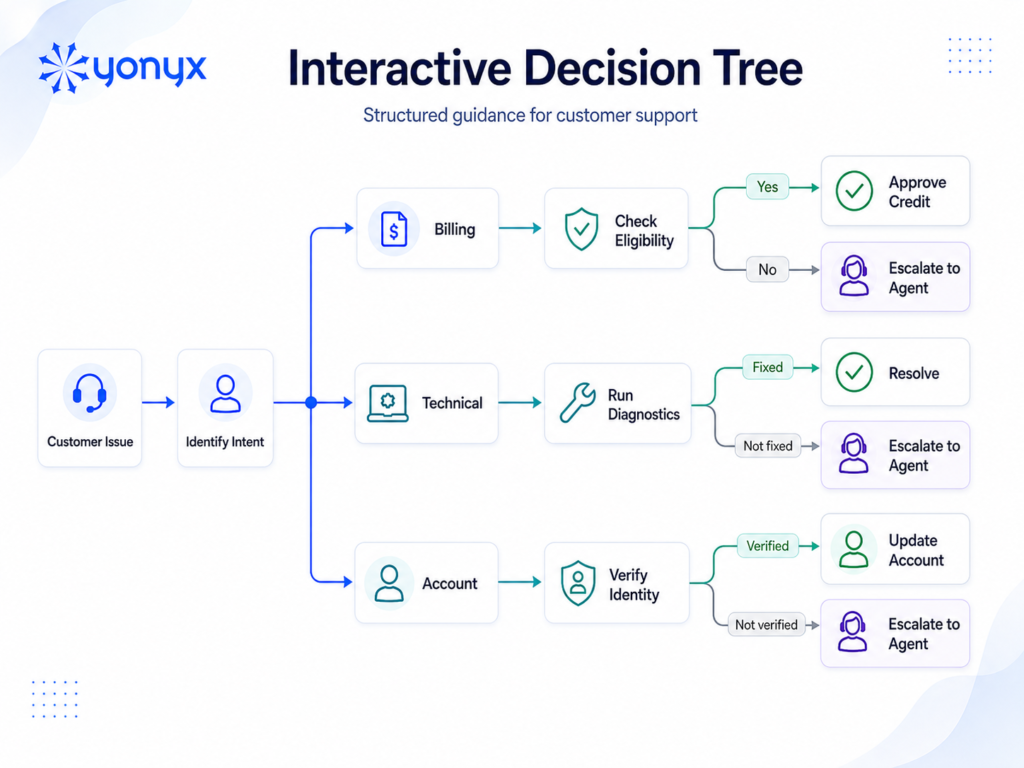
Decision trees are one way to encode those controls. Rules engines, application permissions, policy-as-code, validators, and approval workflows can play similar roles.
No single guardrail is enough. The process, tool permissions, identity controls, and monitoring layer must reinforce one another.
Customer Support Failures Must Be Traceable
Consider a disputed refund. The customer says it was promised. The billing system shows no transaction.
A useful investigation needs more than the chat transcript. The team may need to reconstruct the following:
- The information retrieved from the account
- The questions asked during the interaction
- The policy path selected
- The tool calls attempted
- Any approval request
- The result returned by the billing system
- The point at which a human took over
A conversation record shows what was said. A workflow record shows which process path was followed. An agent trace shows model and tool activity. The system of record confirms what actually happened.
Platforms with role-based permissions and interaction records can capture part of that evidence. Full traceability may also require logs from the agent framework, CRM, integration layer, and transaction system.
Agentic AI vs. Decision Trees vs. Hybrid Workflows
Agentic AI and decision trees are often framed as competing approaches. They solve different problems.
Agentic AI is useful when the system must interpret incomplete information and adapt its approach. Decision trees are useful when the required process is already known. Most serious customer service deployments will use a combination.
Where Agentic AI Frameworks Perform Best
Agentic AI is suited to work where the route to resolution cannot be fully specified in advance.
Examples include:
- Interpreting an unclear technical problem
- Combining information from several knowledge sources
- Choosing the right internal tool or specialist
- Revising a troubleshooting plan as new evidence appears
- Summarizing a long customer history
- Coordinating several tools to complete a request
OpenAI recommends agents for workflows involving nuanced judgment, difficult-to-maintain rule sets, or heavy use of unstructured information. It also advises using deterministic automation when those conditions do not apply.
Agentic systems provide flexibility, but each additional decision introduces another point where the model can choose poorly.
Where Interactive Decision Trees Perform Best
Decision trees and structured workflows fit processes with known conditions, required steps, and defined outcomes.
Typical examples include the following:
- Identity verification
- Warranty qualification
- Refund eligibility
- Required diagnostic sequences
- Disclosure and consent steps
- Approval thresholds
- Escalation conditions
- Structured information collection
These workflows still respond to customer answers. The difference is that each response moves the interaction through reviewed logic rather than allowing the model to invent the process.
A decision tree can require information, calculate an outcome, call an approved system, and route an exception. Its logic can be inspected before deployment and reviewed when a policy changes.
It can still be wrong. A workflow that encodes an outdated rule will apply that rule consistently. Governance and version control remain essential.
Why Customer Support Often Needs a Hybrid Model
Consider a customer requesting compensation for a delayed delivery.
The AI agent can interpret the complaint, identify the order number, retrieve the shipment history, and recognize that the customer wants a refund rather than another status update.
A structured workflow can then check the following:
- Was the order delivered?
- Does a carrier exception apply?
- Has the customer already received a credit?
- Is the amount within the permitted limit?
- Is supervisor approval required?
The AI handles the customer’s language. The workflow applies the policy.
If the conditions are met, an approved tool can process the credit. If the case falls outside the rules, the system transfers it with the order details and completed checks attached.
This hybrid design preserves flexibility without allowing the model to improvise financial policy.
Recommended Comparison Table
| Approach | Best suited for | Flexibility | Predictability | Auditability | Human control |
| Agentic AI framework | Dynamic, open-ended, multistep work | High | Variable | Depends on implementation | Must be designed |
| Decision tree or structured workflow | Repeatable, policy-driven processes | Medium | High | High when logged and versioned | Built into the process |
| Hybrid workflow | Complex support with controlled actions | High | High | High when both layers are traced | Configurable |
These are common characteristics, not guarantees. The deciding factor is where the model receives discretion and where the business requires fixed execution.
How a Deterministic Control Layer Works
A deterministic control layer defines the required information, permitted actions, approval points, and escalation conditions around an AI agent.
It does not prevent the model from interpreting an unusual request. It prevents that interpretation from bypassing the business process.
1. Gather the Customer’s Context
The agent may need the customer’s intent, account status, order history, product, support tier, previous contacts, and current channel.
Some of that information can be collected conversationally. The rest may come from a CRM or transaction system.
Access should follow the task. An order-status agent does not need broad access to payment details. A troubleshooting agent does not need permission to change an account owner.
2. Route the Case Through Approved Decision Logic
Once the request is understood, the process determines what must happen next.
A billing workflow may require authentication, charge classification, previous-credit checks, and an approval threshold. A troubleshooting workflow may require power, connectivity, error code, and warranty checks.
The workflow controls:
- The next required question
- Mandatory information
- Available actions
- Permitted outcomes
- Escalation conditions
Retrieving a policy tells the agent what the rule says. Decision logic makes the interaction follow it.
3. Invoke Tools and Business Systems
The agent may need to:
- Read a CRM record
- Update a support case
- Check warranty status
- Calculate eligibility
- Schedule an appointment
- Send an approved message
- Record a disposition
- Submit a transaction
Read-only tools generally carry less risk than tools that change data. Write access, reversibility, authentication, account permissions, and financial impact should determine how much oversight each action requires.
4. Pause for Approval or Escalate Exceptions
A routine appointment change may be automated after verification. A large refund or ownership change may need a supervisor.
Modern agent frameworks can pause before a sensitive tool call and resume after a person approves or rejects it. The human-in-the-loop approval pattern is designed for actions that require review before execution.
Common handoff triggers include:
- Failed verification
- Repeated unsuccessful attempts
- Low confidence
- A policy exception
- High financial impact
- An irreversible action
- A customer request for a person
- A request outside the approved scope
A good handoff includes the information already collected. The customer should not have to repeat the entire interaction.
5. Record the Complete Resolution Path
The record should connect the conversation to the business outcome.
Depending on the process, that may include the following:
- Customer inputs
- Workflow branches
- Retrieved account data
- Tool calls
- Approval events
- Human handoffs
- Timestamps
- Final system updates
An agent saying “Your refund has been processed” is not evidence of a completed transaction. The billing system must confirm it.
Customer Support Use Cases for Bounded Autonomy
The balance between AI discretion and fixed workflow logic depends on the interaction.
Technical Troubleshooting
Customers describe symptoms, not root causes.
“The router keeps dropping” might refer to a service outage, weak wireless coverage, a damaged cable, incorrect configuration, or failing hardware.
AI can interpret the description and adapt its questions. A diagnostic workflow can require the essential checks:
- Identify the affected devices
- Check the service status
- Confirm hardware indicators
- Test wired and wireless connectivity
- Apply approved fixes
- Escalate unresolved or replacement cases
The model helps diagnose an unclear problem. The workflow prevents routine steps from disappearing from the process.
Refunds, Eligibility, and Account Changes
Refunds become complicated once previous credits, transaction limits, delivery exceptions, and customer history are involved.
AI can gather the request and supporting details. Fixed logic can check the following:
- Purchase date
- Delivery status
- Product condition
- Previous refund history
- Customer tier
- Requested amount
- Authorization level
- Required evidence
Routine cases may qualify for automatic processing. Exceptions move to the appropriate reviewer.
“Low risk” must be defined by the organization. The same transaction may be routine for one business and high risk for another.
Customer Self-Service With Escalation
Self-service should help customers finish a task, not keep them away from an agent.
A guided journey can handle troubleshooting, document collection, eligibility checks, and routine requests. It should also detect when the customer has reached an unsupported situation, failed a required step, or asked for human help.
Gartner advises against forcing every customer through AI before allowing access to a person. Its research found that customers value AI assistance but resist systems that become barriers to human support.
The same approved process can support self-service and assisted service. The interface changes; the underlying rules do not.
Regulated or High-Consequence Interactions
The cost of an incorrect action determines how much autonomy is acceptable.
Financial servicing, insurance administration, identity-sensitive account changes, and formal complaints may require stronger verification, records, and oversight.
The NIST Generative AI Profile recommends aligning AI controls with legal requirements, organizational goals, and risk tolerance.
For each process, define:
- The data the agent may access
- The decisions it may recommend
- The actions it may perform
- Mandatory disclosures
- Review and escalation conditions
- Record-retention requirements
How to Evaluate an Agentic AI Framework for Support
Framework comparisons often emphasize models, memory, latency, tokens, and multi-agent orchestration.
A contact center also needs to evaluate policy control, system access, maintenance, escalation, and business outcomes.
Can It Enforce Approved Process Logic?
Determine whether the system can require steps or only suggest them.
Can it block a refund until eligibility is confirmed? Require authentication before an account change? Present a mandatory disclosure? Route a policy exception to the correct reviewer?
Recommendations may make agents faster. Enforced conditions make the process more reliable.
Can It Limit and Approve Sensitive Actions?
Review:
- Role-based access
- Tool-specific permissions
- Approval thresholds
- Reversibility
- Authentication
- Human override
- Permission revocation
- Emergency shutdown controls
A framework’s ability to call a tool does not justify giving the agent unrestricted access to it.
Can It Integrate With Existing Systems?
Customer service work spans CRMs, ticketing tools, billing platforms, knowledge bases, scheduling systems, and back-office applications.
Check whether integrations provide:
- Secure read and write access
- Stable APIs
- Clear tool definitions
- Error handling
- Identity management
- Version control
- Confirmation from the system of record
A polished demonstration may hide brittle integrations. Production reliability depends on what happens when an API is slow, unavailable, or returns incomplete data.
Can Every Interaction Be Reviewed?
Avoid accepting “fully auditable” without details.
Ask whether the retained records include:
- Customer and system inputs
- Workflow decisions
- Model responses
- Tool activity
- Approval events
- Human handoffs
- Failures and retries
- Final business outcomes
Also ask where the records are stored, how long they are retained, and whether they can be connected to the relevant customer or case without exposing unnecessary data.
Can Operations Teams Maintain the Process?
Support policies change. Products are updated. New exceptions appear.
If each workflow change requires engineering work, the automation will lag behind the operation.
Developers will still own integrations, security, and agent architecture. Support operations, knowledge management, QA, and compliance teams should be able to review and maintain the business rules they understand best.
Can It Measure Customer and Operational Outcomes?
Latency and token use matter to engineering teams. They do not show whether the customer’s issue was resolved.
The evaluation should include:
- First-contact resolution
- Customer satisfaction
- Average handle time
- Cost per resolution
- Self-service containment
- Transfer rate
- Repeat contacts
- Escalation rate
- Policy adherence
- Human intervention
- Task completion
A fluent answer is not a completed service outcome.
A Roadmap From Agent Guidance to Agentic Support
Broad autonomy should not be the starting point. Build the process first, then automate the parts that perform reliably.
Stage 1: Identify High-Volume, Repeatable Journeys
Look for journeys with:
- Repeated agent questions
- Frequent transfers
- High repeat-contact rates
- Long information-search times
- Stable policy rules
- Known escalation paths
- Measurable outcomes
- Usable process data
Volume alone is not enough. Consider the consequences of failure, exception frequency, data quality, and integration readiness.
A stable process with little ambiguity may need conventional automation rather than an AI agent.
Stage 2: Convert Policies Into Executable Workflows
Document:
- Required inputs
- Decision conditions
- Permitted actions
- Exceptions
- Escalation points
- Disclosures
- Process ownership
- Final outcomes
This work often exposes differences between documented policy and actual agent behavior.
Once the process is visible, teams can decide which decisions belong to AI, which belong to fixed rules, and which still require a person.
Stage 3: Add AI Assistance for Workflow Authors and Support Teams
The first useful AI implementation may happen behind the scenes.
AI can help authors:
- Rewrite unclear instructions
- Summarize source documents
- Draft response options
- Translate content
- Adjust tone
- Identify missing branches
For example, AI-assisted call-script authoring can speed up the creation and refinement of guided content without giving AI authority over live customer transactions.
Support teams may also use copilots for case summaries, knowledge retrieval, and workflow recommendations before automating actions.
Stage 4: Automate Low-Risk Actions Within Boundaries
Start with actions that have limited impact and clear recovery options, such as:
- Sending an approved email
- Updating a case category
- Recording a disposition
- Scheduling a standard appointment
- Retrieving shipment status
- Triggering a known diagnostic step
Define risk according to financial impact, permissions, privacy, reversibility, and customer harm.
Sensitive actions stay behind approval until the evidence supports a different decision.
Stage 5: Adjust Autonomy Based on Evidence
Review whether the system:
- Completes the correct task
- Selects the correct workflow
- Uses tools accurately
- Escalates at the right point
- Follows policy
- Produces acceptable customer outcomes
- Fails safely
- Creates usable records
The findings may support more autonomy. They may also justify tighter controls or a return to human handling.
The objective is not to automate the highest possible percentage of contacts. It is to resolve more contacts correctly.
How to Measure Agentic AI in the Contact Center
An AI agent can produce polished conversations while making the operation worse.
It may lower handle time by transferring difficult cases too early. It may increase containment by making human support harder to reach. It may claim a task is complete before the system of record confirms it.
Measure the customer outcome, operational impact, and system behavior together.
Customer and Operational Metrics
Track:
- First-contact resolution: Was the issue resolved without another interaction?
- Customer satisfaction: Did the customer consider the outcome successful?
- Average handle time: How much assisted-service time did the interaction require?
- Cost per resolution: What did it cost to complete the full journey?
- Self-service containment: Did the customer finish without assisted support?
- Transfer rate: How often did the interaction move between teams?
- Repeat-contact rate: Did the customer return with the same problem?
- Escalation rate: How often was higher-level support required?
- After-call work: How much administrative effort remained?
Use the current performance of the specific journey as the baseline. Broad industry averages rarely reflect the same channel mix, customer population, or process complexity.
Governance and Control Metrics
Add measures that show how the agent behaves:
- Policy-adherence rate
- Human-intervention rate
- Unauthorized-action rate
- Approval-reversal rate
- Tool-call failure rate
- Exception frequency
- Workflow-completion rate
- Trace coverage
- Escalation accuracy
- Final task-success rate
These are operating measures, not universal benchmarks. Each organization must define them against its risk tolerance and process design.
Do Not Optimize One Metric in Isolation
Lower handle time is not an improvement when repeat contacts rise. Higher containment is not an improvement when customer satisfaction falls. Fewer handoffs are not an improvement when unauthorized actions increase.
Industry guidance on balancing AHT and CSAT makes the same point: speed must be evaluated alongside service quality.
Use a balanced scorecard covering resolution, experience, cost, and control.
FAQs About Agentic AI Frameworks for Customer Support
What is an agentic AI framework?
An agentic AI framework is software used to build AI agents that can understand goals, make decisions, use external tools, retain context, and complete multistep tasks.
How does agentic AI work?
Agentic AI uses a language model to interpret a goal, choose actions, call tools, evaluate results, and continue until the task is completed, stopped, or transferred.
What is agentic AI in customer service?
Agentic AI in customer service can interpret customer requests, retrieve account information, use business systems, complete approved tasks, and escalate cases to human agents.
How is agentic AI different from generative AI?
Generative AI creates content or responses. Agentic AI uses generative models within a larger system that can plan, use tools, perform actions, and work toward an outcome.
How is an AI agent different from a chatbot?
A chatbot usually answers questions or follows a scripted conversation. An AI agent can select tools, access external systems, and complete multistep tasks.
Build for Controlled Autonomy, Not Autonomy Alone
A contact center does not need an agent that can do anything. It needs an agent that can perform specific tasks under defined conditions and produce evidence of the outcome.
Agentic AI provides interpretation and adaptability. Structured workflows provide consistency and process control. Human agents handle exceptions that require judgment, authority, or empathy.
A reliable customer service architecture assigns each of those roles deliberately.
Structured workflow technology does not replace an agent-development framework. It turns policies, support knowledge, and operating procedures into decision paths that can guide employees, support self-service, and constrain automated actions.